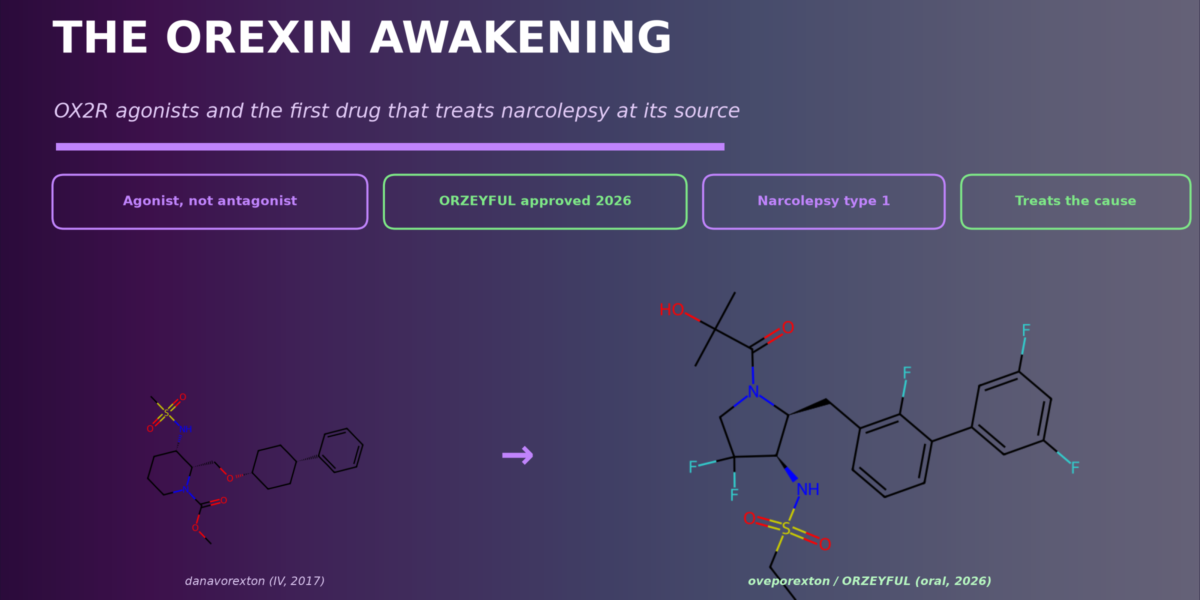
The switch that runs your day
Deep in the hypothalamus, a small population of neurons produces two neuropeptides — orexin-A and orexin-B (also called hypocretin-1 and -2). They are the master “stay awake” signal, acting on two G-protein-coupled receptors, OX1R and OX2R. Of the two, OX2R is the one that matters for wakefulness: activate it across the locus coeruleus, tuberomammillary nucleus, raphe and basal forebrain and you sustain arousal; lose it and the sleep–wake boundary collapses.
Narcolepsy type 1 (NT1) is what happens when those neurons die. An autoimmune attack — autoreactive T cells targeting the hypocretin peptides — destroys the orexin-producing cells permanently. The receptors are still there, fully functional; it’s the signal that’s gone. Patients suffer overwhelming daytime sleepiness, fragmented night sleep, and cataplexy (sudden loss of muscle tone triggered by emotion). For decades the only tools were symptom-maskers: stimulants for sleepiness, sodium oxybate for night-time and cataplexy, antidepressants for cataplexy. None touched the actual defect.
Prior generation vs. next generation: the same target, opposite direction
Here’s the conceptual heart of the whole field. The orexin system has been drugged before — but in the opposite direction and for the opposite disease.
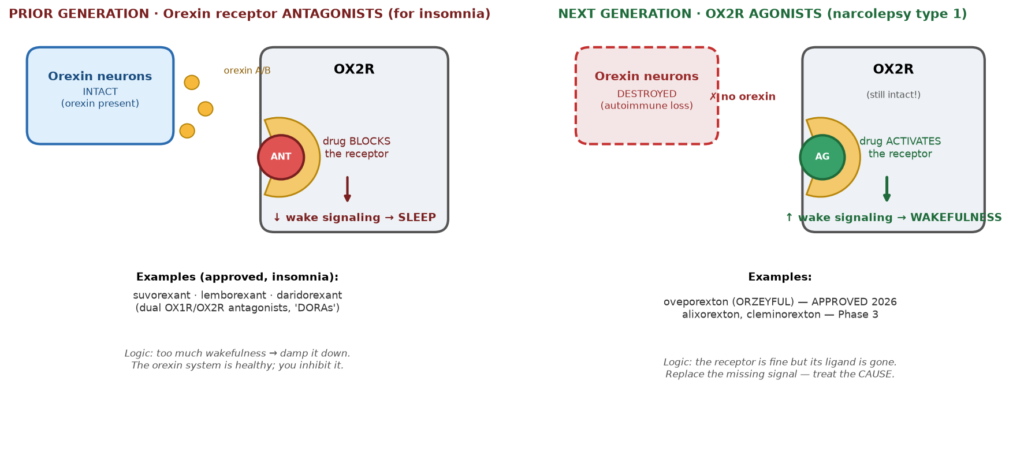
Prior generation — antagonists for insomnia. The first orexin drugs to reach the market were dual orexin receptor antagonists (DORAs): suvorexant (Belsomra, 2014), lemborexant (Dayvigo, 2019), and daridorexant (Quviviq, 2022). In an insomnia patient the orexin system is intact and overactive at night — so you block the receptors to let sleep in. The logic is subtractive: too much wake signal, damp it down.
Next generation — agonists for narcolepsy. In NT1 the problem is the mirror image: the receptor is fine but its ligand is gone. So instead of blocking OX2R you activate it — a small molecule that stands in for the missing orexin peptide. The logic is additive and, crucially, mechanism-based: you are replacing a specific deficiency, the way levodopa replaces dopamine in Parkinson’s. This is the first time narcolepsy can be treated at its root cause rather than its symptoms.
Same receptor, opposite pharmacology, opposite disease. That flip — from antagonist to agonist — is the entire “next generation” story.
The medicinal chemistry: a hard road to an oral agonist
Agonizing a peptide GPCR with a small molecule is genuinely difficult, and the path was littered with failures. The instructive lineage is Takeda’s, because they solved it in public, one molecule at a time.
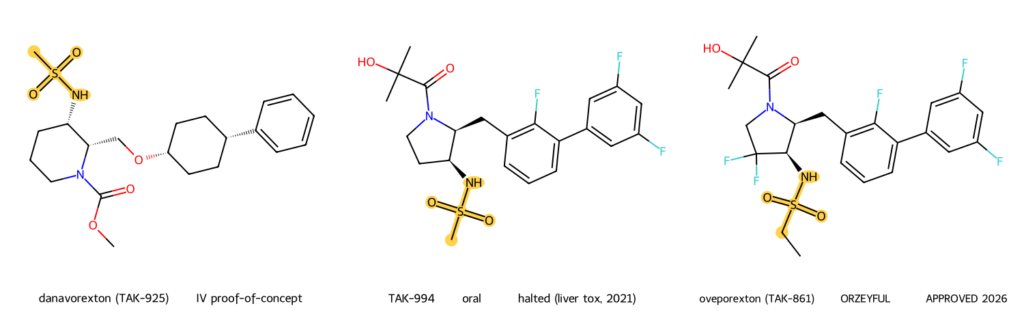
- Danavorexton (TAK-925) — the proof of concept. This intravenous OX2R-selective agonist showed, in humans, that pharmacologically activating OX2R really does restore wakefulness and reduce cataplexy. But it wasn’t orally bioavailable — a lab demonstration, not a product. Structurally it is built on an aminopiperidine methanesulfonamide bearing a phenylcyclohexyl-methyl ether.
- TAK-994 — the oral leap, and a hard lesson. Takeda re-worked the scaffold into an orally active agonist and it worked on efficacy — but the Phase 2 program was halted in 2021 when patients developed off-target drug-induced liver injury (DILI). Note the structural change: the piperidine has contracted to a pyrrolidine, and a 3,5-difluorophenyl / 2-fluorophenyl biphenyl arm has replaced the ether. This wasn’t Takeda’s problem alone — the field hit a wall of toxicity: Merck halted MK-6552 in 2024 over liver-tox signals, and Jazz dropped JZP441 in 2023 over visual and cardiovascular effects.
- Oveporexton (TAK-861) — the winner. The scaffold was refined again: the same difluorobiphenyl recruiting arm and methanesulfonamide anchor, but now with a gem-difluoro pyrrolidine, an ethyl sulfonamide, and a 2-hydroxyisobutyryl amide cap. These changes preserved OX2R potency while engineering out the hepatotoxicity liability that killed TAK-994. It is orally active, once-daily-capable, and clean on the liver.
The structural throughline (gold) is the methanesulfonamide-bearing saturated N-heterocycle — the OX2R “warhead.” Everything else is a decade of tuning selectivity, oral exposure, and safety around it.
The approved drug: oveporexton (ORZEYFUL)
In 2026 the FDA approved Takeda’s oveporexton, brand name ORZEYFUL — the first-in-class orexin receptor agonist and the first drug ever to target the underlying biology of narcolepsy.
- What it is: an oral, OX2R-selective agonist. Selectivity for OX2R over OX1R matters — OX1R engagement is associated with blood-pressure and anxiety-like effects in preclinical models, so staying off it is a cleaner path to wakefulness.
- The evidence: two global Phase 3 trials, FirstLight (NCT06469828) and RadiantLight (NCT06505031), both hit all primary and secondary endpoints with p < 0.001 across doses at week 12 — statistically significant, clinically meaningful improvements in excessive daytime sleepiness (Maintenance of Wakefulness Test, Epworth Sleepiness Scale), weekly cataplexy rate, and quality of life.
- Tolerability: generally well tolerated; the most common adverse events were insomnia and urinary urgency/frequency (both on-mechanism — you’ve turned the wake system back on), with no serious treatment-related events reported and >95% of participants continuing into the long-term extension.
- The significance: as Emmanuel Mignot (a principal investigator, and one of the scientists who originally discovered the orexin basis of narcolepsy) framed it, this enables “a different kind of conversation” — a therapy that addresses the disease, not just its symptoms.
Why this is a big deal
- Mechanism-based, not symptomatic. For the first time, narcolepsy type 1 can be treated at its cause — replacing a missing signal rather than masking its consequences.
- A pharmacological hat-trick. Making a small-molecule agonist of a peptide GPCR, orally bioavailable, CNS-penetrant, and safe on the liver, is hard. The field’s toxicity graveyard (TAK-994, MK-6552, JZP441) is a reminder of how hard — which makes oveporexton’s clean profile a genuine medicinal-chemistry achievement.
- A platform, not a single drug. With one approval and at least three more agonists in or entering Phase 3, OX2R agonism is becoming a class, with a reach that likely extends well beyond narcolepsy.
The orexin system took two decades to fully drug in both directions. The antagonists taught us to switch wakefulness off. The agonists — now, finally, in patients — switch it back on.
For twenty years, orexin drugs did one thing: they switched wakefulness OFF. A new class does the opposite — and in 2026 the first one reached patients. This is the story of the flip from antagonist to agonist, the medicinal chemistry that made it survivable, and the drugs racing to market.