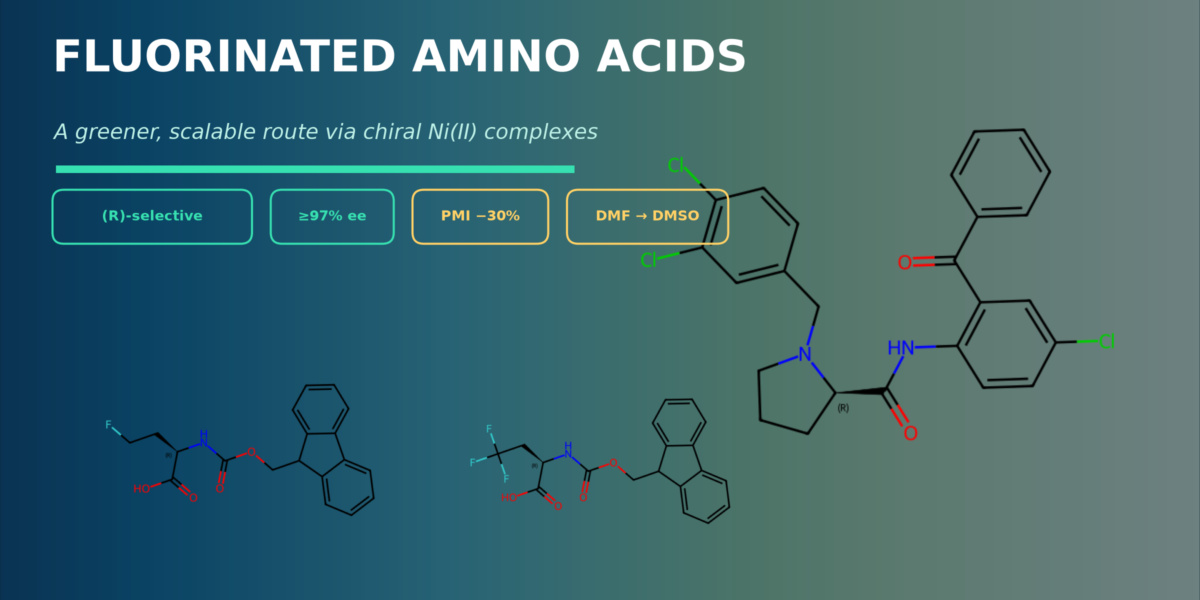
Why fluorinated amino acids, and why the (R)-series?
Non-canonical amino acids are the building blocks of modern peptide drugs and designer biomaterials, and fluorine is one of the most powerful edits a chemist can make to one. Swapping a C–H for a C–F changes lipophilicity, conformation, hydrogen-bonding, and — crucially for drugs — metabolic stability, without adding much steric bulk.
There’s a stereochemical twist that makes this paper especially useful. Because most biological receptors are tuned to natural L-amino acids, the unnatural (R)-configured fluorinated amino acids offer a route to peptides with longer half-lives and altered binding — exactly what you want for metabolically robust therapeutics. This work is the first to prepare a series of Fmoc-protected fluorinated (R)-amino acids on scale.
The chemistry rests on a well-known platform: a chiral Ni(II) Schiff-base complex that acts as a recyclable “chiral auxiliary,” letting you alkylate a glycine equivalent with near-perfect stereocontrol. That platform works — but the published route to it was, in the authors’ framing, impractical at scale. This paper is a step-by-step teardown and rebuild of every operation, optimizing not just yield but cost, time, and environmental footprint. That’s the heart of process chemistry, and it’s what makes this a great case study.
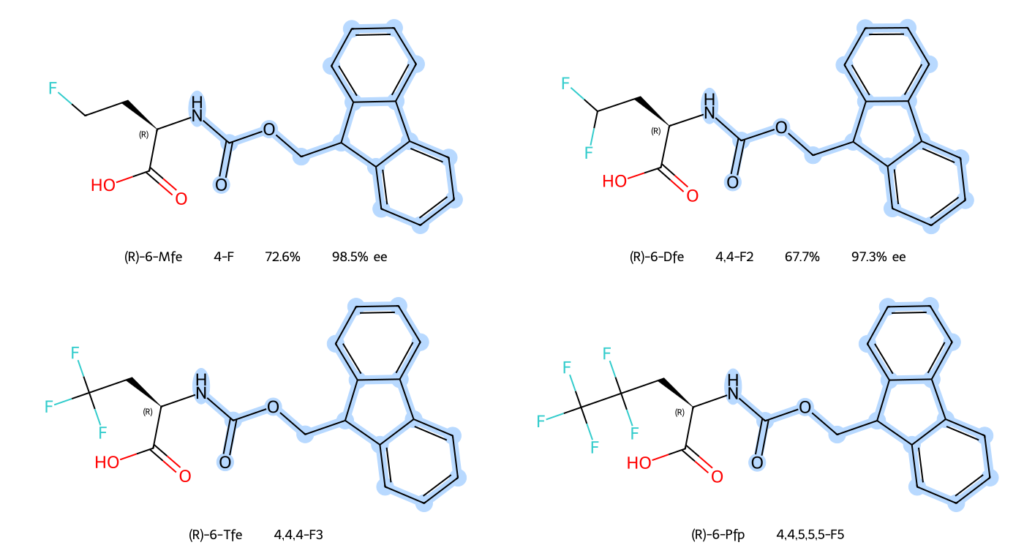
The four targets
The campaign delivers four Fmoc-protected fluorinated (R)-amino acids — a fluorine “ladder” from a single C–F all the way to a pentafluoro side chain — each isolated at 10 g scale with high enantiopurity.
The route, and the fix at every step
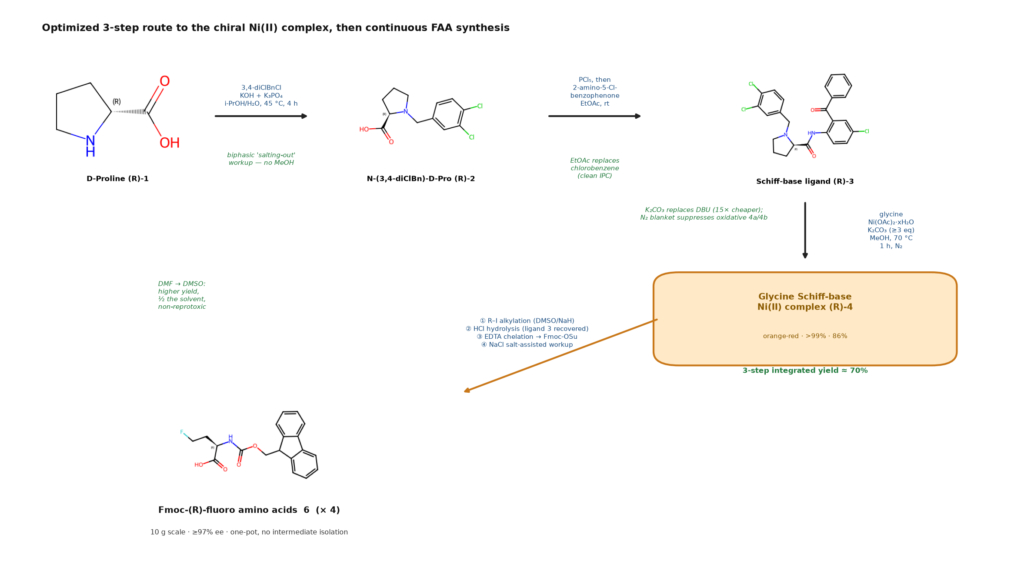
The synthesis is a three-step build of the chiral glycine Schiff-base Ni(II) complex (R)-4, followed by a continuous, one-pot alkylation/deprotection/protection sequence to the amino acids. What follows is what was wrong with the literature process and what the authors did about it — the interesting part.
Step 1 — N-benzylation of proline: taming three impurities at once
D-Proline is N-alkylated with 3,4-dichlorobenzyl chloride. Simple on paper, but the reaction is a three-way fight against over-alkylation (quaternary ammonium salt 2A), O-benzylation (benzyl ester 2B), and a solvent-derived ether (2C). The authors screened bases, solvents and temperature (13 entries) and landed on an elegant answer:
- A biphasic H₂O/i-PrOH system. Water’s hydrogen-bonding network passivates the carboxylate — suppressing the ester 2B — and adding water shifts the isopropoxide equilibrium back, suppressing the ether 2C.
- A milder base pairing (KOH + K₃PO₄) slows the SN2 over-alkylation that forms 2A. (Notably, they avoid KI, which would generate the more reactive benzyl iodide and accelerate 2A.)
The best conditions (Entry M) hit ~86% conversion with the three impurities each held to single digits, in 4 h.
The workup is the real prize. Instead of the traditional laborious extractions to remove KCl with large volumes of methanol or acetonitrile, the mixture undergoes spontaneous phase separation on standing — a “salting-out” effect from the K₃PO₄-saturated aqueous phase. The product is then precipitated as its hydrochloride salt from acetone at pH 2–3, and an acetone slurry wash removes residual 2A/2B. The payoff: higher reactor loading (volumetric productivity up several-fold), a cycle time in hours, and no bulk-methanol carbon footprint.
Step 2 — amide formation: swapping out chlorobenzene
Proline acid (R)-2 is activated with PCl₅ and coupled with 2-amino-5-chlorobenzophenone to give the Schiff-base ligand (R)-3. PCl₅ in chlorobenzene is the literature standard (it suppresses decarboxylation and activates fast at room temperature), but chlorobenzene is a scale-up headache: it co-elutes with the product under the HPLC method (so you’re flying blind on in-process control), it boils at 131 °C (hard to strip), and it stinks.
A solvent screen (chloroform, dimethyl carbonate, ethyl acetate vs. chlorobenzene) showed conversion and yield were essentially solvent-independent (75–78%, >99% purity across the board) — but the alternatives resolved the HPLC interference, letting the team actually see the methyl-ester surrogate peak that tells them activation is complete. Ethyl acetate won on safety, price, and ease of removal. A 20 g run worked smoothly, and the crude (still carrying KCl) fed directly into the next step — no dedicated purification.
Step 3 — the Ni(II) complex: cheaper base, and a real mechanistic story
Forming Ni(II) complex (R)-4 from ligand 3, glycine and a nickel source is where the paper earns its “process research” title. Two changes and one piece of genuine mechanistic detective work:
- DBU → K₂CO₃. The widely used Soloshonok conditions call for 5 equiv of DBU. K₂CO₃ gives comparable yields at ~1/15th the base cost — a direct hit to process economics. The mechanism demands a minimum of three equivalents of base (one each to deprotonate the Schiff-base ligand, glycine, and the diphenylketone-amide nitrogen); below that, the reaction simply doesn’t go.
- Ni(OAc)₂·xH₂O (partial hydrate) over the tetrahydrate, which markedly accelerates the reaction — an 18 g run completes in 1 h.
But faster nickel comes with a catch: over-reaction breeds two oxidative impurities, 4a (a skeletal-collapse product from C–C cleavage) and 4b (an α-hydroxylated complex). The authors show these form only after ligand 3 is fully consumed, and — through a clean set of control experiments — that they arise from aerobic oxidation of a nickel-enolate intermediate. The nickel center activates O₂ through high-valent Ni(III)/Ni(IV) species; excess Ni(II) acts as a regioselectivity switch, diverting a strained oxanickelacycle from the degradative C–C cleavage (→ 4a) toward α-hydroxylation (→ 4b). The practical lesson is simple and actionable: run under a nitrogen blanket. Doing so cut the impurities to <1% and made the scale-up robust — atmospheric exclusion turns out to be the critical process parameter.
Over the first three steps the optimized, largely telescoped sequence delivers (R)-4 in ~70% integrated yield at >99% purity.
Step 4 — continuous synthesis of the amino acids, and a DMF problem solved
With the auxiliary in hand, complex (R)-4 is carried through a continuous, one-pot sequence with no intermediate isolation:
- Alkylation with the appropriate fluorinated alkyl iodide → (R)-5 (wet crude used directly).
- Acidic hydrolysis, which releases the free amino acid and the chiral ligand (R)-3, recovered for reuse — the auxiliary is recyclable.
- Ni²⁺ removal by EDTA chelation, then Fmoc protection with Fmoc-OSu at pH 8.4.
- A salt-assisted (NaCl brine) liquid–liquid workup followed by differential-solubility crystallization (CHCl₃ / toluene / n-heptane).
Two things make this step shine. First, the salt-assisted workup fixes a nasty scale-up bottleneck: in the original protocol the Fmoc intermediate would precipitate catastrophically during acidification, wrecking phase separation and demanding huge solvent volumes. Saturating the aqueous phase with NaCl restores clean partitioning and lets the process run at ≥10 g.
Second, the team confronts a regulatory liability head-on: DMF is reprotoxic and tightly constrained under ICH Q3C. They replace it with DMSO, which is not only safer but better performing — yields rose across all four substrates (dramatically so for the pentafluoro Pfp: 80% vs 49%). DMSO’s higher dielectric constant produces more reactive “naked” anions, and trace dimsyl sodium (from NaH + DMSO) helps deprotonate hindered substrates. The reaction runs at double the concentration, so half the solvent volume offsets DMSO’s higher unit cost, and DMSO wastewater is far easier to treat than nitrogen-bearing DMF waste.
The scorecard
The authors quantify the win with green-chemistry metrics: the optimized continuous process cuts Process Mass Intensity (PMI) by ~30% versus the batch literature benchmark, mainly by eliminating the isolation/refinement of intermediate (R)-3 and slashing solvent use.
| What changed | From | To | Why it matters |
|---|---|---|---|
| Step-1 workup | MeOH/MeCN extractions to remove KCl | Biphasic salting-out + HCl-salt precipitation | Higher throughput, no bulk-MeOH footprint |
| Step-2 solvent | Chlorobenzene | Ethyl acetate | Clean HPLC/IPC, easy removal, safer |
| Step-3 base | DBU (5 equiv) | K₂CO₃ | ~15× cheaper base |
| Step-3 atmosphere | Air | N₂ blanket | Suppresses oxidative impurities 4a/4b to <1% |
| Step-4 solvent | DMF | DMSO | Non-reprotoxic, higher yield, ½ the volume |
| Overall | Multistep, isolate each | Telescoped/continuous | ~70% over 3 steps; PMI −30% |
Bottom line. This is process chemistry done the way it should be: not chasing a single headline yield number, but interrogating every transformation — its impurities, its workup, its solvent, its safety and cost — and rebuilding the route so it is cheaper, faster, greener, and genuinely scalable. The result is a practical, ≥97% ee platform for a fluorine ladder of (R)-amino acids that peptide chemists can actually use.
A close read of Ge, Zaiser & Koksch, “Practical Synthesis of Fluorinated Amino Acids: Process Optimization toward Improved Sustainability,” Org. Process Res. Dev. 2026, 30, 1602–1614 (open access, CC-BY).