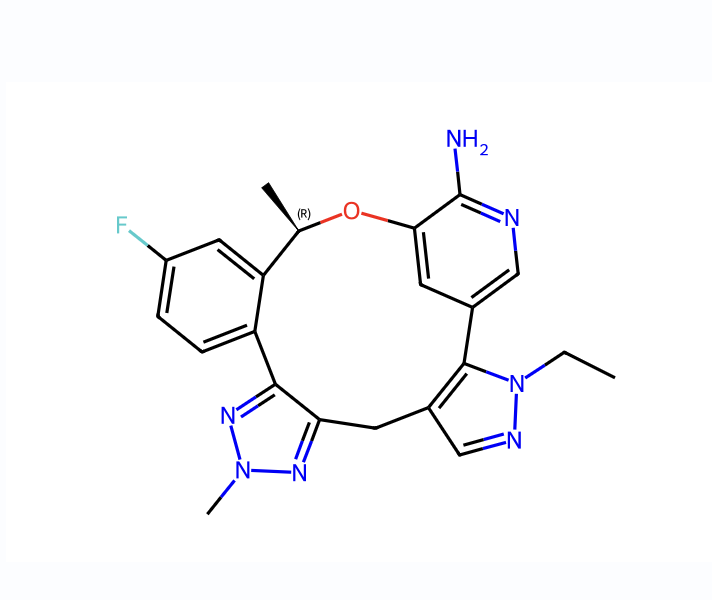
Mechanism: Zidesamtinib is a small-molecule inhibitor of the tyrosine kinase ROS1, including ROS1 resistance mutations. In biochemical assays (PI §12.1) it inhibits ROS1 (IC50 = 0.7 nM) with much weaker activity against the tropomyosin receptor kinases — TRKB (IC50 = 54 nM), TRKC (193 nM), TRKA (258 nM) — i.e. ~77-fold ROS1-vs-TRKB selectivity; it also inhibits ALK (IC50 = 3 nM). This deliberate TRK(B)-sparing profile is the mechanistic basis for its low CNS/neurological adverse-event burden versus TRK-inhibiting comparators. In vitro it suppresses viability of cells expressing ROS1 fusions and resistance mutations (G2032R, S1986F, F2004C/V, L2026M, D2033N, G2101A) and, as a brain-penetrant macrocycle, shows antitumour activity in an intracranial ROS1-fusion NSCLC xenograft. Discovery/pharmacology: Drilon et al., Cancer Discov 2023;13(3):598-615 (PMID 36511802); resistance-mutation structural biology: Tangpeerachaikul et al., Mol Cancer Ther 2025;24(7):1005-1019 (PMID 40299789).
Synthesis Route of the Originator
Zidesamtinib (NVL-520; JIDEYTRO) is a pentacyclic macrocyclic aryl-ETHER. The disconnection is taken from the Nuvalent composition-of-matter patent US 11,542,278 B1 / WO 2021/226269 A1 (‘Heteroaromatic macrocyclic ether chemotherapeutic agents’), in which zidesamtinib is a labelled example; no dedicated OPRD/process paper exists (verified on PubMed), and the medicinal-chemistry rationale is described in Drilon et al., Cancer Discov 2023, 13(3), 598-615 (PMID 36511802). The verified patent strategy: (1) the benzylic aryl ether is formed FIRST, on an open-chain precursor, by SNAr of the (R)-1-(5-fluoro-2-iodophenyl)ethanol onto an activated (nitro/halo) bromopyridine — this is the structural departure from lorlatinib’s macrolactamization; (2) the ‘west’ pyrazole-CH2-triazole diarylmethane fragment (built by heteroaryl carbinol formation then Et3SiH/TFA deoxygenation) is joined to the ‘east’ fluorophenyl-ether-aminopyridine unit by an intermolecular Suzuki-Miyaura coupling (via the triazolyl-Bpin), giving an open-chain dibromo precursor (C22H22Br2FN7O); (3) the ~14-membered MACROCYCLE is then closed by an intramolecular Pd-catalysed biaryl coupling — either one-pot Miyaura borylation/intramolecular Suzuki or direct C–H arylation (Pd, KOAc or potassium pivalate, high dilution) — forming the pyrazole(C5)-aminopyridine bond and giving zidesamtinib directly (a final Fe/NH4Cl reduction unmasks the 2-aminopyridine hinge if a nitropyridine was carried through). Building blocks include 5-bromo-1-ethyl-1H-pyrazole-4-carbaldehyde (CAS 1780579-42-1) and a 4-fluoro-2-iodobenzoic-acid-derived fluorophenyl unit (parent acid CAS 56096-89-0). CONDITIONS ARE REPRESENTATIVE for the named transformations (the exact per-compound conditions/yields sit on image-only pages of US 11,542,278); the transformation TYPES and the ether-first / macrocyclize-last logic are verified from the patent’s General Methods. The full chain is RDKit-validated and the final product canonicalizes exactly to the target C22H22FN7O, (R). Verify against the patent/process literature before scale-up.
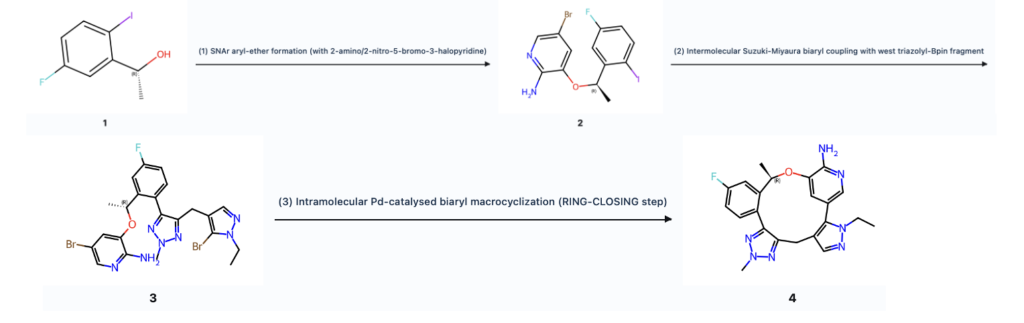
aReagents and conditions: (1) 3-halo-5-bromo-2-nitro(or 2-amino)pyridine (1.0 eq), base (NaH or Cs2CO3, 1.2-2 eq), DMF or NMP, 0 C -> 60 C. Benzylic secondary alkoxide displaces the pyridine C3 halide (nitro-activated). Proceeds with RETENTION at the benzylic centre (O stays CIP #1 in both alcohol and ether -> label stays R). [representative partner/oxidation state]; (2) West fragment triazolyl-Bpin (from 4-((5-bromo-1-ethyl-1H-pyrazol-4-yl)methyl)-5-iodo-2-methyl-2H-1,2,3-triazole via Miyaura borylation, B2pin2/Pd/KOAc; 1.1 eq), Pd(dppf)Cl2 (5 mol%), K3PO4 or K2CO3 (2-3 eq), dioxane/H2O, 80-90 C. Forms the triazole(C5)-fluorophenyl biaryl bond; leaves pyrazole-Br and pyridine-Br as the two macrocyclization handles. [Suzuki/borylation is the verified patent tactic; which biaryl is intermolecular is representative]; (3) Close the pyrazole(C5)-aminopyridine(C5) bond by either (a) one-pot Miyaura borylation / intramolecular Suzuki (B2pin2 then Pd, aqueous base), or (b) direct intramolecular C-H arylation, Pd catalyst with potassium acetate or potassium pivalate as base (the patent states these bases are effective for the macrocyclization). Run at high dilution to suppress oligomerization. Gives zidesamtinib directly (or after a final Fe/NH4Cl nitro reduction if the 2-nitropyridine was carried through). [transformation type verified from patent General Methods; RDKit-verified to regenerate the exact target].
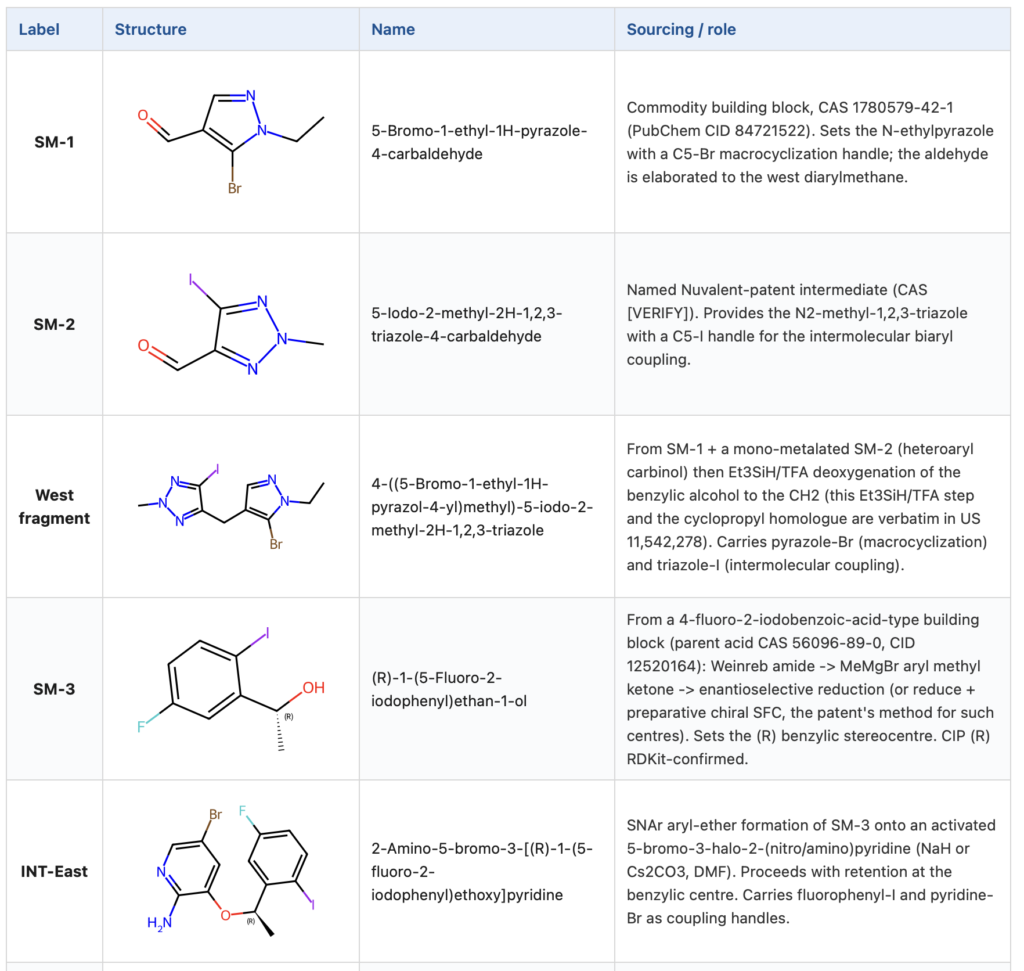
Key Intermediates
Crystal Forms, Salts, and Solid-State Profile
- API in approved drug product: Zidesamtinib free base (C22H22FN7O, MW 419.46). White to tan powder; pKa 4.89. Single (R) benzylic stereocentre. Solid-form / crystalline claims are covered by WO 2023/196900 A1.
- Strengths approved: 25 mg (pink film-coated) and 100 mg (yellow film-coated) oral tablets; 100 mg QD.
- Third-party polymorph activity: No third-party US polymorph activity identified as of 2026-07-29 (approval is one week old and COM-protected to ~2041). Monitor SureChEMBL / Espacenet.
- Originator polymorph filing: Nuvalent (now GSK) crystalline drug-substance form covered under WO 2023/196900 A1 (solid forms & preparation).
Key peer-reviewed literature
- Itchins M et al., Lung Cancer 2026 — Real-world treatment sequencing and survival in ROS1-Rearranged NSCLC across evolving… (PMID 42365776)
- Wespiser M et al., Front Oncol 2026 — ROS1-positive non-small cell lung cancer: from genomics to treatment decisions(PMID 41704605)
- Bischoff H et al., Curr Oncol 2025 — Evolving Therapeutic Landscape of ROS1-Positive Non-Small Cell Lung Cancer: An Updated Review (PMID 41294688)
- Tangpeerachaikul A et al., Mol Cancer Ther 2025 — Zidesamtinib Selective Targeting of Diverse ROS1 Drug-Resistant Mutations (PMID 40299789)
- van der Wel JWT et al., Lung Cancer 2025 — Novel strategies for rare oncogenic drivers in non-small-cell lung cancer: An update… (PMID 40118657)
- Desilets A et al., Cancer 2025 — Targeting ROS1 rearrangements in non-small cell lung cancer: Current insights and…(PMID 40171848)
Comparator / competitive class
| Asset | Code | Sponsor | Mechanism | Selectivity | Stage | IP cliff |
|---|---|---|---|---|---|---|
| Repotrectinib (Augtyro) | TPX-0005 | Bristol Myers Squibb | ROS1/TRK macrocyclic TKI, next-gen, brain-penetrant | ROS1/TRK (not TRK-sparing) | FDA-approved for ROS1+ NSCLC 15-Nov-2023 (TRIDENT-1; NEJM 2024, DOI 10.1056/NEJMoa2302299). 1L ORR 79%, DoR 34.1 mo; pretreated ORR 38%; G2032R ORR 59% (10/17) | TRK-mediated neuro-tox (dizziness ~57%) is the key contrast vs zidesamtinib |
| Taletrectinib (Ibtrozi) | AB-106 / DS-6051b | Nuvation Bio (AnHeart; Zai Lab in China) | ROS1-selective, CNS-active next-gen TKI | ROS1-selective (some TRK activity) | FDA-approved for ROS1+ NSCLC 11-Jun-2025 (TRUST-I, JCO DOI 10.1200/JCO.24.00731). Naive ORR ~85–90%, pretreated ~52–62%, G2032R ORR ~80%; dizziness ~21%, dysgeusia ~15% | The most direct next-gen competitor covering both 1L and 2L; lower neuro-tox than repotrectinib but more than zidesamtinib |
| Entrectinib (Rozlytrek) | RXDX-101 | Roche/Genentech | ROS1/NTRK/ALK TKI, CNS-active | ROS1/NTRK (TRK-inhibiting) | FDA-approved 1L ROS1+ NSCLC 2019 (integrated analysis JCO DOI 10.1200/JCO.20.03025, ORR ~67%) | 1st-gen; no G2032R coverage; TRK-driven CNS AEs (dizziness, cognitive/mood) |
| Crizotinib (Xalkori) | PF-02341066 | Pfizer | Multikinase ALK/ROS1/MET TKI, 1st-gen | ROS1/ALK/MET | FDA-approved 1L ROS1+ NSCLC 2016 (PROFILE 1001, ORR ~72%) | Poor CNS penetration; no G2032R coverage; generic-era pricing |
| Lorlatinib (Lorbrena) | PF-06463922 | Pfizer | ALK/ROS1 macrocyclic (macrolactam) TKI, brain-penetrant | ALK/ROS1 (TRK-active CNS effects) | Approved in ALK+ NSCLC; used OFF-LABEL for ROS1 post-crizotinib. Limited vs G2032R | CNS/cognitive/mood AEs (TRK + ALK CNS); the macrolactam contrast to zidesamtinib’s aryl-ether macrocycle |
CMC / manufacturing risk profile
- API DMF holder: [VERIFY] — Nuvalent/GSK contract API manufacture to a CDMO; DMF Type II expected. Pharmaresources Co., Ltd. appears as a co-assignee on the CoM patent (potential process partner).
- Drug product CMO: [VERIFY] — oral film-coated tablet (25/100 mg) fill/finish via a solid-dose CDMO
- KSM supply: 5-bromo-1-ethyl-1H-pyrazole-4-carbaldehyde (CAS 1780579-42-1, commercial); 5-iodo-2-methyl-2H-1,2,3-triazole-4-carbaldehyde (dedicated); 4-fluoro-2-iodobenzoic-acid-derived fluorophenyl unit (parent acid CAS 56096-89-0); an activated bromo-nitro/amino-pyridine. Process value concentrates in the chiral benzylic alcohol (SM-3) and the macrocyclization.
- Critical process risk: (1) The intramolecular Pd biaryl MACROCYCLIZATION — high-dilution ring closure with oligomerization as the classic failure mode; base/catalyst choice (KOAc vs pivalate; borylation/Suzuki vs C-H arylation) is the key process lever. (2) Setting and preserving the benzylic (R) stereocentre (asymmetric reduction or chiral SFC; SNAr must run with retention). (3) Single-regioisomer control of the 2H-triazole and 1H-pyrazole. (4) Pd removal to ICH-Q3D limits after two Pd couplings. (5) Solid-form control per WO 2023/196900.
- Estimated API COGs (USD): Back-of-envelope at commercial scale: $8,000–25,000 / kg API (long convergent macrocyclic route, two Pd couplings incl. a high-dilution macrocyclization, a chiral center, Pd-removal burden). ESTIMATE. At 100 mg/day and an orphan-sized population, absolute API demand is low (tens of kg/yr); API cost is negligible versus branded oncology pricing — economics are driven by price and commercial spend, not COGs.