Specialty Platforms

Advanced Modality Chemistry

Deep chemistry expertise in the modalities driving the next generation of drug discovery — small molecules, PROTACs, ADCs, and macrocycles. AI-augmented route design, every route verified by a PhD chemist.

Publication-style advanced modalities graphic showing PROTAC ternary complex, ADC linker payload, small molecules, and macrocycles.
Small Molecule, PROTAC, ADC, Macrocycle
Platform 01

PROTACs & Molecular Glues

Targeted protein degradation is one of the most exciting frontiers in drug discovery. Astinova brings specialized synthetic expertise to the demanding chemistry required to design and synthesize effective PROTAC and molecular glue degraders.

PROTACs are hetero-bifunctional molecules requiring precise coupling of a target-binding warhead, a carefully designed linker, and an E3 ligase-recruiting ligand — often via 10–20+ step synthesis routes with multiple stereocenters and sensitive functional groups.

Ligand-Linker-Payload Design & Synthesis

  • End-to-end synthesis of bifunctional PROTAC molecules
  • Convergent assembly of target warhead + linker + E3 ligand
  • Complex multi-step synthesis (10–20+ steps)

E3 Ligase Ligand Synthesis

  • VHL ligands (VH032 class, hydroxyl-proline based)
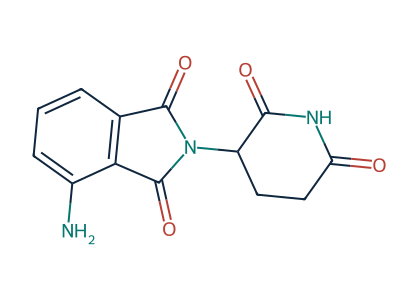
  • CRBN ligands (thalidomide, lenalidomide, pomalidomide analogs)
  • IAP-recruiting ligands (bestatin-based)
  • Novel E3 ligase ligands on request

Linker Library Design & Synthesis

  • PEG-based flexible linkers (PEG1–PEG8+)
  • Alkyl, piperidinyl, piperazinyl, and mixed linkers
  • Rigid aromatic and semi-rigid linker variants
  • Clickable and bifunctional linker handles

SAR & Ternary Complex Optimization

  • Systematic linker length and composition SAR
  • Exit vector exploration on both warhead and E3 ligand
  • Ternary complex formation support
  • Hook effect mitigation through design

Linker & Payload Synthesis

  • Cleavable linkers: valine-citrulline (vc), acid-labile, disulfide
  • Non-cleavable linkers: maleimide, NHS-ester based
  • Linker-payload conjugates with defined stoichiometry
  • High-purity isolated intermediates (>95%)

Cytotoxic Payload Analogs

  • Auristatin class analogs (MMAE, MMAF-type)
  • Maytansine/maytansinoid analogs (DM1, DM4-type)
  • Calicheamicin class analogs
  • Novel payload synthesis on request

Conjugation-Ready Components

  • Site-specific conjugation handles
  • Drug-to-antibody ratio (DAR) optimization support
  • Controlled intermediate quality (purity, endotoxin-awareness)
  • Multi-mg to gram scale production
Platform 02

ADCs & DACs

Antibody-drug conjugates (ADCs) and degrader-antibody conjugates (DACs) depend critically on the quality and design of their small molecule components — the linkers and cytotoxic payloads that define efficacy and safety.

Astinova synthesizes high-purity ADC components, including cleavable and non-cleavable linkers, cytotoxic payload analogs, and complete linker-payload constructs ready for bioconjugation.

Key differentiator: We synthesize complete linker-payload conjugates (not just payloads alone), enabling streamlined antibody conjugation by your bioconjugation team.

Platform 03

Small Molecules

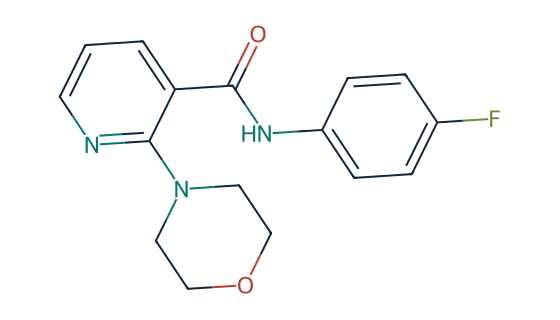
Small molecules remain the backbone of drug discovery — and the core of what we do. Our AI-augmented retrosynthesis engine proposes candidate routes for novel chemical entities and generic APIs; a PhD synthetic chemist then corrects, scale-matches and costs every one. Automation makes us fast; expertise makes us right.

From a single target we deliver decision-ready, scale-matched routes — lab, kilo and commercial — each with conditions, yield, landed cost and hazard reality, plus IP-aware route options grounded in the originator-patent record.

Representative result: an 18-step de-novo route collapsed to four by recognising a classical condensation the engine alone never surfaced — a curated-chemistry win, not a machine ranking.

NCE Route Design

  • Top-route portfolios for novel chemical entities
  • Scaffold & fragment analysis
  • Synthetic-feasibility review
  • Disconnection-diversity mapping

Multi-Scale Synthesis Routes

  • Lab, kilo and commercial routes for one target
  • Each scale-matched with conditions & yield
  • Generic API routes grounded in granted patents
  • Current-vs-recommended process optimization

Cost, Hazard & IP-Aware Selection

  • Step-wise costed workbooks, route-vs-route economics
  • Dominant-cost-driver analysis
  • Landed cost, reagent availability & hazard flags
  • IP-landscape-aware design (informational, not legal FTO)

Multi-Chiral Center Control

  • Synthesis of molecules with 4–8+ stereocenters
  • Enantioselective synthesis strategies (>99% ee achievable)
  • Relative and absolute stereochemistry determination
  • Chiral HPLC confirmation and enantiopure separation

Macrocyclization Strategies

  • Macrolactamization (amide bond forming cyclization)
  • Macrolactonization (ester-based cyclization)
  • Ring-closing metathesis (RCM) approach
  • Intramolecular coupling strategies

Asymmetric Synthesis Tools

  • Asymmetric organocatalysis (NHC, Brønsted acid)
  • Transition metal-catalyzed asymmetric reactions
  • Chiral auxiliary-mediated synthesis
  • Atroposelective synthesis of axially chiral molecules
Platform 04

Macrocycles & Asymmetric Synthesis

Macrocyclic drugs occupy a unique chemical space between small molecules and biologics, offering excellent selectivity and the ability to hit previously undruggable targets. Their synthesis demands mastery of macrocyclization chemistry and stereocontrol.

Astinova's synthetic team has deep experience in asymmetric synthesis, including multi-chiral center control, enantioselective reactions, and atroposelective synthesis for atropisomeric drug candidates.

Highlight capability: Atroposelective synthesis of axially chiral biaryl compounds — increasingly important in modern kinase inhibitor and PROTAC programs.

Discuss Your Advanced Modality Program

Our chemistry experts are ready to discuss your program needs and propose a tailored approach.