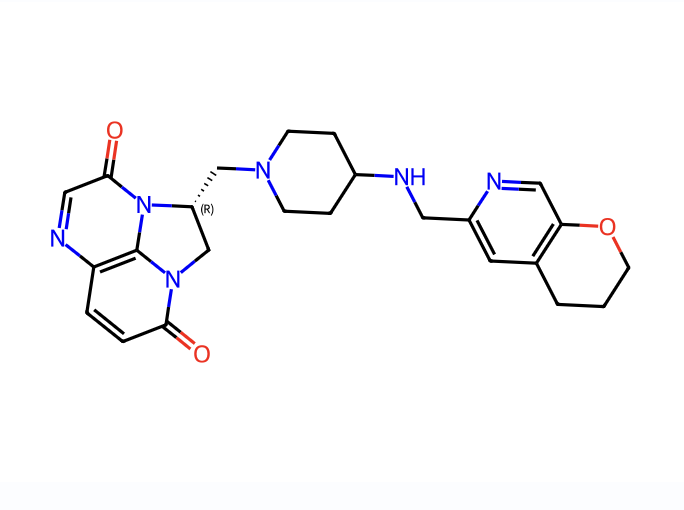
Compiled: 2026-08-14 · Trigger event: FDA approval, 2025-03-25 Innovator: GlaxoSmithKline LLC (US NDA holder; composition-of-matter patents held by Glaxo Group Limited). Developed with US government biodefense co-funding (BARDA OTA HHSO100201300011C; DoD/DTRA HDTRA1-07-9-0002). Status: Approved NME
Mechanism: Gepotidacin is a first-in-class, bactericidal TRIAZAACENAPHTHYLENE antibacterial that inhibits bacterial DNA replication by inhibiting two bacterial type II topoisomerase enzymes — DNA gyrase (GyrA/GyrB) and topoisomerase IV (ParC/ParE) — which catalyse the ATP-dependent breakage, strand passage and religation of double-stranded DNA needed to relieve topological strain during replication. Unlike fluoroquinolones, which stabilise the enzyme–DNA covalent cleavage complex at two metal-bridged sites and trap double-strand breaks, gepotidacin binds at a DISTINCT, NOVEL site and blocks the enzyme by a different mode: a single gepotidacin molecule engages the enzyme, interacting directly with the conserved catalytic aspartate of one GyrA/ParC subunit (Asp82 in the studied enzyme; equivalent to GyrA Asp90 / ParC Asp86 in Neisseria gonorrhoeae) and indirectly, via a bridging water, with the aspartate of the second subunit. For most target pathogens gepotidacin provides WELL-BALANCED DUAL inhibition of both enzymes with comparable potency; because it inhibits two independent targets through the same novel interaction, high-level target-mediated resistance generally requires CONCURRENT mutations in BOTH enzymes (two distinct mutational events), conferring a low propensity for resistance and retained activity against many fluoroquinolone-resistant strains (whose mutations map to the quinolone-binding, not the gepotidacin-binding, positions). This is not absolute — reduced susceptibility has been seen in FQ-resistant N. gonorrhoeae when a pre-existing ParC D86N is joined by a new GyrA A92T mutation.
Synthesis Route of the Originator
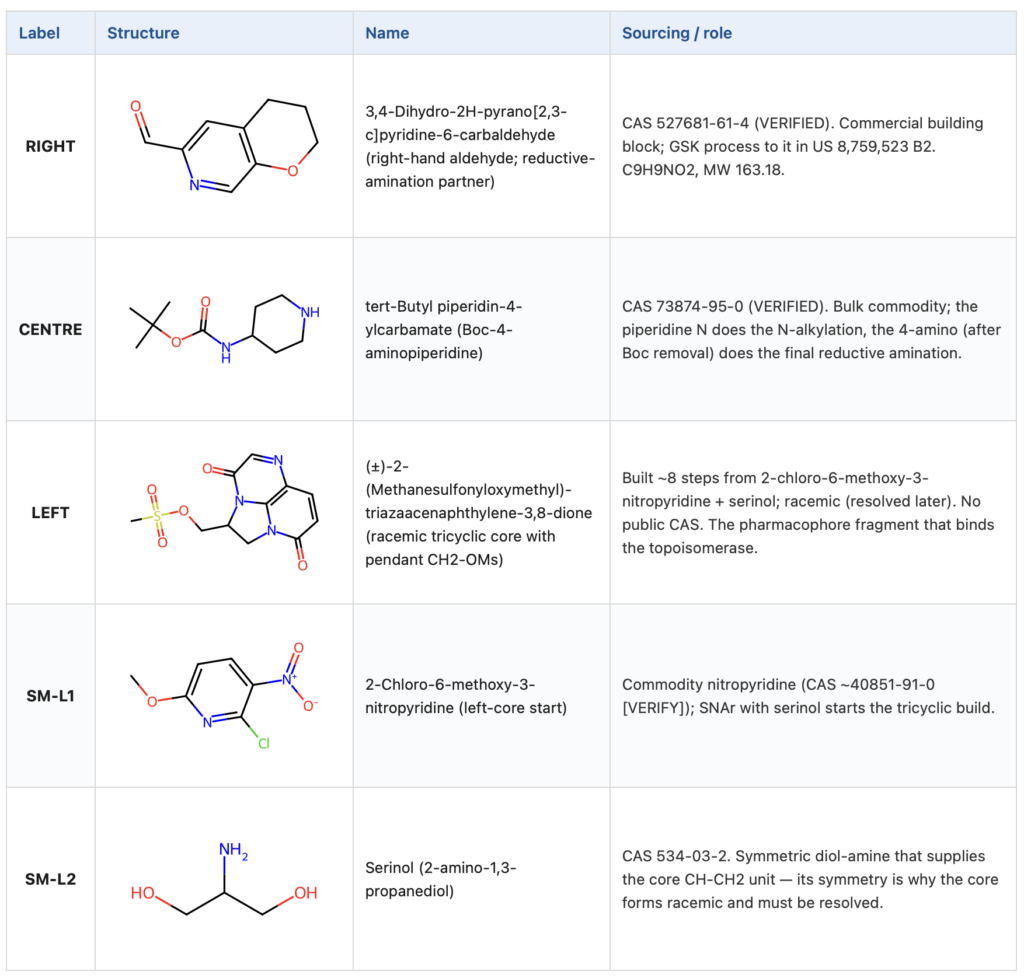
Gepotidacin is assembled CONVERGENTLY from three fragments: (LEFT) a racemic triazaacenaphthylene-dione core with a pendant CH2-mesylate, built over ~8 steps from 2-chloro-6-methoxy-3-nitropyridine + serinol (SNAr → acetonide protection → nitro reduction → N-alkylation with ethyl bromoacetate → lactam ring closure → oxidation → acetal cleavage → cyclodehydrative bis-mesylation); (CENTRE) tert-butyl piperidin-4-ylcarbamate (Boc-4-aminopiperidine, CAS 73874-95-0); (RIGHT) 3,4-dihydro-2H-pyrano[2,3-c]pyridine-6-carbaldehyde (CAS 527681-61-4). Endgame: N-ALKYLATION of the piperidine N onto the tricyclic mesylate (C–N bond #1) → Boc removal → CHIRAL RESOLUTION to set the single (3R) centre (the core forms racemic from symmetric serinol; NO asymmetric step or chiral pool) → REDUCTIVE AMINATION (NaBH(OAc)3) of the (3R)-4-aminopiperidine with the pyranopyridine aldehyde (C–N bond #2, final) → gepotidacin free base → mesylate (dihydrate, Form 1) drug substance. Only ONE of the two C–N bonds is a reductive amination. Source: GSK patent estate (WO 2008/128942 = US 8,389,524, gepotidacin mono-HCl = Example 39; pyranopyridine process US 8,759,523; crystalline-form WO 2021/219637). No public OPRD/J.Med.Chem. full-route paper exists; step conditions are patent-example values.
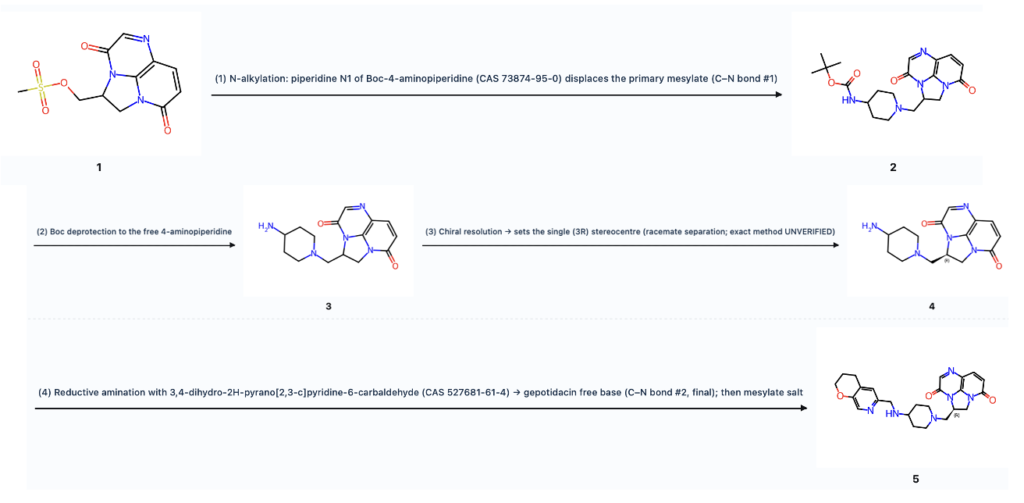
aReagents and conditions: (1) tert-butyl piperidin-4-ylcarbamate (Boc-4-aminopiperidine, ~1.0–1.2 eq), acetonitrile, pyridine (or other tertiary-amine base), 50–90 °C, ~5 h. The secondary piperidine nitrogen displaces the primary CH2-OMs on the tricyclic core. The core is racemic at this point (it derives from symmetric serinol). Conditions are patent-example values (WO2008/128942 family) — verify before scale-up.; (2) HCl (4 M in 1,4-dioxane, or HCl/CH2Cl2), ~20 °C, ~1 h; free-base on workup. Removes the tert-butyl carbamate to unmask the 4-amino group for the final reductive amination.; (3) Resolution of the racemate to the (3R) enantiomer — e.g. preparative chiral chromatography / SFC, or a diastereomeric-salt resolution (resolving agent/method not publicly verified). The (3R) enantiomer is carried forward. The core is racemic because it is built from symmetric serinol (2-amino-1,3-propanediol); there is no asymmetric catalytic or chiral-pool step — the stereocentre is set here by separation.; (4) 3,4-dihydro-2H-pyrano[2,3-c]pyridine-6-carbaldehyde (1.0–1.1 eq), NaBH(OAc)3 (or NaBH3CN), Et3N, CHCl3/MeOH (~9:1), rt, ~2 h; workup sat. NaHCO3, extract 20% MeOH/CH2Cl2 (~32% for this stage in the patent example). Forms the secondary amine linking the pyranopyridine to the piperidine, giving gepotidacin free base (m/z 448 [M+H]+). DRUG SUBSTANCE: free base + ~1 eq methanesulfonic acid, acetone, 50 °C then cool → gepotidacin MESYLATE dihydrate (Form 1; WO2021/219637 A1); 750 mg base = 910.7 mg mesylate per tablet..
Key intermediates
Crystal Forms, Salts, and Solid-State Profile
- API in approved drug product: Gepotidacin MESYLATE, crystalline dihydrate (Form 1; WO 2021/219637 A1). Each tablet contains gepotidacin 750 mg (free-base equivalent) = 910.7 mg gepotidacin mesylate (anhydrous). Free base C24H28N6O3, MW 448.53; one (3R) stereocentre.
- Strengths approved: 750 mg (free-base equivalent) film-coated tablets; uUTI dose 1,500 mg (2×750 mg) BID ×5 days.
- Third-party polymorph activity: No notable third-party US polymorph challenge documented at this early post-launch stage.
- Originator polymorph filing: GSK solid-state estate = mesylate salt (WO 2016/027249) + crystalline mesylate-dihydrate Form 1 (WO 2021/219637 / US 12,528,809) + tablet formulation (WO 2024/028263).
Key patent filings
| Patent / Application | Type | Assignee | Filed | Expiry (~) | |
|---|---|---|---|---|---|
| US 8,389,524 B2 (= WO 2008/128942 A1; EP family) — ‘Tricyclic nitrogen containing compounds as antibacterial agents’ | Composition of matter (core genus; drug substance). Gepotidacin mono-HCl is Example 39 of the WO parent. | Glaxo Group Limited | Priority 2007-04-20; granted 2013-03-05 | ~2029-02-12 nominal (incl. PTA). Glaxo Group filed a Patent Term Extension (5 yr requested) on this patent for BLUJEPA (Federal Register review-period determination 2026-02-13); if granted in full, effective expiry ~2034-02 [VERIFY final PTE grant]. | |
| WO 2016/027249 A1 — gepotidacin salts (mesylate) | Salt-form (mesylate) patent | GSK / Glaxo Group Limited | Priority ~2014–2015 | ~2035 [VERIFY exact] | |
| WO 2021/219637 A1 (= US 12,528,809) — crystalline forms of gepotidacin | Polymorph / crystalline-form (mesylate dihydrate, Form 1) | GSK / Glaxo Group Limited | Priority ~2020 | ~2041 [VERIFY] | |
| WO 2024/028263 A1 — gepotidacin formulation | Drug-product / formulation | GSK / Glaxo Group Limited | Priority ~2022 | ~2043 [VERIFY] |
US regulatory exclusivities
| Exclusivity | Expiry | Para IV gate | Applies? |
|---|---|---|---|
| NCE (New Chemical Entity), 5-year | 2030-03-25 | 2029-03-25 (NCE-1; earliest Para IV ANDA submission) | Yes — 5-yr NCE from the 2025-03-25 first approval. |
| GAIN Act QIDP +5-year extension (Qualified Infectious Disease Product) | ~2035-03-25 | n/a (adds to NCE) | Yes — QIDP adds 5 years to the NCE term → ~10-year combined regulatory exclusivity (the practical LOE gate, typically exceeding the nominal 2029 COM term unless PTE is granted). |
| New-indication / other exclusivity (uncomplicated urogenital gonorrhea, sNDA S-001) | [VERIFY Orange Book code] | n/a | The gonorrhea sNDA (approved 2025-12-11) may carry its own QIDP/exclusivity; confirm Orange Book codes for NDA 218230. |
ANDA / Paragraph IV monitoring calendar
- Approval date: 2025-03-25
- Para IV ANDA window opens: 2029-03-25 (NCE-1)
- NCE exclusivity ends: 2030-03-25
- COM patent nominal expiry: ~2029-02-12 (US 8,389,524, incl. PTA)
- Effective LoE (with PTE): ~2034-02 if the requested 5-yr Patent Term Extension is granted [VERIFY final grant]
- Likely first Para IV filers: No Para IV ANDA filers expected before the 2029-03-25 NCE-1 window; the ~2035 QIDP/GAIN exclusivity gate is the binding LOE driver [VERIFY Orange Book once listed].
| Date | Event |
|---|---|
| 2025-03-25 | FDA approval, uUTI (NDA 218230) |
| 2025-12-11 | FDA approval, uncomplicated urogenital gonorrhea (sNDA S-001) |
| 2029-03-25 | NCE-1 Para IV ANDA window opens |
| 2030-03-25 | NCE exclusivity expires |
| ~2035-03-25 | QIDP/GAIN combined exclusivity gate |
Available experimental protein structures (RCSB PDB)
| PDB ID | Target | Title | Resolution (Å) | Method | Released |
|---|---|---|---|---|---|
| 2PVB | DNA gyrase | PIKE PARVALBUMIN (PI 4.10) AT LOW TEMPERATURE… | 0.91 | X-RAY DIFFRACTION | 1998-10-07 |
| 7G1F | DNA gyrase | Crystal Structure of human FABP4 in complex… | 0.91 | X-RAY DIFFRACTION | 2023-06-14 |
| 7G1R | DNA gyrase | Crystal Structure of human FABP4 in complex… | 0.93 | X-RAY DIFFRACTION | 2023-06-14 |
| 3NO0 | Topoisomerase IV | Aquifex aeolicus type IIA topoisomerase… | 1.3004 | X-RAY DIFFRACTION | 2010-12-01 |
| 1P20 | Topoisomerase IV | Surprising Roles of Electrostatic Interactions… | 1.34 | X-RAY DIFFRACTION | 2003-05-13 |
| 4P0Z | Topoisomerase IV | Structure of the double stranded DNA binding… | 1.35 | X-RAY DIFFRACTION | 2014-07-30 |
For SAR / docking and ligand-bound forms relevant to polymorph analysis.
Key peer-reviewed literature
- Zorman M et al., Eur J Med Chem 2026 — Antibacterial and antibiofilm activities of novel bacterial topoisomerase inhibitors… (PMID 42208368)
- Mann CA et al., J Mol Biol 2026 — Novel Bacterial Topoisomerase Inhibitors: A New Front in an Old War (PMID 42242421)
- Jayasundara P et al., Infect Dis Model 2026 — Simulating treatment effects for gonorrhoea using a within-host mathematical model (PMID 41694615)
- Arends SJR et al., Microbiol Spectr 2026 — Characterization of gepotidacin activity, including in vitro kill kinetics,… (PMID 42560055)
- Koeth LM et al., Antimicrob Agents Chemother 2026 — In vitro antibacterial activity of gepotidacin in combination with other antimicrobial… (PMID 42390436)
- Paopang P et al., J Antimicrob Chemother 2026 — Antimicrobial resistance in Neisseria gonorrhoeae isolates at the Bangrak STIs Center,… (PMID 42550164)
- Mukherjee A et al., J Infect Dis 2026 — Genetic Background Modulates Zoliflodacin and Gepotidacin Cross-Resistance and Fitness… (PMID 41858024)
- Saeed Akhtar M et al., Expert Opin Pharmacother 2026 — Gepotidacin in oral antibacterial pharmacotherapy: efficacy, safety, and clinical positioning (PMID 42454567)
- Koeth LM et al., Diagn Microbiol Infect Dis 2026 — Influence of different media and incubation times for determining the minimum… (PMID 42000672)
- Zainal HM et al., J Infect Chemother 2026 — Efficacy and safety of oral type II topoisomerase inhibitors versus ceftriaxone-based… (PMID 42486336)
Comparator / competitive class
| Asset | Code | Sponsor | Mechanism | Selectivity | Stage | IP cliff |
|---|---|---|---|---|---|---|
| Sulopenem etzadroxil/probenecid (ORLYNVAH) | — | Iterum Therapeutics (US commercialization via Pharmacosmos/partner) | Oral penem (β-lactam) prodrug + probenecid boost | Enterobacterales uUTI (incl. quinolone-resistant/ESBL) | FDA-approved 2024-10-25 for uUTI in women with limited/no oral alternatives | The most direct branded uUTI competitor; narrower ‘limited options’ label vs BLUJEPA’s broader uUTI indication. |
| Zoliflodacin (NUZOLVENCE) | ETX0914 | Innoviva Specialty Therapeutics / GARDP / NIAID | Spiropyrimidinetrione — bacterial type II topoisomerase inhibitor (mechanistic cousin of gepotidacin) | Neisseria gonorrhoeae | FDA-approved ~2025-12 (single-dose oral uncomplicated gonorrhea) | Competes with BLUJEPA’s GONORRHEA indication (single-dose vs two-dose), not uUTI. |
| Nitrofurantoin | generic | multiple generics | Nitrofuran (multiple intracellular targets) | uUTI first-line | Generic standard-of-care (BLUJEPA’s EAGLE comparator) | Pennies-per-course incumbent — the economic benchmark BLUJEPA must beat on resistance/superiority. |
| TMP-SMX / fosfomycin / fluoroquinolones | generic | multiple generics | Folate-synthesis inhibitor / phosphonic acid / topoisomerase (FQ) | uUTI | Generic standard-of-care (use eroding with resistance + FQ safety warnings) | Cheap first-line options; resistance is the wedge for BLUJEPA. |