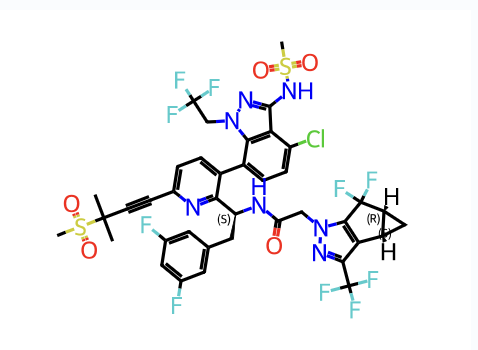
Lenacapavir (YEZTUGO (PrEP) and SUNLENCA (HIV-1 treatment)) — Drug Intelligence Dossier
Compiled: 2026-06-17 · Trigger event: FDA approval, 2025-06-18 Innovator: Gilead Sciences, Inc. (development code GS-6207) Status: Approved NME
INN: lenacapavirBrand (US): YEZTUGO (PrEP) and SUNLENCA (HIV-1 treatment)CAS: 2189684-44-2ChEMBL: —MW: 968.3 g/molNDA #: NDA 220020 / 220018 (YEZTUGO, PrEP); original NME NDA 215974 / 215973 (SUNLENCA, treatment, 2022-12-22)Approval: 2025-06-18
Lenacapavir (Sunlenca / for PrEP, Yeztugo) is a first-in-class HIV-1 capsid inhibitor — a multi-stage inhibitor that targets the viral capsid protein (CA) rather than an enzyme.
Synthesis Route of the Originator
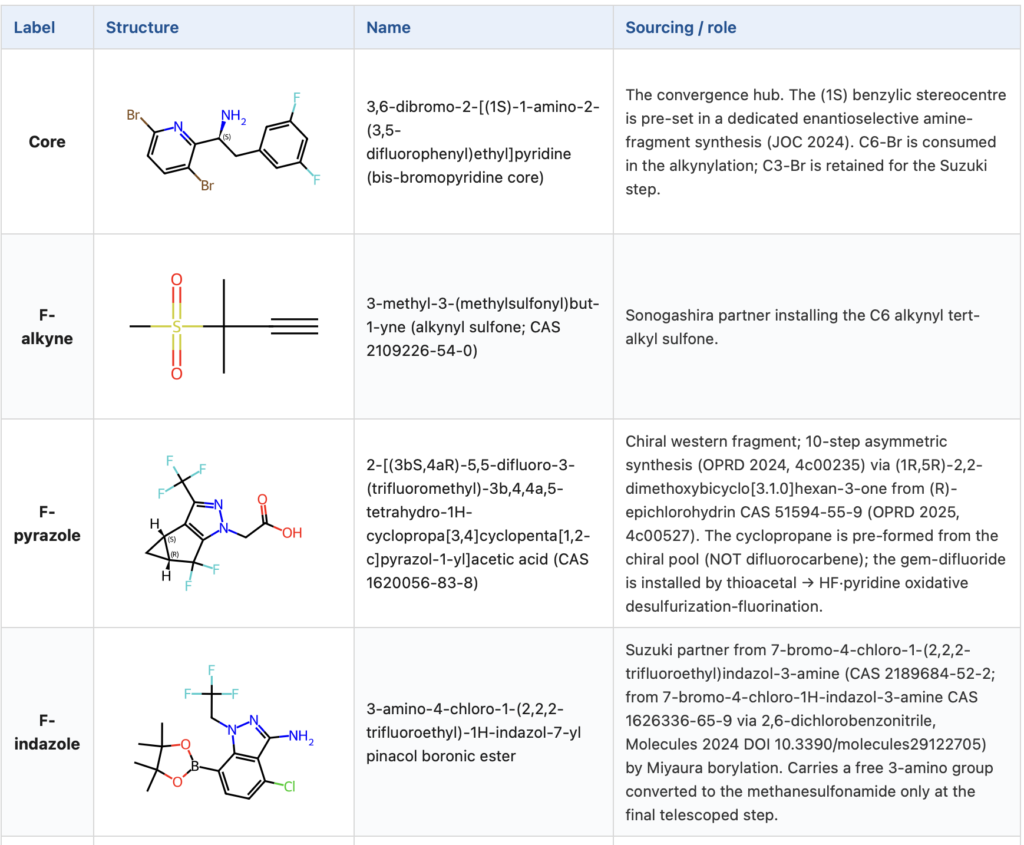
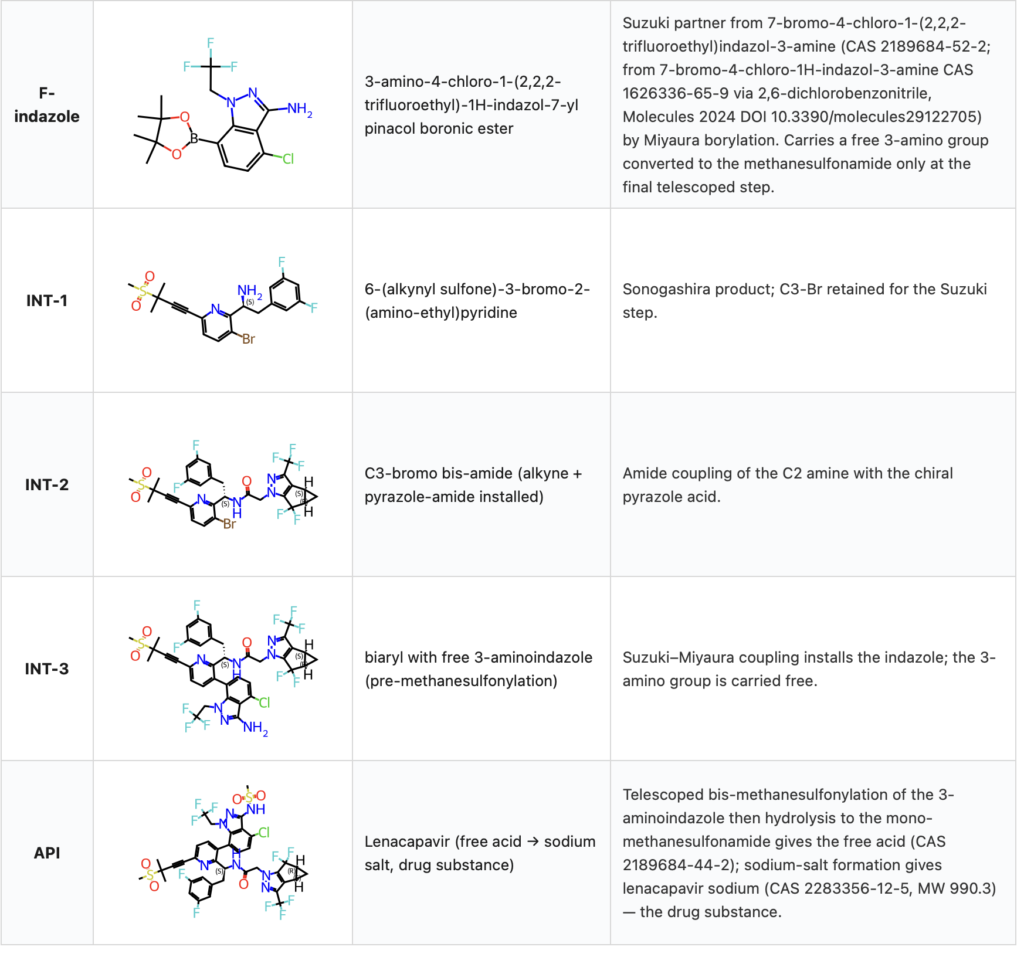
Lenacapavir is among the most synthetically complex small molecules ever approved (MW 968 free acid; 10 fluorines; 3 stereocentres; indazole + pyridine + cyclopropane-fused pyrazole + alkynyl sulfone). Gilead’s commercial route (Org. Process Res. Dev. 2024, DOI 10.1021/acs.oprd.4c00242) converges three major fragments onto a bis-bromopyridine core that already carries the pre-set (1S)-1-amino-2-(3,5-difluorophenyl)ethyl group. The four end-game operations are: (1) Sonogashira-type alkynylation at pyridine C6 with 3-methyl-3-(methylsulfonyl)but-1-yne; (2) amide coupling of the C2 amine with the chiral (3bS,4aR) difluoro-trifluoromethyl cyclopropa-cyclopenta-pyrazole acetic acid; (3) Suzuki–Miyaura coupling at C3 with the 3-amino-4-chloro-1-(2,2,2-trifluoroethyl)indazol-7-yl boronic ester; (4) telescoped bis-methanesulfonylation of the indazole 3-amino group followed by hydrolysis to the mono-methanesulfonamide, giving the API; conversion to the sodium salt gives the drug substance. The major fragments are made in dedicated multistep asymmetric sequences: the pyrazole fragment in a 10-step route (OPRD 2024, DOI 10.1021/acs.oprd.4c00235) via (1R,5R)-2,2-dimethoxybicyclo[3.1.0]hexan-3-one from (R)-epichlorohydrin (OPRD 2024, DOI 10.1021/acs.oprd.4c00527); the enantiopure benzylic-amine fragment via a new asymmetric route (JOC 2024, DOI 10.1021/acs.joc.4c02380); a concise one-pot Heck/Suzuki variant of the assembly is also reported (OPRD 2025, DOI 10.1021/acs.oprd.5c00443). All five end-game intermediate SMILES were validated in RDKit (final free acid == target). Transformation names and the four-step order are verbatim from the OPRD 2024 abstract; per-step reagents/temperatures are representative unless quoted — verify against the primary OPRD/JOC papers before scale-up.



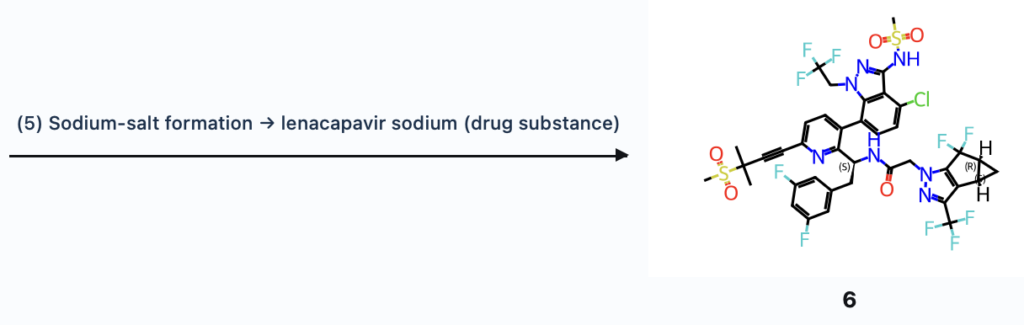
aReagents and conditions: (1) 3-methyl-3-(methylsulfonyl)but-1-yne (alkynyl sulfone), Pd/Cu catalysis, amine base — selective at the C6-bromide, leaving the C3-bromide for the later Suzuki step (per OPRD 2024 final-assembly sequence; exact catalyst/solvent in the primary paper — representative here). The (1S) benzylic stereocentre is set upstream in the amine-fragment synthesis (JOC 2025, DOI 10.1021/acs.joc.4c02380; discovery uses an Ellman (S)-sulfinamide, the process uses a dynamic kinetic resolution).; (2) (2-{(3bS,4aR)-5,5-difluoro-3-(trifluoromethyl)-3b,4,4a,5-tetrahydro-1H-cyclopropa[3,4]cyclopenta[1,2-c]pyrazol-1-yl}acetic acid) + a standard amide-coupling activator (e.g. T3P/HATU + amine base) — representative; the C3-bromide is retained for the next step. The pyrazole fragment is built in a 10-step asymmetric route (OPRD 2024, DOI 10.1021/acs.oprd.4c00235) via the (1R,5R)-2,2-dimethoxybicyclo[3.1.0]hexan-3-one intermediate from (R)-epichlorohydrin CAS 51594-55-9 (OPRD 2025, DOI 10.1021/acs.oprd.4c00527). Fragment C acid = CAS 1620056-83-8; alkynyl sulfone = CAS 2109226-54-0.; (3) Indazol-7-yl pinacol boronic ester (3-amino, 4-chloro, N1-CH₂CF₃), Pd catalyst, base, aqueous co-solvent — forms the pyridine–indazole biaryl bond (per OPRD 2024). A concise one-pot sequential Heck/Suzuki variant is also reported (OPRD 2025, DOI 10.1021/acs.oprd.5c00443). The indazole 3-amino group is carried free at this stage.; (4) Methanesulfonyl chloride (excess) bis-mesylates the indazole 3-NH₂ to N(SO₂CH₃)₂; controlled hydrolysis removes one mesyl to give the mono-methanesulfonamide (the API motif). Telescoped per OPRD 2024 final assembly.; (5) Treat the free acid (acidic methanesulfonamide N–H) with a sodium base; crystallise → lenacapavir sodium (C₃₉H₃₁ClF₁₀N₇NaO₅S₂, MW 990.3), the drug substance in SUNLENCA and YEZTUGO..
Crystal Forms, Salts, and Solid-State Profile
- API in approved drug product: Lenacapavir sodium (C₃₉H₃₁ClF₁₀N₇NaO₅S₂, MW 990.3; free acid C₃₉H₃₂ClF₁₀N₇O₅S₂, MW 968.3). Light yellow to yellow solid; practically insoluble in water. Highly lipophilic (cLogP ~6.4) and high-MW — formulated as an oral tablet (low/variable oral bioavailability 4–7%) and, critically, as a long-acting SC injectable that forms a subcutaneous depot for slow release over months.
- Strengths approved: Tablets 300 mg; SC injection 463.5 mg/1.5 mL (309 mg/mL)
- Third-party polymorph activity: Salt/crystalline-form applications under Section 3(d) opposition in India; monitor SureChEMBL/Espacenet for third-party activity. Genuine generic threat is gated to ~2041 by the long-acting/use estate, not by polymorph forms.
- Originator polymorph filing: Gilead solid-form / salt patents (US 11,267,799 + choline-salt family) protect the marketed sodium form
CMC / manufacturing risk profile
- API DMF holder: Gilead Sciences (in-house API process; commercial route in OPRD 2024, DOI 10.1021/acs.oprd.4c00242)
- Drug product CMO: Gilead — oral tablet (300 mg) + sterile long-acting SC injectable (the depot-forming solution is the differentiating, IP-protected drug product)
- KSM supply: (R)-epichlorohydrin (commodity → chiral bicyclic ketone → pyrazole fragment); 3,5-difluorophenyl building blocks; the bis-bromopyridine core; 3-methyl-3-(methylsulfonyl)but-1-yne; the 3-amino-4-chloro-1-(trifluoroethyl)indazole boronate. Value concentrates in the two chiral-fragment syntheses (pyrazole, benzylic amine).
- Critical process risk: (1) Setting and preserving 3 stereocentres (the (1S) amine and (3bS,4aR) cyclopropane) — chiral-fragment synthesis governs API quality. (2) Two Pd-catalysed couplings (Sonogashira + Suzuki) → Pd removal to ICH-Q3D. (3) Highly fluorinated, high-MW, low-solubility molecule — handling/crystallisation challenges. (4) The bis-methanesulfonylation/hydrolysis selectivity. (5) Drug-product: reproducible long-acting SC depot performance (the commercial moat).
Key peer-reviewed literature
- Matthews PC et al., Lancet Gastroenterol Hepatol 2026 — A changing HIV treatment landscape: what does lenacapavir mean for people living with HBV? (PMID 42269621)
- Carbajal C et al., Clin Microbiol Rev 2026 — Interactions between long-acting antiretrovirals and opioids: a call for clinical awareness (PMID 41817180)
- Charpentier C et al., Antimicrob Agents Chemother 2026 — A French national observatory of people with HIV initiating lenacapavir-based… (PMID 42268209)
- Raccagni AR et al., Expert Opin Pharmacother 2026 — Injectable long-acting pre-exposure prophylaxis for HIV prevention: advancements and… (PMID 42240197)
- Sax PE et al., AIDS Patient Care STDS 2026 — People with HIV Continuing on Complex Regimens in the Era of Treatment Optimization:… (PMID 42244221)
- Idrees M et al., Ann Med Surg (Lond) 2026 — Commentary on PURPOSE-1 and PURPOSE-2 trials of lenacapavir: a breakthrough in HIV prevention (PMID 42254175)
- Zhang H et al., J Clin Pharmacol 2026 — A Phase 1 Study to Evaluate the Potential Drug-Drug Interaction Between Islatravir and… (PMID 42213486)
- Endo T et al., J Infect Chemother 2026 — Perioperative pharmacokinetics of lenacapavir during massive hemorrhage in a patient… (PMID 42048836)
- Beres LK et al., Lancet HIV 2026 — Targeted universalism for long-acting PrEP: an urgent need to avoid risk targeting and…(PMID 41965241)
- Vellas C et al., J Clin Virol 2026 — HIV-1 gag genotypic resistance testing using short-read and long-read next-generation…(PMID 41886877)