| Field | Value |
|---|---|
| Target name | Bromodomain-containing protein 4 (BRD4); BET family member (UniProt O60885) |
| Gene | BRD4 — chromosome 19p13.12; NCBI Gene 23476 |
| Class | Epigenetic ‘reader’. BET (Bromodomain & Extra-Terminal) family — two tandem bromodomains (BD1, BD2) plus an ET domain; paralogues BRD2, BRD3 and testis-specific BRDT. Not an enzyme in the conventional sense (an intrinsic HAT/atypical-kinase activity is reported but contested). |
| Ligands / mechanism | Binds acetyl-lysine marks on histones (H3K27ac; H4K5/8/12/16ac) via conserved bromodomain asparagines; recruits P-TEFb (CDK9–cyclin T1) to phosphorylate RNA Pol II and drive transcriptional elongation. Concentrates at super-enhancers that sustain MYC and other oncogenes. |
| Expression | Ubiquitous; nuclear / chromatin-associated; remains bound to chromatin through mitosis (‘epigenetic bookmarking’). |
| Function | Transcriptional co-activator / elongation factor coupling histone acetylation to output of growth- and survival-driving genes (notably MYC). |
| Disease rationale | Oncology is the anchor. NUT carcinoma is defined by the BRD4–NUT fusion oncogene (t(15;19)). Hematologic malignancies (AML, myelofibrosis) depend on BRD4 via MYC/BCL2 and NF-κB-driven cytokine programs; selected solid tumors (castration-resistant prostate cancer; ASCL1-driven SCLC). Targeted DEGRADATION is pursued over occupancy to also remove BRD4’s non-bromodomain scaffolding functions and achieve deeper, more durable knockdown — a lower-dose / wider-therapeutic-window benefit is hypothesised but not yet demonstrated clinically. A separate cardiovascular / anti-inflammatory hypothesis (BD2-selective apabetalone) reached Phase 3 but FAILED its primary endpoint. |
| Class liability | Dose-limiting thrombocytopenia is the universal, on-target toxicity of BET inhibitors (BET/GATA1-dependent suppression of megakaryopoiesis), alongside GI toxicity and fatigue, across structurally distinct agents. BD2-selectivity (ABBV-744, NUV-868, apabetalone) has reduced but not eliminated it. This liability is a core driver of interest in degraders and tumor-selective approaches. |
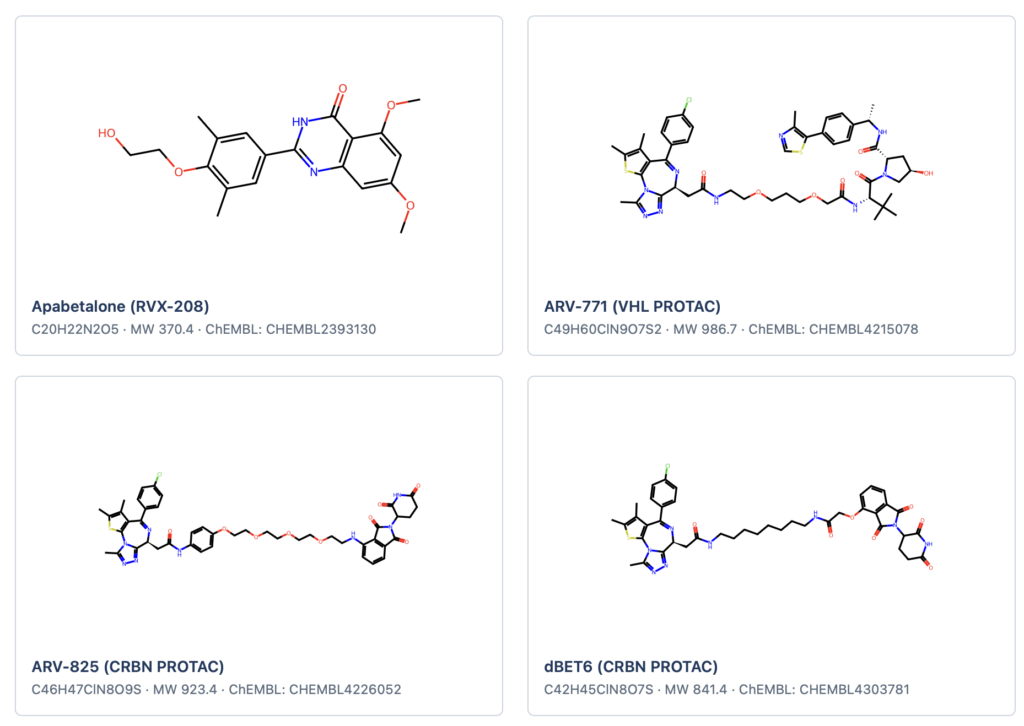
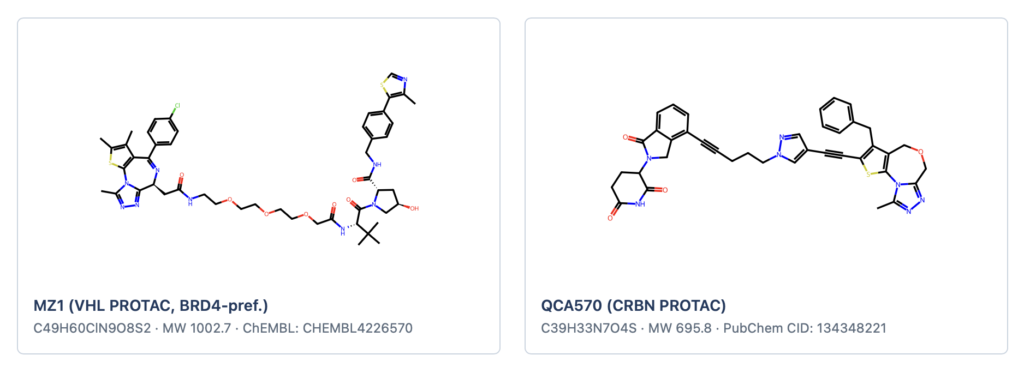
| Approval status | No BET/BRD4 inhibitor and no BRD4/BET degrader is approved anywhere as of June 2026 — all assets are investigational. Closest to approval: pelabresib (pan-BET inhibitor) in myelofibrosis — MANIFEST-2 met its spleen-volume endpoint but missed the symptom endpoint and is NOT filed; a leukemic-transformation imbalance prompted a new pivotal trial (MANIFEST-3). The only clinical-stage dedicated BRD4 degrader is RNK05047 (Ranok) — a chaperone-mediated ‘CHAMP’ degrader, not a PROTAC — in Phase 1/2. (Note: vepdegestrant/ARV-471 is an FDA-filed PROTAC but degrades the estrogen receptor, not BRD4, and is excluded.) |
Clinical-stage BRD4 / BET agents (inhibitors & degraders)
| Compound (code) | Developer | Modality | Route | Phase / status | Lead indication(s) |
|---|---|---|---|---|---|
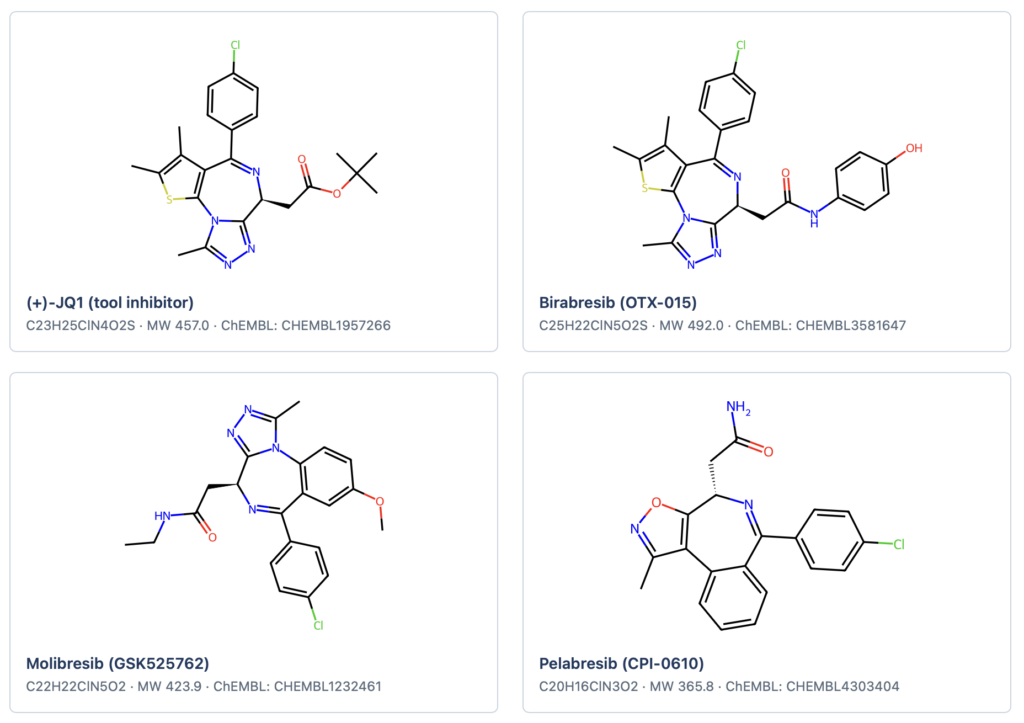
| Pelabresib (CPI-0610 / DAK539) | Novartis (ex-Constellation / MorphoSys) | Pan-BET inhibitor | Oral | Phase 3 active. MANIFEST-2 met spleen endpoint (SVR35 66% vs 35%) but missed symptom endpoint (TSS50); not filed; new pivotal MANIFEST-3 recruiting (2026) | Myelofibrosis (+ ruxolitinib) |
| ZEN-3694 | Zenith Epigenetics | Pan-BET inhibitor | Oral | Phase 2b active; FDA Fast Track (NUT carcinoma, 2025) | mCRPC (+ enzalutamide); NUT carcinoma |
| BMS-986158 | Bristol Myers Squibb | Pan-BET inhibitor | Oral | Phase 1/2 active (pivoted to myelofibrosis) | Myelofibrosis; multiple myeloma |
| INCB057643 | Incyte | Pan-BET inhibitor | Oral | Phase 1/2 active (LIMBER program) | Myelofibrosis / MPN |
| ABBV-744 | AbbVie | BD2-selective inhibitor | Oral | Phase 1b active (MF, + ruxolitinib/navitoclax); AML arm terminated. DLTs still thrombocytopenia/anemia | Myelofibrosis; mCRPC |
| EP31670 (NEO2734) | Epigenetix | Dual BET + CBP/p300 inhibitor | Oral | Phase 1 recruiting | Solid tumors, NUT carcinoma, CMML |
| Apabetalone (RVX-208) | Resverlogix | BD2-selective inhibitor | Oral | Phase 3 completed — BETonMACE MISSED primary MACE endpoint (HR 0.82, p=0.11); development funding-stalled | Cardiovascular (post-ACS + type-2 diabetes) |
| RNK05047 (CHAMP-1) | Ranok Therapeutics | BRD4 degrader — chaperone-mediated (CHAMP), not a PROTAC | IV | Phase 1/2 recruiting (NCT05487170). Only BRD4-selective degrader in the clinic | Advanced solid tumors; DLBCL |
| Birabresib (OTX-015 / MK-8628) | Oncoethix → Merck | Pan-BET inhibitor | Oral | Discontinued (~2017) — limited single-agent efficacy | NUT carcinoma, AML, DLBCL |
| Molibresib (GSK525762) | GSK | Pan-BET inhibitor | Oral | Discontinued — modest efficacy, thrombocytopenia ~51% | NUT carcinoma, NHL, breast |
| Trotabresib (CC-90010) | Celgene → BMS | Pan-BET inhibitor (CNS-penetrant) | Oral | Discontinued 2024 (strategic) despite documented BBB penetration | Glioblastoma |
| Mivebresib (ABBV-075) | AbbVie | Pan-BET inhibitor | Oral | Discontinued — myelofibrosis study halted at n=1; thrombocytopenia | AML, solid tumors |
| NUV-868 | Nuvation Bio | BD2-selective inhibitor | Oral | Discontinued 2024 (risk-benefit; Phase 2 declined) | Ovarian, pancreatic, mCRPC, TNBC |
| RO6870810 (TEN-010) | Roche | Pan-BET inhibitor | SC | Discontinued — combo study terminated (immune-related AEs) | NUT carcinoma, ovarian, TNBC |