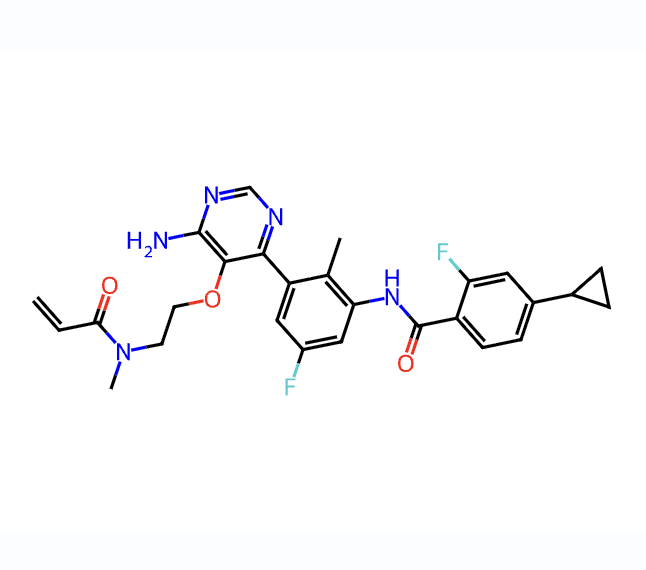
Compiled: 2026-06-17 · Trigger event: FDA approval, 2025-09-30 Innovator: Novartis Pharmaceuticals Corporation Status: Approved NME
INN: remibrutinibBrand (US): RHAPSIDOCAS: 1787294-07-8ChEMBL: CHEMBL4483575MW: 507.5 g/molNDA #: NDA 218436Approval: 2025-09-30
Mechanism: Remibrutinib is an oral, small-molecule covalent (irreversible) inhibitor of Bruton’s tyrosine kinase (BTK), engaging the catalytic Cys481 via its acrylamide warhead and binding an inactive BTK conformation — the basis of its high kinome selectivity (reported biochemical IC₅₀ ~1 nM). BTK is expressed in mast cells, basophils, B cells, macrophages, and platelets and signals downstream of the high-affinity IgE receptor (FcεR1), Fcγ receptors, and the B-cell antigen receptor (BCR). Remibrutinib also inhibits the BTK-related TEC-family kinases TEC and BMX. By blocking FcεR1/FcγR signalling it inhibits mast-cell and basophil degranulation — release of histamine and other proinflammatory mediators driven by pathogenic IgE or IgG — the mechanism relevant to CSU. ChEMBL CHEMBL4483575; target BTK (CHEMBL5251). Ref: Angst et al., J. Med. Chem. 2020, PMID 32083858.
Synthesis Route of the Originator
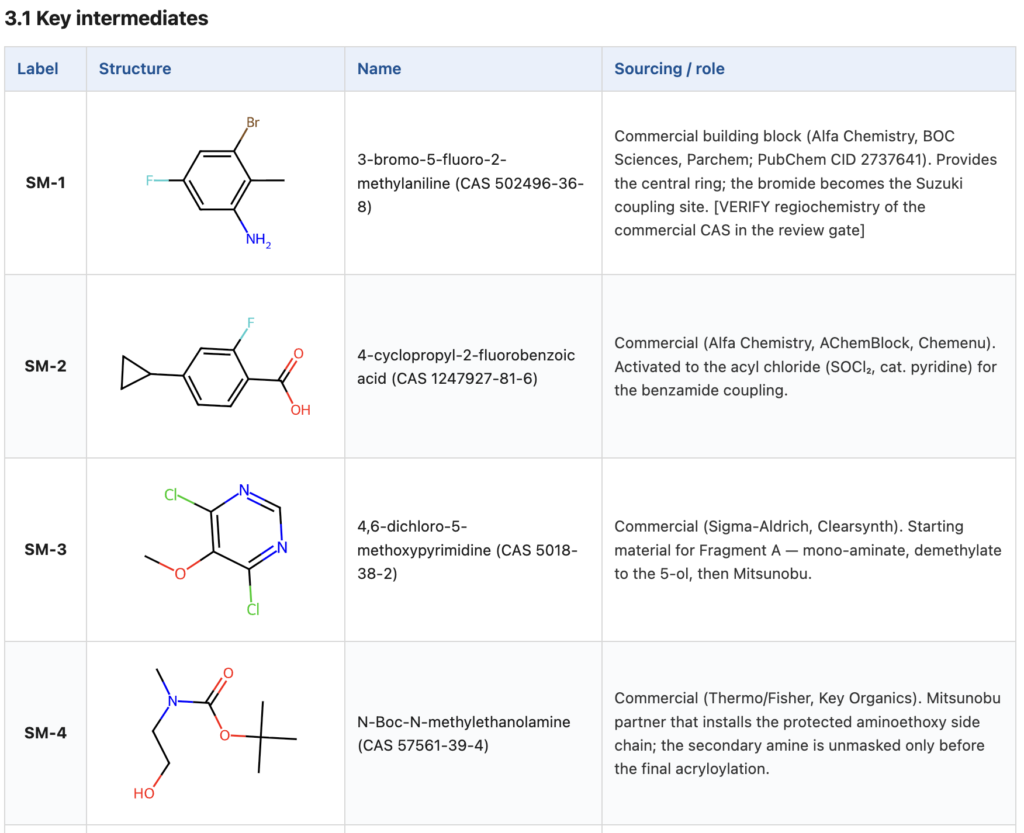
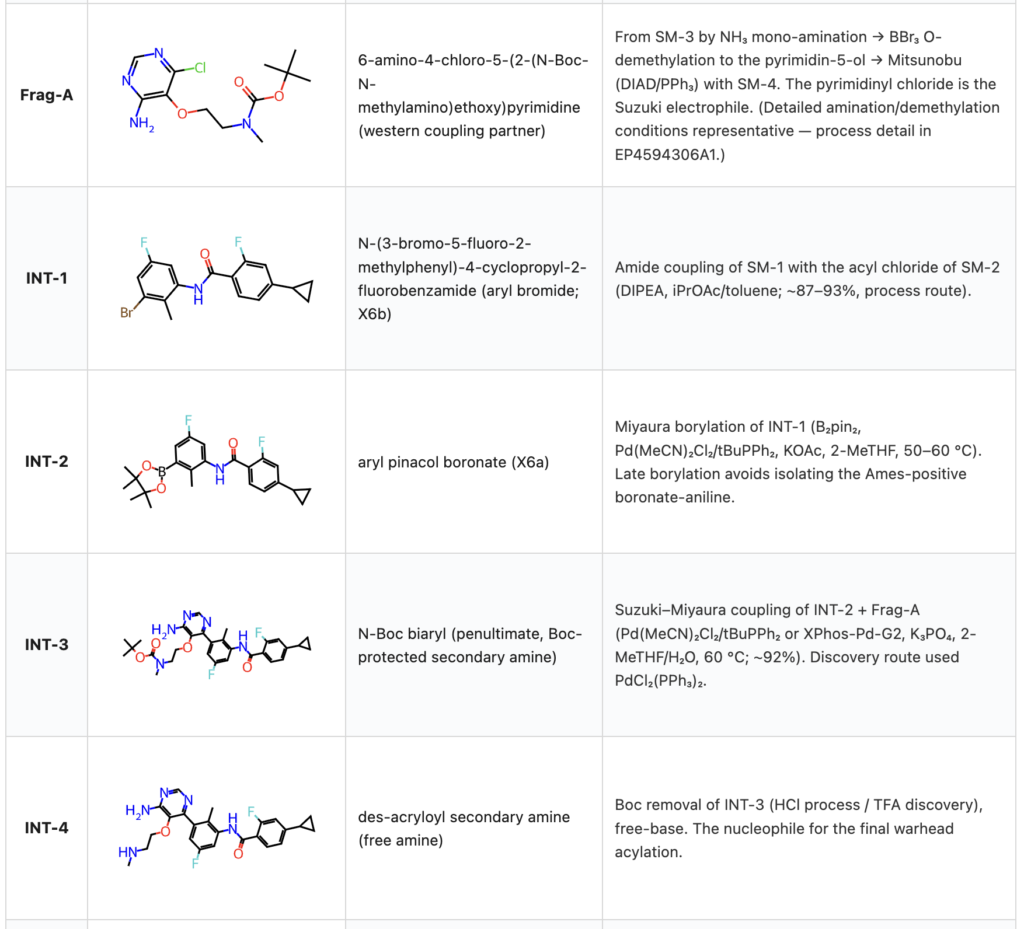
Convergent route disclosed in the Novartis discovery paper (Angst et al., J. Med. Chem. 2020, 63, 5102-5118; remibrutinib = compound 25) and optimised in the process patent (WO2024069507A1 / EP4594306A1). Fragment B (central aniline) is built by acylating 3-bromo-5-fluoro-2-methylaniline with 4-cyclopropyl-2-fluorobenzoyl chloride (INT-1), then borylated to the arylboronate (INT-2). Fragment A is a 6-amino-4-chloropyrimidine bearing the N-Boc-N-methyl-aminoethoxy side chain (built from 4,6-dichloro-5-methoxypyrimidine by mono-amination, O-demethylation to the 5-ol, and Mitsunobu with N-Boc-N-methylethanolamine). Suzuki–Miyaura coupling of INT-2 with Fragment A forms the Boc-protected biaryl (INT-3); Boc removal frees the secondary amine (INT-4); acryloylation installs the acrylamide warhead to give remibrutinib, crystallised as anhydrous Form A. The warhead is installed last — the standard covalent-kinase-inhibitor strategy. The improved process deliberately carries the aniline as an aryl bromide and borylates late to avoid a genotoxic boronate-aniline. Conditions are representative for the named transformations (corroborated by the process patent and a 2023 Molecules review); verify per-step loadings/temperatures against the discovery-paper SI before scale-up.


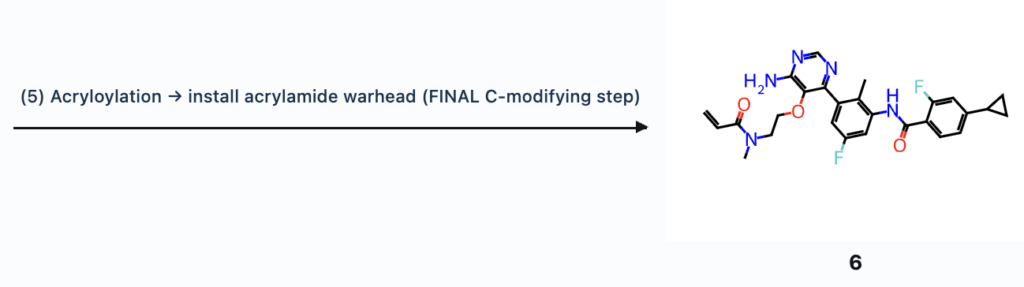
aReagents and conditions: (1) 4-cyclopropyl-2-fluorobenzoic acid (CAS 1247927-81-6) → acyl chloride (SOCl₂, cat. pyridine, toluene, 50 °C); then SM-1 aniline, DIPEA, iPrOAc/toluene; ~87–93% (process route, EP4594306A1); (2) B₂pin₂ (or bis-boronic acid), Pd(MeCN)₂Cl₂ (0.25–0.5 mol%), tBuPPh₂, KOAc, 2-MeTHF, 50–60 °C (process route, EP4594306A1). The process route deliberately borylates late to avoid isolating the Ames-positive boronate-aniline of the original route.; (3) Fragment A pyrimidinyl chloride (1.0 eq), Pd(MeCN)₂Cl₂ + tBuPPh₂ (or XPhos-Pd-G2), K₃PO₄, 2-MeTHF/H₂O ~10:3, 60 °C, ~24 h, ~92% (process route). Discovery route used PdCl₂(PPh₃)₂.; (4) HCl (process route) or TFA/CH₂Cl₂ (discovery route), rt; free-base on workup; (5) Acryloyl chloride (1.05 eq), Na₂CO₃ (1.2 eq), EtOAc, 50→65 °C (process route); discovery route used acrylic acid + T3P/base. Warhead installed last to avoid Michael side-reactions/oligomerisation upstream. Crystallise to anhydrous Form A (free base)..
atent Landscape & Exclusivity
2.1 Key patent filings
| Patent / Application | Type | Assignee | Filed | Expiry (~) | |
|---|---|---|---|---|---|
| WO2015079417A1 — ‘Novel amino pyrimidine derivatives’ (composition of matter) | Composition of matter (originator) | Novartis AG (inventors incl. D. Angst et al.) | PCT published 2015-06-04; priority ~2013 (the BTK-inhibitor amino-pyrimidine benzamide series described in Angst et al., J. Med. Chem. 2020) [VERIFY exact priority date on Espacenet] | ~2034–2035 nominal (20 yr from PCT filing), before any PTE [VERIFY exact date] | |
| WO2024069507A1 / EP4594306A1 — ‘Synthesis methods and intermediates for the production of remibrutinib’ (process) | Process | Novartis | ~2023 (published 2024) | ~2043–2044 nominal | |
| WO2023161887A1 — ‘Remibrutinib for use in the treatment of hidradenitis suppurativa’ (method of use) | Method of use | Novartis | ~2022 (published 2023) | ~2042–2043 nominal |
Structural class & SAR background: Convergent route disclosed in the Novartis discovery paper (Angst et al., J. Med. Chem. 2020, 63, 5102-5118; remibrutinib = compound 25) and optimised in the process patent (WO2024069507A1 / EP4594306A1). Fragment B (central aniline) is built by acylating 3-bromo-5-fluoro-2-methylaniline with 4-cyclopropyl-2-fluorobenzoyl chloride (INT-1), then borylated to the arylboronate (INT-2). Fragment A…
Crystal Forms, Salts, and Solid-State Profile
- API in approved drug product: Remibrutinib free base (C₂₇H₂₇F₂N₅O₃, MW 507.54; achiral — no stereocentres). White to pale-yellow powder; practically insoluble in water. Marketed drug-substance form is the anhydrous crystalline Form A (per process patent EP4594306A1).
- Strengths approved: 25 mg oral film-coated tablet, twice daily
- Third-party polymorph activity: No third-party US polymorph activity identified as of 2026-06-17 — expected given the long-dated COM. Monitor SureChEMBL/Espacenet.
- Originator polymorph filing: Novartis anhydrous Form A is the marketed solid form; polymorph claims expected within the Novartis estate
Pharmacology snapshot
| Target | Activity (ChEMBL pChEMBL) | Selectivity |
|---|---|---|
| Tyrosine-protein kinase BTK | Kd = 0.24 nM | — |
| Unchecked | IC50 = 36.0 nM | — |
| Tyrosine-protein kinase Tec | Kd = 77.0 nM | — |
| Cytoplasmic tyrosine-protein kinase BMX | Kd = 540.0 nM | — |
| Voltage-gated inwardly rectifying potassium channel KCNH2 | IC50 = 1400.0 nM | — |
| Phosphatidylinositol 4-kinase beta | IC50 = 3100.0 nM | — |
PK summary: – t½: Short — estimated elimination t½ ≈ 1 to 2 h (covalent, irreversible BTK engagement means pharmacodynamic effect outlasts plasma exposure, enabling BID dosing despite the short t½) – Tmax: Median Tmax ≈ 1 h (range 0–4 h) at steady state – Steady-state PD: Flat dose-response for UAS7 at Week 4 across 0.2–4× the recommended dose; near-complete BTK occupancy underlies the efficacy plateau and the 25 mg BID dose selection. – Food effect: No clinically significant effect of a high-fat meal (1000 kcal, 50% fat) — may be taken with or without food.
- KSM supply: 3-bromo-5-fluoro-2-methylaniline (CAS 502496-36-8), 4-cyclopropyl-2-fluorobenzoic acid (CAS 1247927-81-6), 4,6-dichloro-5-methoxypyrimidine (CAS 5018-38-2), N-Boc-N-methylethanolamine (CAS 57561-39-4), acryloyl chloride, B₂pin₂ — all commercial. No precious-metal-heavy chemistry beyond catalytic Pd (Suzuki + borylation).
- Critical process risk: (1) Pd removal to ICH-Q3D limits after the borylation + Suzuki steps. (2) Regiocontrol/purity of the di-substituted aniline and pyrimidine fragments. (3) Late-stage acrylamide installation must avoid Michael oligomerisation — controlled acryloylation. (4) Anhydrous Form A polymorph control on crystallisation. Note: process patent specifically engineered the route to AVOID a genotoxic (Ames-positive) boronate-aniline intermediate — a genotoxic-impurity control point.
Comparator / competitive class
| Asset | Code | Sponsor | Mechanism | Selectivity | Stage | IP cliff |
|---|---|---|---|---|---|---|
| Omalizumab (Xolair) | — | Genentech/Roche (US); Novartis (ex-US) | Anti-IgE monoclonal antibody | IgE | Approved for CSU since 2014 — the incumbent advanced therapy; injectable (SC q4wk) | biologic; biosimilars emerging |
| Dupilumab (Dupixent) | — | Sanofi / Regeneron | Anti-IL-4Rα monoclonal antibody | IL-4Rα | FDA-approved for CSU 2025; injectable (SC) — newest biologic competitor | biologic |
| Rilzabrutinib | PRN1008 | Sanofi | Reversible-covalent BTK inhibitor | BTK | Phase 3 in CSU (positive Ph2 RILECSU); the most direct ORAL-BTKi follower [VERIFY Ph3 status] | — |
| Fenebrutinib | GDC-0853 | Roche/Genentech | Reversible (non-covalent) BTK inhibitor | BTK | Positive Phase 2 in CSU (Nat Med 2021); program now MS-focused — reversible transaminase elevations seen | — |
Key peer-reviewed literature
- Sánchez J et al., J Allergy Clin Immunol Glob 2026 — Knowledge among primary care physicians on urticaria treatment: Impact of educational… (PMID 42256030)
- Mosnaim G et al., Ann Allergy Asthma Immunol 2026 — Remibrutinib impact on disease control, sleep, and quality of life: Analysis of phase… (PMID 42297099)
- Labrador-Horrillo M et al., J Investig Allergol Clin Immunol 2026 — A New Drug Target in Allergic Diseases: Bruton Tyrosine Kinase (PMID 42043389)
- Giménez-Arnau AM et al., J Allergy Clin Immunol Pract 2026 — Safety of remibrutinib in chronic spontaneous urticaria: a pooled analysis of REMIX-1… (PMID 42242425)
- Wu L et al., J Am Acad Dermatol 2026 — Indirect Comparison of Remibrutinib and Dupilumab in Omalizumab-Refractory Chronic… (PMID 42235605)
- Sher M et al., J Allergy Clin Immunol Pract 2026 — Solar urticaria successfully treated with Remibrutinib (PMID 42173244)
- Lamkin EN et al., Trends Pharmacol Sci 2026 — Remibrutinib (Rhapsido) for chronic spontaneous urticaria (PMID 42168043)
- Yang M et al., Z Rheumatol 2026 — Efficacy and safety of pharmacological treatment for Sjögren’s disease: a network meta-analysis (PMID 42113283)
- Khan SA et al., Mol Divers 2026 — Chemistry, pharmacology and spotlight on the clinical trials of remibrutinib: a first… (PMID 42084704)
- Aguilar-González L et al., J Dtsch Dermatol Ges 2026 — Efficacy and safety of remibrutinib in chronic spontaneous urticaria: clinical experience (PMID 42068168)