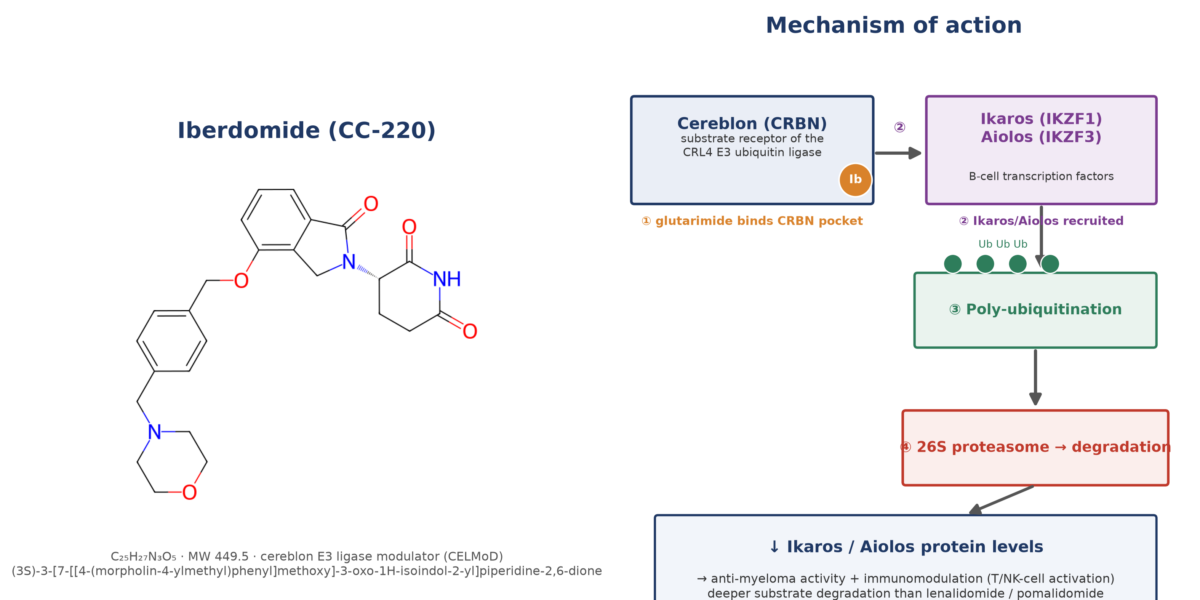
Mechanism: Iberdomide is a potent, orally available cereblon (CRBN) E3 ligase modulator (CELMoD). It binds CRBN — the substrate receptor of the CRL4^CRBN E3 ubiquitin ligase — and reshapes the substrate-recruitment surface to drive ubiquitination and proteasomal degradation of the myeloma-survival transcription factors IKZF1 (Ikaros) and IKZF3 (Aiolos). Relative to the first-generation IMiDs lenalidomide and pomalidomide, iberdomide binds CRBN with ~20-fold higher affinity (reported CRBN-binding IC50 ~150 nM), giving deeper/more complete Ikaros-Aiolos degradation and retained activity in lenalidomide/pomalidomide-resistant myeloma cells with dysregulated CRBN. Downstream effects are dual: direct anti-myeloma (apoptosis, suppression of the IRF4/MYC axis) plus immunomodulatory T-cell and NK-cell co-stimulation, with preclinical synergy alongside dexamethasone, proteasome inhibitors and anti-CD38 antibodies. The CRBN-DDB1-CC-220 co-crystal structure (Matyskiela et al., 2018) shows the morpholinomethyl-benzyloxy arm making additional cereblon contacts away from the Ikaros/Aiolos interface, rationalising the affinity gain. Refs: PMID 28425720 (crystal/medchem), PMID 29945920 (Ikaros/Aiolos PD).
t½: Terminal t½ ~9-13 h (single dose) — supports once-daily dosing on the 21-of-28-day schedule · Tmax: Oral; absorbed with a Tmax of a few hours [VERIFY vs label §12.3]
Synthesis Route of the Originator
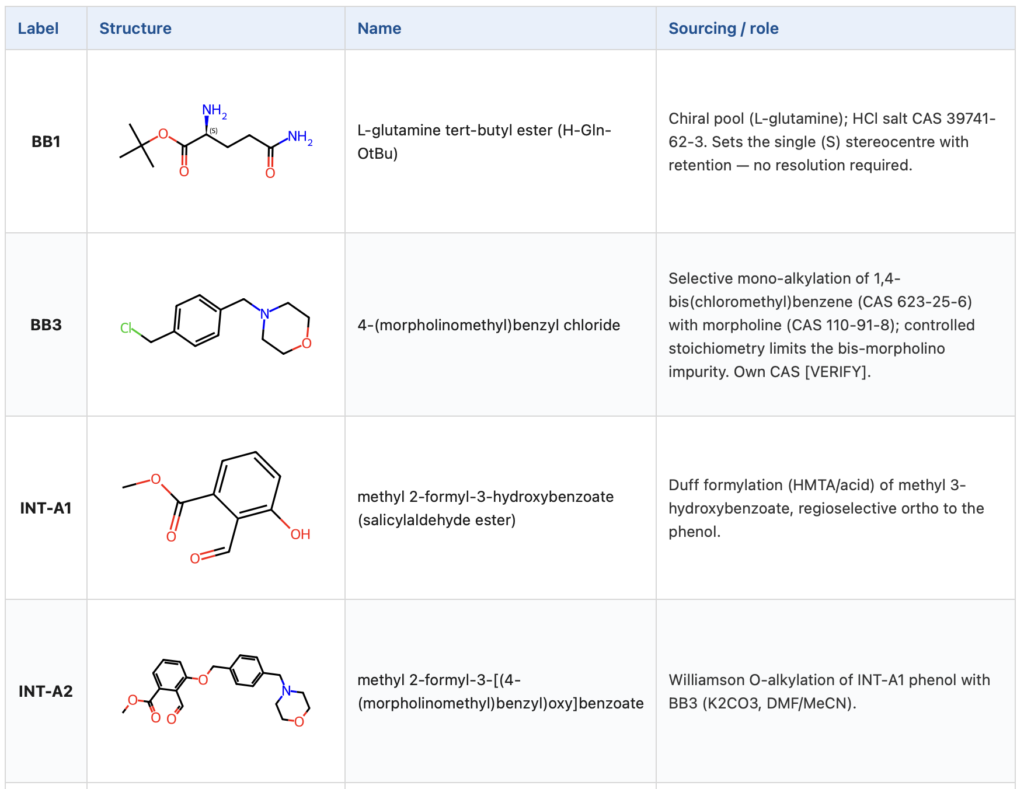
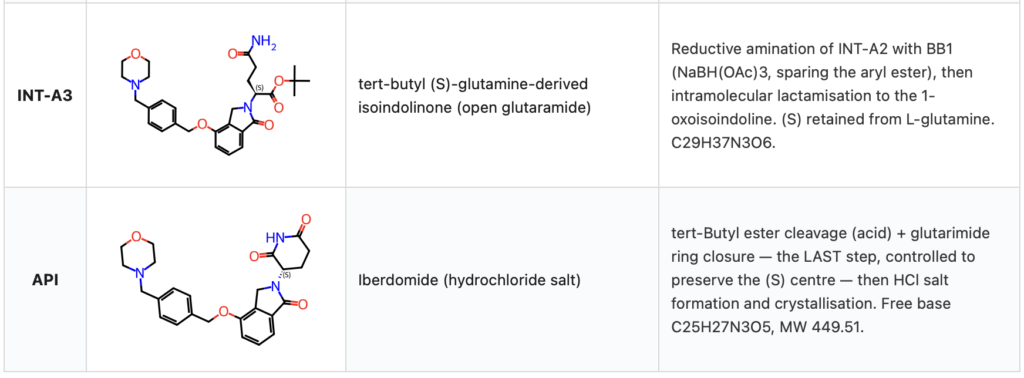
Disclosed kilogram-scale process (Zacuto et al., Org. Process Res. Dev. 2024, 28(1), 46-56 and 57-66) reconstructed at the level of disclosed building blocks and step order. Three fragments converge from the L-glutamine chiral pool. Methyl 3-hydroxybenzoate is Duff-formylated ortho to the phenol to the salicylaldehyde ester (INT-A1); Williamson O-alkylation with 4-(morpholinomethyl)benzyl chloride (from selective mono-alkylation of 1,4-bis(chloromethyl)benzene with morpholine) installs the benzyl ether (INT-A2). Reductive amination of the aldehyde with L-glutamine tert-butyl ester followed by intramolecular lactamisation builds the 1-oxoisoindoline (INT-A3), carrying the open glutaramide. Finally, tert-butyl ester cleavage and glutarimide (imide) ring closure — deliberately the LAST step, run under controlled conditions to protect the labile (S) C3 centre — give iberdomide, isolated as the hydrochloride. STEREO: the single (S) stereocentre traces from L-glutamine (2S) with retention throughout;
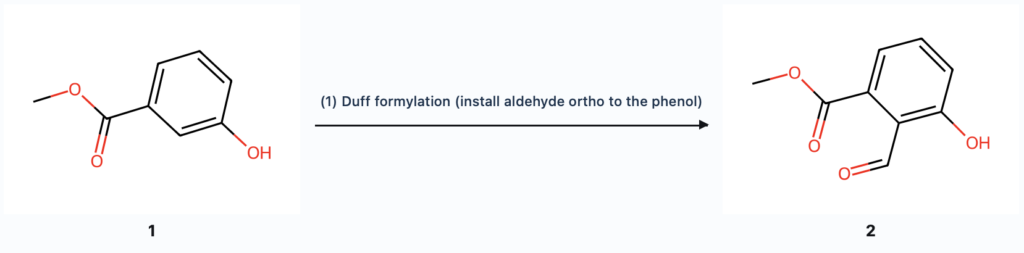

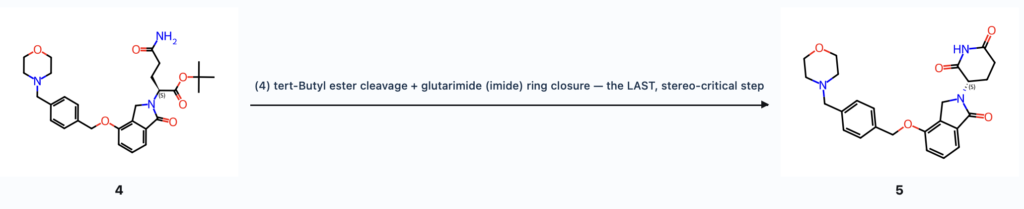
aReagents and conditions: (1) Hexamethylenetetramine (HMTA), acid (AcOH/TFA), heat — regioselective ortho-formylation between the phenol and the ester to give the salicylaldehyde ester.; (2) 4-(morpholinomethyl)benzyl chloride (BB3, 1.0-1.1 eq; from mono-alkylation of 1,4-bis(chloromethyl)benzene [CAS 623-25-6] with morpholine [CAS 110-91-8]), K2CO3, DMF or MeCN, 50-80 °C. Controlled stoichiometry on BB3 formation avoids the bis-morpholino impurity.; (3) L-glutamine tert-butyl ester (BB1, H-Gln-OtBu; CAS 39741-62-3 as HCl salt), NaBH(OAc)3 or NaBH4 (chemoselective imine reduction sparing the aryl ester), then intramolecular lactamisation (benzylamine onto the aryl ester → 1-oxoisoindoline). Sets/retains (S) from the L-glutamine chiral pool.; (4) Acid (TFA or HCl) removes the tert-butyl ester; the liberated alpha-acid cyclises onto the gamma-primary amide to close the piperidine-2,6-dione (glutarimide) under CDI or thermal/coupling conditions. Run LAST and under controlled conditions (OPRD Part 2) to preserve the labile (S) C3 stereocentre. Free base C25H27N3O5, MW 449.51.; (5) The marketed ZENBEXUS drug substance is iberdomide hydrochloride (C25H27N3O5·HCl; per FDA label DESCRIPTION). Treat the free base with HCl in a suitable solvent and crystallise. (The OPRD process papers developed the besylate/BSA salt as an isolation/process form; the registered form is the HCl.).
Key intermediates
Crystal Forms, Salts, and Solid-State Profile
- API in approved drug product: Iberdomide hydrochloride (C25H27N3O5·HCl; MW ~485.97 salt / 449.51 free base) is the marketed ZENBEXUS drug substance (per FDA label DESCRIPTION). Chemical name: (3S)-3-[4-({4-[(morpholin-4-yl)methyl]phenyl}methoxy)-1-oxo-2,3-dihydro-1H-isoindol-2-yl]piperidine-2,6-dione hydrochloride. (The BMS/Celgene OPRD process papers developed the besylate/BSA salt as an isolation form; the registered form is the HCl.)
- Strengths approved: EQ 1 mg and EQ 0.75 mg base oral capsules; 1 mg QD Days 1-21 of 28-day cycles.
- Third-party polymorph activity: No third-party US solid-form activity confirmed as of curation [VERIFY SureChEMBL/Espacenet].
- Originator polymorph filing: Celgene/BMS HCl-salt crystalline-form patent expected (secondary estate) [VERIFY exact number once Orange Book lists Zenbexus].
Available experimental protein structures (RCSB PDB)
| PDB ID | Target | Title | Resolution (Å) | Method | Released |
|---|---|---|---|---|---|
| 1R6J | Interleukin-1 beta | Ultrahigh resolution Crystal Structure of syntenin PDZ2 | 0.73 | X-RAY DIFFRACTION | 2004-05-04 |
| 32OA | Interleukin-1 beta | The ultra-high-resolution hyaluronan-binding… | 0.775 | X-RAY DIFFRACTION | 2026-08-12 |
| 7R2H | Interleukin-1 beta | 0.79A resolution structure of DMSO bound Cyclophilin D | 0.79 | X-RAY DIFFRACTION | 2023-02-15 |
| 9V09 | Protein cereblon/Zinc finger… | Cryo-EM structure of lenalidomide-organized… | 3.25 | ELECTRON MICROSCOPY | 2026-08-19 |
| 9V0C | Protein cereblon/Zinc finger… | Cryo-EM structure of iberdomide-organized… | 3.27 | ELECTRON MICROSCOPY | 2026-08-19 |
| 9UUM | Protein cereblon/Zinc finger… | Cryo-EM structure of mezigdomide-organized… | 3.41 | ELECTRON MICROSCOPY | 2026-06-10 |
| 2FMA | Tumor necrosis factor | Structure of the Alzheimer’s Amyloid Precursor… | 0.85 | X-RAY DIFFRACTION | 2007-01-16 |
| 6ZSY | Tumor necrosis factor | Crystal structure of the Grindelwald… | 0.926 | X-RAY DIFFRACTION | 2021-03-31 |
| 4XDX | Tumor necrosis factor | The crystal structure of soluble human… | 0.95 | X-RAY DIFFRACTION | 2015-12-23 |
For SAR / docking and ligand-bound forms relevant to polymorph analysis.
Clinical & Regulatory Profile
5.1 Approved indication
- Approval date (US): 2026-08-13
- NDA number: NDA 221075
- Brand (US): ZENBEXUS
- Indication: In combination with daratumumab and hyaluronidase-fihj and dexamethasone (regimen ‘ZDd’), for adult patients with multiple myeloma who have received at least 1 prior line of therapy including a proteasome inhibitor AND an immunomodulatory agent. FIRST-IN-CLASS: the first cereblon E3 ligase modulator (CELMoD) approved for multiple myeloma. Approved under ACCELERATED APPROVAL based on MRD-negative complete response (CR) at any time; continued approval may be contingent on verification of clinical benefit in the confirmatory portion of EXCALIBER-RRMM.
Key peer-reviewed literature
- Niiyama-Uchibori Y et al., Br J Haematol 2026 — Cellular and molecular impacts of CELMoDs and IMiD on the induction of myeloid-derived… (PMID 42637534)
- — et al., Cancer Discov 2026 — In Regulatory First, Myeloma Drug Approved Based on MRD Negativity (PMID 42627098)
- Lin H et al., J Proteome Res 2026 — Ultrahigh-Throughput Liquid Chromatography with Tandem Mass Spectrometry Method for… (PMID 42087393)
- Alvaro ME et al., Eur J Haematol 2026 — Targeting Ikaros and Aiolos: Next-Generation Cereblon E3 Ligase Modulators in MM (PMID 41651798)
- Li W et al., Front Immunol 2026 — Comparative effectiveness and safety of biologics and targeted small-molecule… (PMID 42170175)
- Tsao C et al., J Gastroenterol Hepatol 2026 — IKZF3 Promotes Gastric cancer Progression and Oxaliplatin Resistance via PI3K/AKT/mTOR… (PMID 41820205)
- Egan AM et al., Int J Mol Sci 2026 — Genetic Polymorphisms in Systemic Lupus Erythematosus and Their Clinical Implications:… (PMID 42123548)
- Naing PT et al., J Hematol Oncol 2026 — Advances in multiple myeloma: key updates from the ASH 2025 meeting (PMID 42021304)
- Korst CLBM et al., Lancet Haematol 2026 — Iberdomide plus low-dose cyclophosphamide and dexamethasone in patients with relapsed… (PMID 41482445)
- Meermeier EW et al., Blood 2025 — An immunostimulatory CELMoD combination overcomes resistance to T-cell engagers caused… (PMID 40864972)