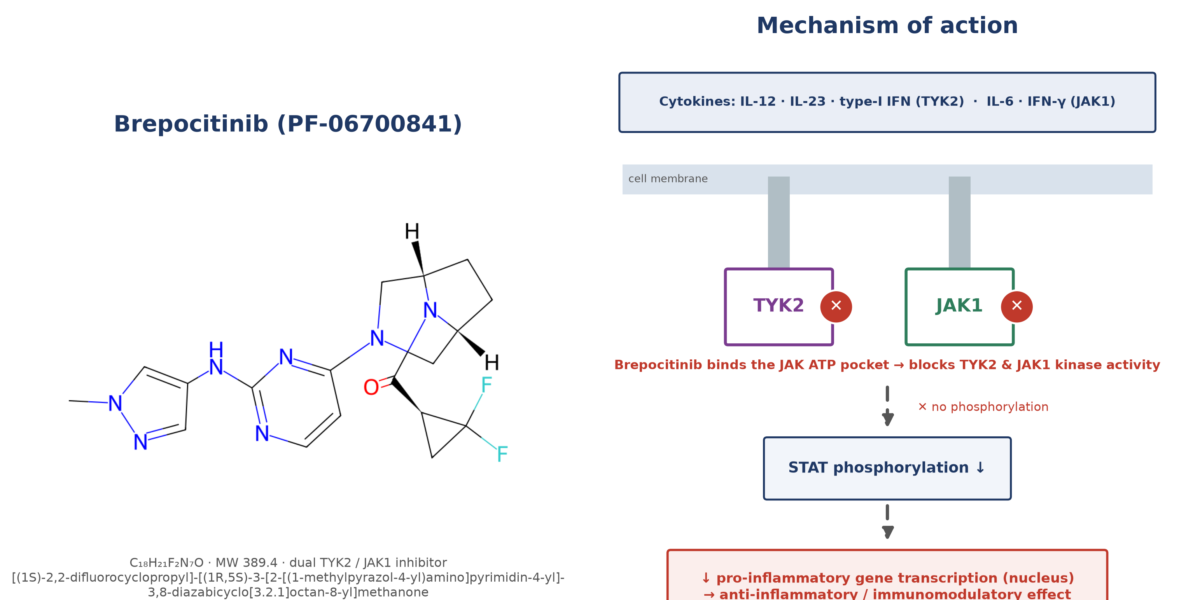
Mechanism: Brepocitinib is an oral, Type I (ATP-competitive) inhibitor that reversibly binds the catalytic JH1 kinase domain of BOTH tyrosine kinase 2 (TYK2; ChEMBL CHEMBL3553) and Janus kinase 1 (JAK1; CHEMBL2835), with relative JAK2/JAK3 sparing (enzymatic IC50 ~TYK2 23 nM / JAK1 17 nM / JAK2 77 nM / JAK3 ~6.5 µM). This dual TYK2+JAK1 blockade suppresses signalling of the type I interferons (IFN-α/β) that drive the dermatomyositis interferon signature, together with IL-12/IL-23, IL-6 and other JAK1/TYK2-dependent cytokines implicated in DM. Mechanistically distinct from deucravacitinib (Sotyktu), which is an ALLOSTERIC JH2-pseudokinase-domain, TYK2-selective inhibitor; brepocitinib’s ATP-competitive JH1 mechanism and JAK1 activity are why the Lisraya label carries the JAK-inhibitor class boxed warning whereas deucravacitinib does not. Refs: PMID 30113844 (discovery), PMID 39008325 (TYK2/JAK1 rationale in DM).
Synthesis Route of the Originator
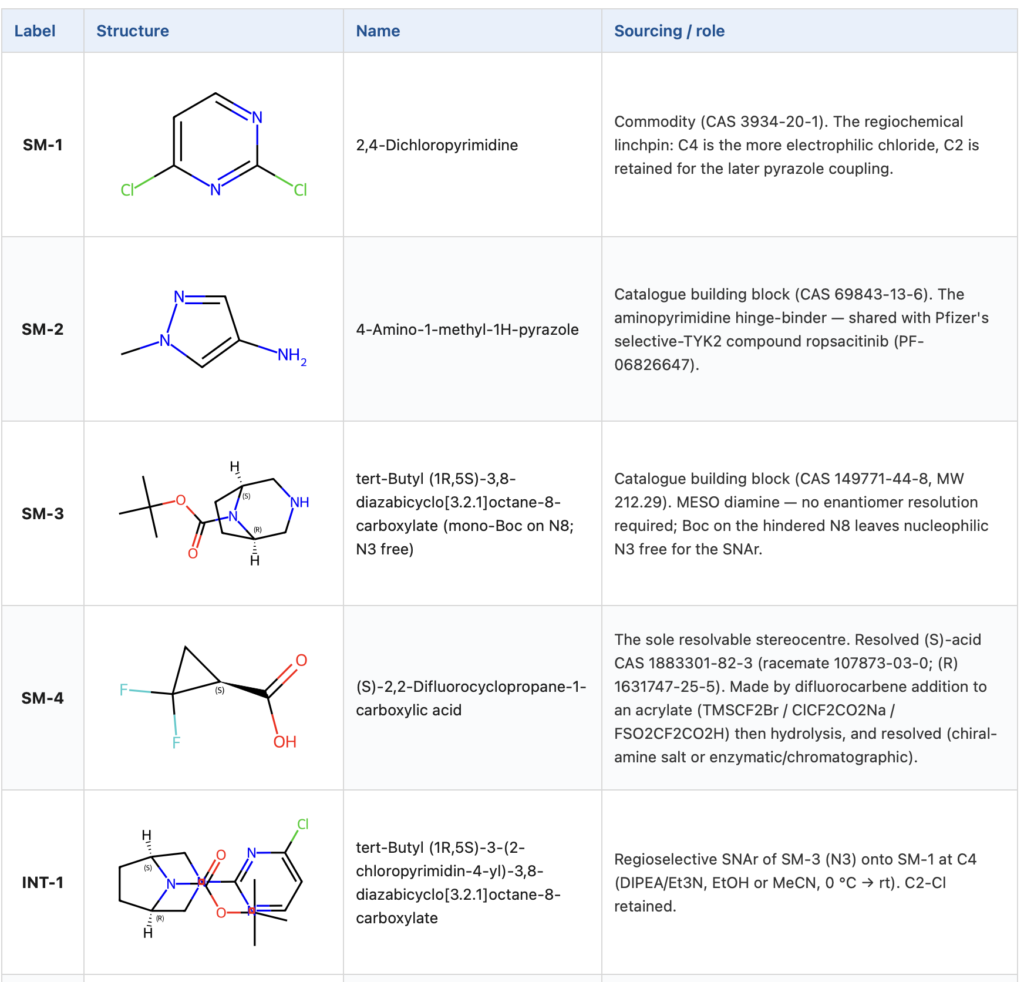
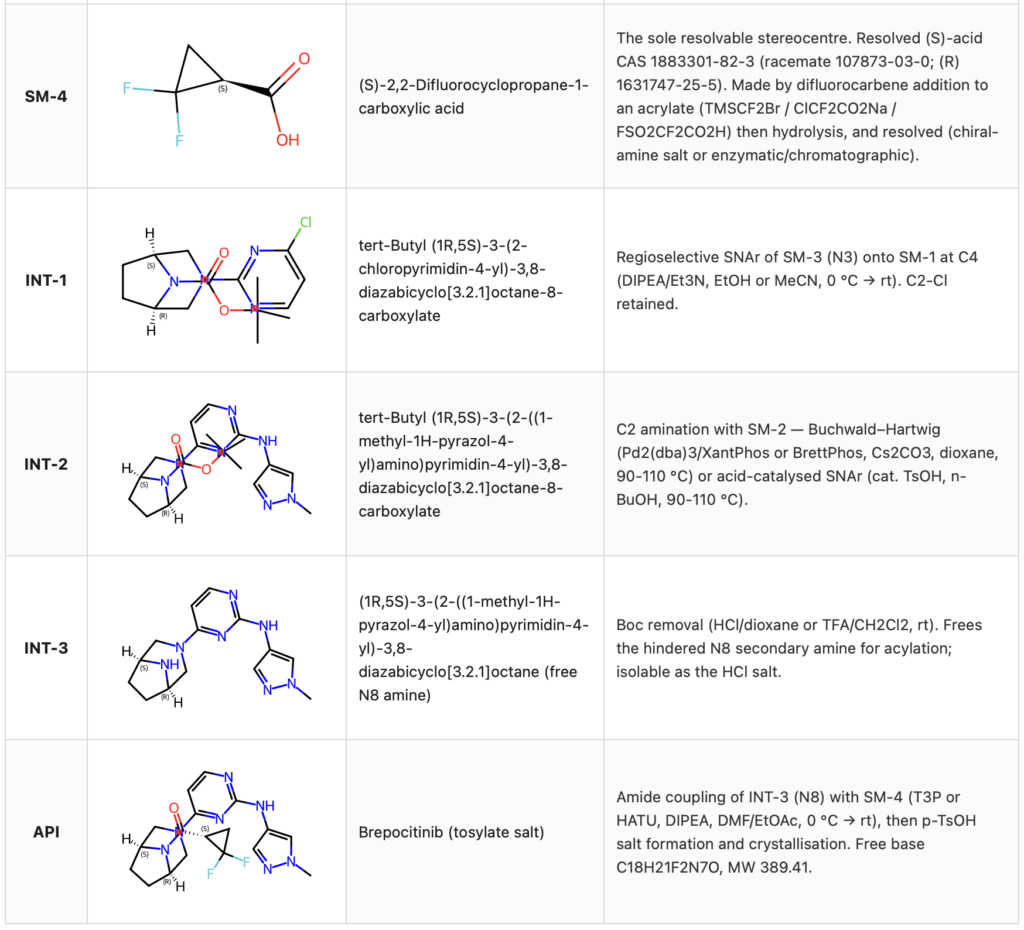
Convergent end-game disclosed in the Pfizer discovery paper (Fensome et al., J. Med. Chem. 2018, 61(19), 8597-8612; PF-06700841). 2,4-Dichloropyrimidine (SM-1) is the regiochemical linchpin: a low-temperature SNAr installs the mono-Boc (1R,5S)-3,8-diazabicyclo[3.2.1]octane (SM-3, Boc on N8, free N3) at the more electrophilic C4 to give INT-1. The weakly nucleophilic 4-amino-1-methylpyrazole (SM-2) is then coupled at the deactivated C2 (Buchwald–Hartwig, or acid-catalysed SNAr) to give the Boc-protected penultimate INT-2. Boc removal frees the hindered N8 bridgehead amine (INT-3), which is acylated LAST with (S)-2,2-difluorocyclopropanecarboxylic acid (SM-4; T3P or HATU, DIPEA) to give brepocitinib, isolated as the tosylate salt. Coupling the resolved acid last minimises material carried through and protects its epimerisable α-stereocentre. STEREO NOTE: the bicyclic diamine is meso (Cs-symmetric) — achiral even with different N3/N8 substituents — so the only enantiopurity concern is the (S)-difluorocyclopropane. All intermediate SMILES RDKit-validated; the final product matches the API canonical SMILES. Precise operational conditions live in the discovery-paper SI and Pfizer patents (WO2016027195A1, US10980815B2) — verify before scale-up; conditions shown are representative for the named transformations.
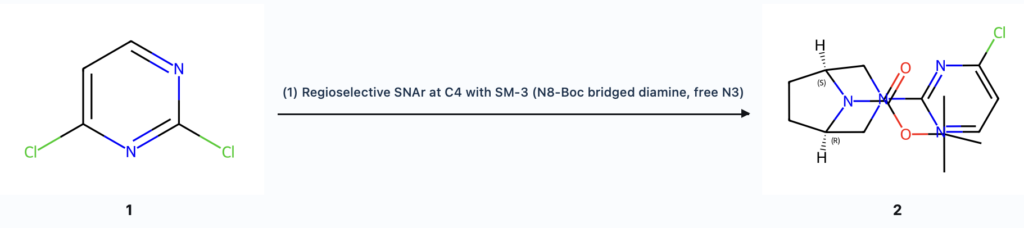


aReagents and conditions: (1) tert-butyl (1R,5S)-3,8-diazabicyclo[3.2.1]octane-8-carboxylate (SM-3, 1.0 eq; CAS 149771-44-8), DIPEA or Et3N (1.5-2 eq), EtOH or MeCN (or NMP), 0 °C → rt. C4-Cl is the more electrophilic site → clean mono-substitution; the C2-Cl is retained for the next coupling.; (2) 4-amino-1-methyl-1H-pyrazole (SM-2, 1.1-1.3 eq; CAS 69843-13-6). Either Buchwald–Hartwig (Pd2(dba)3 / XantPhos or BrettPhos, Cs2CO3, 1,4-dioxane, 90-110 °C) or acid-promoted SNAr (cat. TsOH or HCl, n-BuOH/dioxane, 90-110 °C) on the deactivated C2 of the electron-rich 4-aminopyrimidine.; (3) HCl (4 M in 1,4-dioxane) or TFA/CH2Cl2, rt, 1-2 h; isolable as the HCl salt or free-based on workup.; (4) (S)-2,2-difluorocyclopropane-1-carboxylic acid (SM-4, 1.05-1.2 eq; CAS 1883301-82-3), T3P (1.5 eq) or HATU (1.2 eq), DIPEA (2-3 eq), DMF or EtOAc, 0 °C → rt, 2-6 h. Coupling the expensive resolved acid LAST minimises material carried through; mild conditions protect the acid α-stereocentre from epimerisation.; (5) The free base is hygroscopic; the clinical/commercial drug substance is the tosylate salt (CAS 2140301-96-6) [VERIFY marketed form vs label DESCRIPTION]. Treat free base with p-toluenesulfonic acid (1.0 eq) in a suitable solvent and crystallise. Free base C18H21F2N7O, MW 389.41..
Key intermediates
Crystal Forms, Salts, and Solid-State Profile
- API in approved drug product: Brepocitinib free base is C18H21F2N7O, MW 389.41 (white to off-white solid). The free base is hygroscopic/deliquescent, so the development drug substance is the tosylate salt (brepocitinib tosylate, CAS 2140301-96-6) [VERIFY marketed solid form vs label DESCRIPTION].
- Strengths approved: 30 mg oral tablet, QD (the approved effective dose). 15 mg was studied but sub-therapeutic.
- Third-party polymorph activity: A third-party tosylate crystal-form filing exists (Hangzhou Solipharma, WO2022161507A1, priority 2021) — monitor SureChEMBL/Espacenet; not an originator asset.
- Originator polymorph filing: Pfizer free-base crystalline-form filing referenced (WO2020165788A1) [VERIFY]; the tosylate is the practical drug-substance form.
Available experimental protein structures (RCSB PDB)
| PDB ID | Target | Title | Resolution (Å) | Method | Released |
|---|---|---|---|---|---|
| 4GQR | Tyrosine-protein kinase JAK1 | Human Pancreatic alpha-amylase in complex with… | 1.2 | X-RAY DIFFRACTION | 2012-10-24 |
| 8BXH | Tyrosine-protein kinase JAK1 | Crystal structure of JAK2 JH1 in complex with… | 1.3 | X-RAY DIFFRACTION | 2023-12-20 |
| 7LL4 | Tyrosine-protein kinase JAK1 | High-resolution crystal structure of human… | 1.31 | X-RAY DIFFRACTION | 2022-01-12 |
| 8BXH | Non-receptor tyrosine-protein… | Crystal structure of JAK2 JH1 in complex with… | 1.3 | X-RAY DIFFRACTION | 2023-12-20 |
| 7LL4 | Non-receptor tyrosine-protein… | High-resolution crystal structure of human… | 1.31 | X-RAY DIFFRACTION | 2022-01-12 |
| 6N7A | Non-receptor tyrosine-protein… | Structure of the human JAK1 kinase domain with… | 1.33 | X-RAY DIFFRACTION | 2019-04-24 |
| 8BXH | Tyrosine-protein kinase JAK2 | Crystal structure of JAK2 JH1 in complex with… | 1.3 | X-RAY DIFFRACTION | 2023-12-20 |
| 7LL4 | Tyrosine-protein kinase JAK2 | High-resolution crystal structure of human… | 1.31 | X-RAY DIFFRACTION | 2022-01-12 |
| 6N7A | Tyrosine-protein kinase JAK2 | Structure of the human JAK1 kinase domain with… | 1.33 | X-RAY DIFFRACTION | 2019-04-24 |
For SAR / docking and ligand-bound forms relevant to polymorph analysis.
Approved indication
- Approval date (US): 2026-08-27
- NDA number: NDA [VERIFY — not yet published; not in Drugs@FDA/openFDA at curation]
- Brand (US): LISRAYA
- Indication: Treatment of dermatomyositis (DM) in adults. FIRST-IN-DISEASE: the first FDA-approved oral drug indicated for dermatomyositis, and the first targeted (non-steroid, non-IVIG) therapy for DM. FDA titled its announcement ‘FDA Approves First Oral Drug Indicated to Treat Dermatomyositis in Adults.’
Key peer-reviewed literature
- Mangold AR et al., JAMA Dermatol 2026 — Skin-Specific Outcomes of Brepocitinib in Patients With Dermatomyositis: Secondary… (PMID 42646746)
- Xia Y et al., Postgrad Med J 2026 — Comparative efficacy of Janus kinase inhibitors in severe alopecia areata: a network…(PMID 42391509)
- Tartaglia J et al., Expert Opin Biol Ther 2026 — Transforming the treatment of autoimmune skin diseases: a journey through biologic therapies (PMID 42593236)
- Almansouri D et al., Expert Opin Pharmacother 2026 — Emerging synthetic drugs for the management of hidradenitis suppurativa: a comprehensive update (PMID 42342652)
- Onuora S et al., Nat Rev Rheumatol 2026 — Brepocitinib shows promise for dermatomyositis (PMID 42115766)
- Krebs M et al., J Eur Acad Dermatol Venereol 2026 — Large-scale meta-analysis of infection risk with JAK-STAT inhibitors in 29,000 patients (PMID 42187316)
- Lundberg IE et al., N Engl J Med 2026 — A Phase 3 Trial of Brepocitinib in Dermatomyositis (PMID 42127396)
- Vleugels RA et al., N Engl J Med 2026 — A Phase 3 Trial of Brepocitinib in Dermatomyositis (PMID 41910335)
- Vermeire S et al., EClinicalMedicine 2026 — Once-daily oral ritlecitinib or brepocitinib versus placebo in patients with…(PMID 41852927)
- Saeed U et al., Iran J Pharm Res 2026 — Dual TYK2/JAK1 Inhibition by Brepocitinib Reprograms Synoviocyte Pathobiology:… (PMID 41757135)