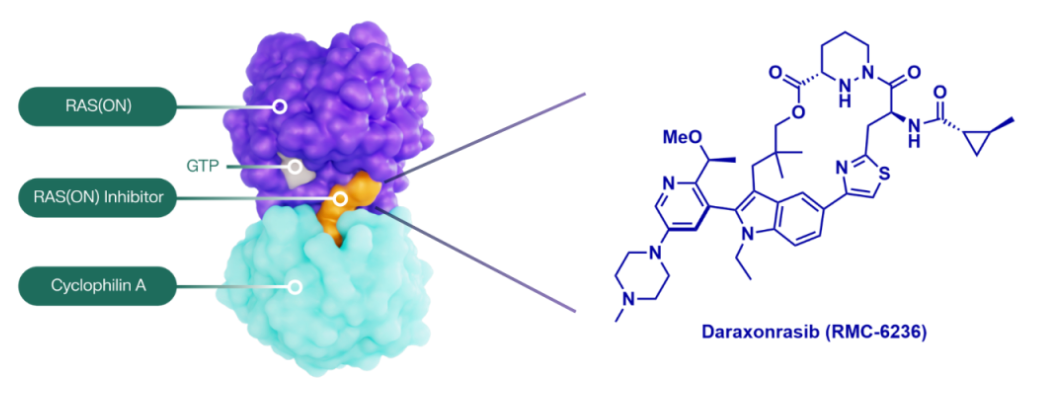
Mechanism: Daraxonrasib (RMC-6236) is an oral, noncovalent, beyond-Rule-of-5 macrocyclic ‘tri-complex’ (molecular-glue) inhibitor of RAS. It first binds the intracellular chaperone cyclophilin A (CypA); the drug–CypA binary complex then presents a neomorphic composite surface that engages the active, GTP-bound (‘ON’) conformation of RAS at the switch I / switch II effector interface, sterically blocking recruitment of downstream effectors (RAF → MEK → ERK) and shutting down MAPK signalling. Because it binds a conserved active-state surface via CypA, it is RAS(ON) MULTI-SELECTIVE (pan-RAS): it inhibits KRAS, NRAS and HRAS — both mutant and wild-type — spanning G12X (G12D/V/R/C/A/S), G13X and Q61X. This contrasts with the approved covalent G12C(OFF)-state inhibitors sotorasib and adagrasib, which trap only the inactive GDP-bound single-cysteine mutant. The genotype-agnostic mechanism is the basis for a PDAC label that requires no RAS mutation test — apt because PDAC is ~90% KRAS-mutant, dominated by G12D/G12V/G12R (G12C is rare). Cellular pERK inhibition EC₅₀ ~1–2.6 nM; potency across mutants spans ~10×. Tri-complex crystal structures: RCSB PDB 9BG5/9BG6/9BGA/9BGC. Refs: PMID 42223072, PMID 42090791; discovery paper DOI 10.1021/acs.jmedchem.4c02314.
Synthesis Route of the Originator
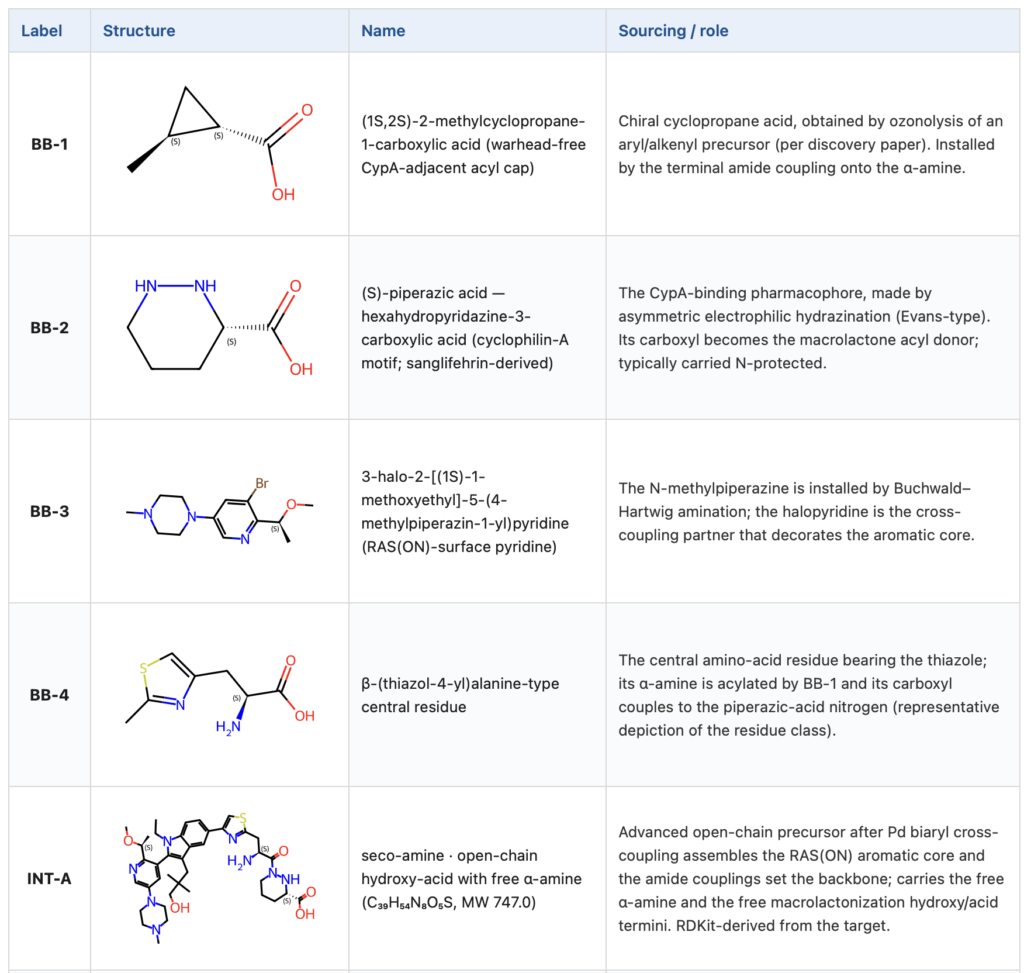
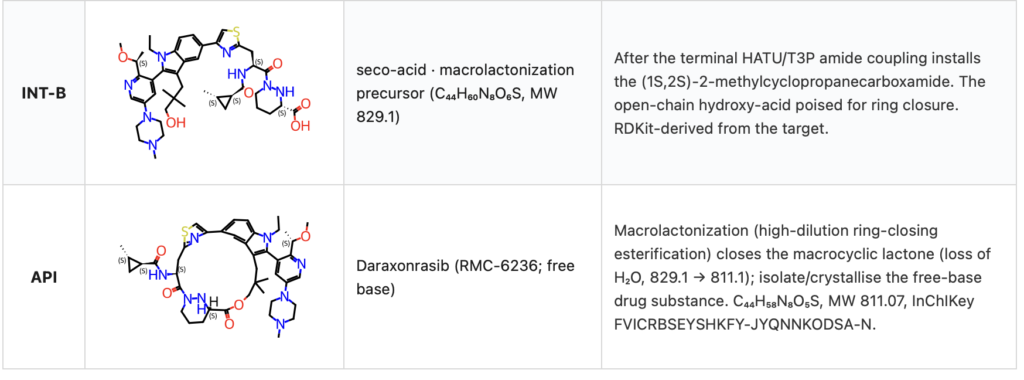
Daraxonrasib is a FULLY SYNTHETIC macrocyclic lactone (not a fermentation-derived semi-synthetic natural product, despite the sanglifehrin-inspired cyclophilin-A pharmacophore). The convergent route joins four building blocks — a β-(thiazol-4-yl)alanine central residue, (S)-piperazic acid (the CypA motif), the N-ethyl-indole RAS(ON)-binding aromatic core (carrying the gem-dimethyl neopentyl alcohol), and 2-[(1S)-1-methoxyethyl]-5-(4-methylpiperazin-1-yl)pyridine — via Pd-catalysed biaryl cross-coupling (Suzuki/Miyaura) and HATU/T3P amide couplings into an open-chain seco-hydroxy-acid. The (1S,2S)-2-methylcyclopropanecarboxamide is installed by the terminal amide coupling, and the macrocycle is closed by a high-dilution MACROLACTONIZATION (Shiina/MNBA or Yamaguchi conditions, representative) to give the drug substance (free base). Building-block chemistry disclosed/implied by the discovery paper (Cregg et al., J Med Chem 2025, 68(6), 6064-6083): asymmetric electrophilic hydrazination for piperazic acid; Buchwald–Hartwig amination for the methylpiperazine-pyridine; ozonolysis for the chiral methylcyclopropane acid. The RevMed scale-up process is captured in patent WO2024216008A1 (Compound A). NOTE: the two intermediate structures shown (seco-amine, seco-acid) were generated by RDKit disconnection from the verified target and are mass-balanced (seco-amine + methylcyclopropanecarboxylic acid − H₂O = seco-acid; seco-acid − H₂O = daraxonrasib); reagents/conditions are REPRESENTATIVE for the named transformations, not the verbatim proprietary process.
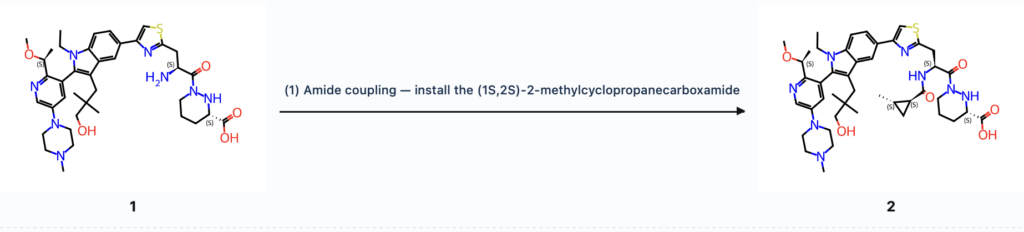
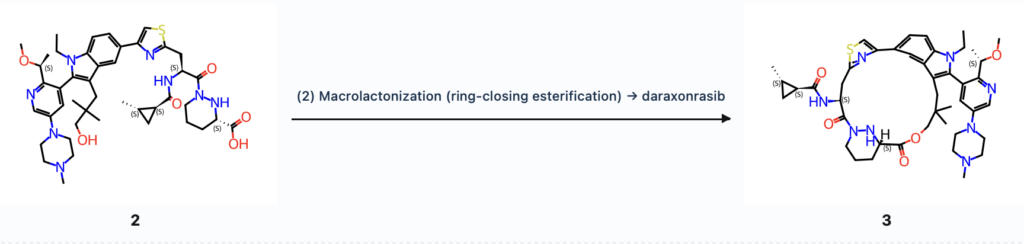
aReagents and conditions: (1) (1S,2S)-2-methylcyclopropane-1-carboxylic acid (1.1 eq), HATU (1.2 eq) or T3P, DIPEA (2–3 eq), DMF/CH₂Cl₂, 0 °C → rt (REPRESENTATIVE for the named amide coupling; the (1S,2S)-methylcyclopropane acid is an ozonolysis-derived chiral building block). Acylates the free α-amine of the thiazolylalanine residue.; (2) Ring-closing esterification of the piperazic-acid carboxyl onto the neopentyl 1° alcohol under high dilution (REPRESENTATIVE conditions for a hindered macrolactonization: e.g. Shiina 2-methyl-6-nitrobenzoic anhydride (MNBA)/DMAP, or Yamaguchi 2,4,6-trichlorobenzoyl chloride/Et₃N then DMAP; toluene, high dilution). Closes the 11-membered-bridge macrocyclic lactone to give the drug substance (free base). Loss of H₂O: 829.1 → 811.1..
Key intermediates
Crystal Forms, Salts, and Solid-State Profile
- API in approved drug product: Daraxonrasib free base (C₄₄H₅₈N₈O₅S, MW 811.07; exact mass 810.4251). A fully synthetic, beyond-Rule-of-5 macrocyclic lactone with 5 defined stereocentres plus one controlled biaryl atropisomer. XLogP ~5.1, TPSA ~162 Ų, HBD 2, HBA 11, RTB 7 (PubChem). Crystalline drug-substance form [VERIFY specific polymorph/solvate].
- Strengths approved: Oral tablet; 300 mg total daily dose [individual tablet strengths VERIFY once label posts]
- Third-party polymorph activity: None identified as of 2026-08-27 (drug approved one day prior; long-dated COM). Monitor SureChEMBL/Espacenet.
- Originator polymorph filing: Salts and isotopic variants are claimed within the RevMed genus (WO2023060253A1); a standalone crystalline-form/formulation patent was not confirmed [VERIFY].
Available experimental protein structures (RCSB PDB)
| PDB ID | Target | Title | Resolution (Å) | Method | Released |
|---|---|---|---|---|---|
| 2ECU | HPAC | Crystal structure of flavin reductase… | 1.3 | X-RAY DIFFRACTION | 2008-01-15 |
| 2ECR | HPAC | Crystal structure of the ligand-free form of… | 1.6 | X-RAY DIFFRACTION | 2008-01-15 |
| 2D37 | HPAC | The Crystal Structure of Flavin Reductase HpaC… | 1.7 | X-RAY DIFFRACTION | 2006-05-30 |
For SAR / docking and ligand-bound forms relevant to polymorph analysis.
Structural class & SAR background: Daraxonrasib is a FULLY SYNTHETIC macrocyclic lactone (not a fermentation-derived semi-synthetic natural product, despite the sanglifehrin-inspired cyclophilin-A pharmacophore). The convergent route joins four building blocks — a β-(thiazol-4-yl)alanine central residue, (S)-piperazic acid (the CypA motif), the N-ethyl-indole RAS(ON)-binding aromatic core (carrying the gem-dimethyl neopentyl…
Pharmacology snapshot
| Target | Activity (ChEMBL pChEMBL) | Selectivity |
|---|---|---|
| Unchecked | EC50 = 0.3 nM | — |
| NCI-H358 | EC50 = 1.0 nM | — |
| HPAC | IC50 = 1.2 nM | — |
| CAPAN-1 | EC50 = 1.3 nM | — |
| Capan-2 | IC50 = 1.4 nM | — |
| NCI-H1975 | EC50 = 1.4 nM | — |
PK summary: – t½: Human terminal t½ not clearly stated in accessible sources as of 2026-08-27 — supports once-daily dosing [VERIFY vs label §12.3] – Tmax: ~1 hour – Steady-state PD: Dose-dependent suppression of RAS–MAPK (pERK) signalling; cellular pERK EC₅₀ ~1–2.6 nM. 300 mg once daily selected in RMC-6236-001 to achieve target pathway inhibition. – Food effect: No clinically significant food effect (high-fat/high-calorie meal) — may be taken with or without food
ANDA / Paragraph IV monitoring calendar
- Approval date: 2026-08-26
- Para IV ANDA window opens: ~2030-08-26 (NCE +4 yr, estimated; not yet in Orange Book)
- NCE exclusivity ends: ~2031-08-26 (NCE +5 yr, estimated)
- COM patent nominal expiry: ~2042 (US 12,280,113 B2 composition of matter; before PTE/PTA) [VERIFY exact date]
- Effective LoE (with PTE): PTE largely neutralised by the 14-yr-from-approval cap (~2040) < COM ~2042; later family members run toward 2043–2044
- Likely first Para IV filers: Generic entry is distant AND manufacturing-gated — a bRo5 macrocyclic lactone with an atropisomer + 5 stereocentres and a high-dilution macrolactonization is well outside routine ANDA capability; expect few if any generics even after 2042
| Date | Event |
|---|---|
| 2026-08-26 | FDA approval (Rasonque) — first RAS(ON) inhibitor; first RAS drug for PDAC |
| ~2026-09 | Orange Book patent + NCE listing expected (30-day patent-submission window) |
| ~2030-08-26 | First Para IV ANDA window opens (NCE +4, estimated) |
| ~2031-08-26 | NCE exclusivity ends (estimated) |
| ~2033-08-26 | Orphan-drug exclusivity ends (7 yr, if ODE confirmed) |
| ~2042 | Composition-of-matter (US 12,280,113 B2) expiry — the true generic gate |
Key peer-reviewed literature
- Conroy T et al., Ann Oncol 2027 — ESMO Clinical Practice Guideline Express Update on daraxonrasib in the treatment of…(PMID 42617733)
- Välimäki E et al., Biomed Pharmacother 2026 — Modelling targeted therapy efficacy in NRAS mutant conjunctival melanoma (PMID 42537395)
- Gungormez EK et al., J Pediatr Surg 2026 — The potential role of daraxonrasib (RMC-6236) in relapsed neuroblastoma patients and… (PMID 42372907)
- Sidaway P et al., Nat Rev Clin Oncol 2026 — Daraxonrasib effective in metastatic pancreatic ductal adenocarcinoma (PMID 42286127)
- Facchinetti F et al., Ann Oncol 2026 — Therapeutic targeting of RAS-mediated resistance in oncogene-driven lung cancer(PMID 42612796)
- Lawrence L et al., Cancer 2026 — Daraxonrasib doubles survival in patients with metastatic pancreatic cancer (PMID 42610483)
- Orsi G et al., Med 2026 — Daraxonrasib in refractory PDAC: A one-eyed king in the land of the blind? (PMID 42600570)
- Foth M et al., Cancer Res 2026 — Genetic Drivers of Sensitivity or Resistance to RAS(ON) Multiselective Inhibitors in…(PMID 42171647)
- Nussinov R et al., J Mol Biol 2026 — The Allosteric Revolution: From Static Structures to Conformational Ensembles and…(PMID 42580397)
- Pillozzi S et al., J Hematol Oncol 2026 — The KRAS targeting revolution in metastatic pancreatic cancer: insights from the…(PMID 42571010)