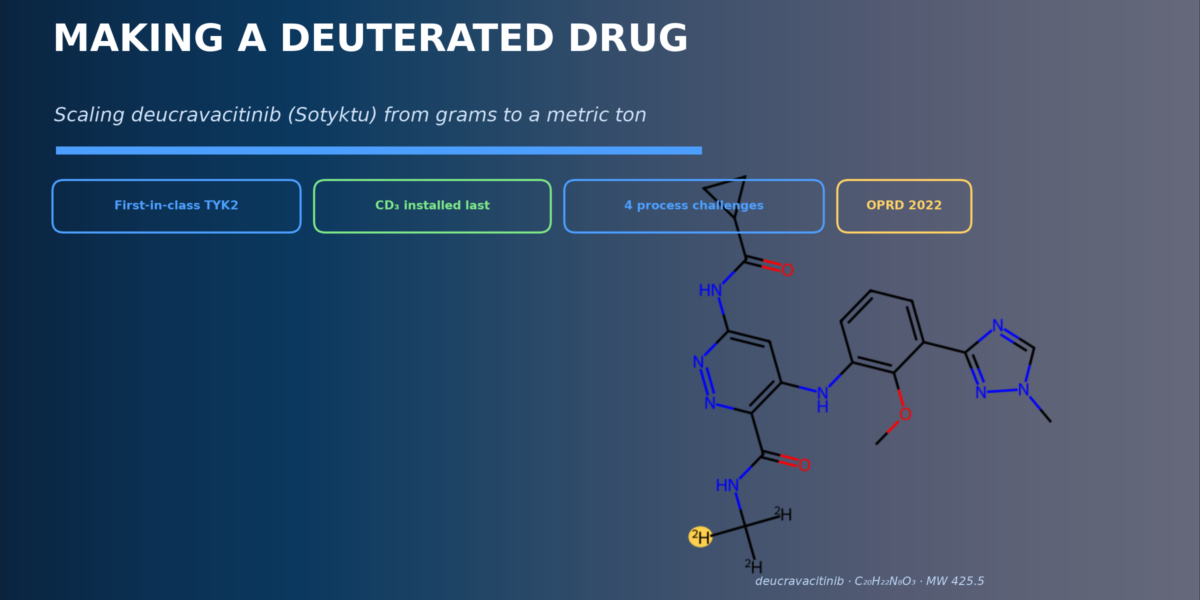
Why this molecule is special
Deucravacitinib (BMS-986165, brand name Sotyktu) is a first-in-class, oral TYK2 inhibitor approved for plaque psoriasis and being pursued across a range of autoimmune diseases — psoriatic arthritis, lupus, inflammatory bowel disease. It is unusual on two counts.
First, it doesn’t inhibit TYK2’s catalytic (ATP) site like most kinase drugs. It binds the pseudokinase (regulatory) domain, which is far less conserved across the JAK family — the structural basis for its selectivity over JAK1/2/3 and its clean safety profile.
Second, and central to this whole story: it is a deuterated drug. One methyl group on the molecule is a trideuteromethyl (CD₃) rather than an ordinary CH₃. That single isotopic edit slows a specific metabolic dealkylation (the C–D bond is harder to break than C–H — the kinetic isotope effect), improving the drug’s metabolic profile. It also means the synthesis carries an unusual constraint: CD₃ is expensive, so the process must install it as late as possible and waste none of it.
This is the challenge the process chemists faced: take a discovery route that could make kilograms, and turn it into a route that safely, cheaply, and cleanly makes more than a metric ton — while respecting the economics of deuterium.
The route at a glance
The commercial synthesis is convergent: two halves are built separately and then stitched together, with the precious CD₃ group added dead last.
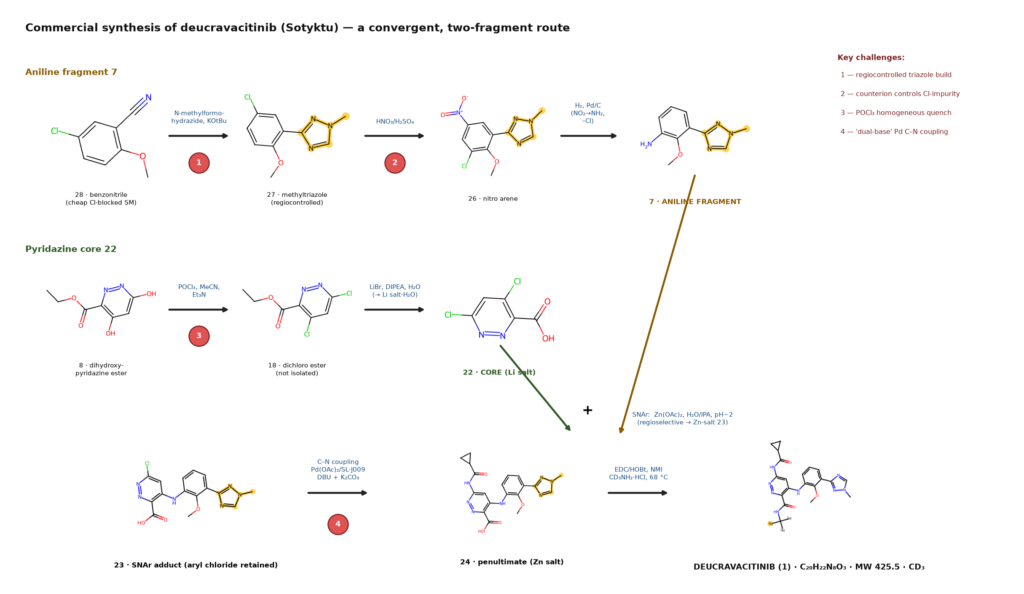
- Aniline fragment (7): a benzonitrile → methyltriazole → nitration → reduction sequence.
- Pyridazine core (22): a dihydroxypyridazine ester → dichlorination → mild ester hydrolysis to a stable lithium salt.
- Convergence: an SNAr joins the two, a palladium-catalyzed C–N coupling appends the cyclopropanecarboxamide, and the final amidation installs the CD₃ amide.
Four steps in that sequence each hid a genuinely hard problem. They are what make this paper worth reading.
Challenge 1 — Building the methyltriazole with the right regiochemistry
The aniline fragment carries a 1-methyl-1,2,4-triazole. The discovery route made it by methylating a pre-formed triazole — and that reaction had poor regioselectivity, alkylating the wrong ring nitrogen a large fraction of the time and dragging down yield.
The process solution was to not methylate at all. Instead they built the methylated triazole de novo from a nitrile — the cheap, chlorine-blocked benzonitrile 28 — using N-methylformohydrazide and a strong base (potassium tert-butoxide). This is a genuinely novel transformation: a direct nitrile-to-methyltriazole cyclocondensation that runs at low temperature and places the methyl group on the correct nitrogen by construction, because the reagent already carries the atoms destined for the ring. Because the methyl is built in with defined connectivity, the regiochemistry problem simply disappears.
The useful lesson: when a late-stage selectivity problem is intractable, the best fix is often to redesign the bond-forming step so the selectivity is never in question — here, building the ring pre-methylated rather than methylating a ring.
Challenge 2 — A counterion that quietly controls an impurity
A small, subtle, beautiful piece of process chemistry. The methyltriazole intermediate 27 was isolated as a salt for handling. The obvious choice, the hydrochloride (27-01), caused trouble two steps later: during the nitration, nitric acid oxidized the chloride counterion to an electrophilic chlorine species, which chlorinated the ring and produced a difficult-to-purge over-chlorinated impurity.
The fix was almost absurdly simple: switch the counterion. Isolating 27 as the bisulfate salt (27-02) instead of the hydrochloride removed the chloride source entirely, and the nitration went from messy to >99% clean.
The useful lesson: the counterion you pick for an intermediate isn’t just a handling decision — it can carry a reactive atom into a downstream step. Trace impurities sometimes trace back to a “spectator” ion that turns out not to be a spectator.
Challenge 3 — Quenching POCl₃ on a substrate that hates water
Converting the dihydroxypyridazine 8 to the dichloride 18 uses POCl₃ — routine chemistry. The problem is the workup. The standard way to destroy excess POCl₃ is a basic aqueous quench, but product 18 is hydrolytically fragile (both C–Cl bonds and the ester are labile), so the very conditions that neutralize the POCl₃ also chew up the product.
Worse, this failure was scale-dependent: controls that held hydrolysis to <1% in the lab gave ~3% on scale, because the quench mixture was biphasic — poor mixing and local hot-spots concentrated the damage where the phases met.
The solution was to engineer a homogeneous quench. By switching the reaction solvent to acetonitrile and raising the solvent loading (3 → 5 L/kg), the quenched mixture stayed single-phase — but only if water was added to the reaction, not the reaction to water (order of addition mattered, because early on the water/MeCN ratio would otherwise be too high and the mixture would split). Trimming the POCl₃ charge to just over stoichiometric (1.3 equiv per OH) cut the quench exotherm, and thermochemistry confirmed that even an uncontrolled quench (+29 °C adiabatic) wouldn’t run away.
The useful lesson: a workup can be the hardest part of a step. A quench that is fine in a flask can fail on scale for purely physical reasons — mixing, phase behavior, heat transfer — and the fix is often to make the system homogeneous so the chemistry stops depending on the stirring.
Challenge 4 — The “dual-base” palladium C–N coupling
The penultimate step is a palladium-catalyzed C–N coupling (Buchwald–Hartwig type) that installs the cyclopropanecarboxamide onto the aryl chloride of intermediate 23. This one fought them at every turn.
The substrate 23 is a zinc carboxylate salt with awkward solubility. Inorganic bases like K₃PO₄ worked only if jet-milled to tiny particle size (surface area limited the rate) — impractical for commercial supply. Switching to K₂CO₃ helped the impurity profile but, as a heterogeneous base, gave inconsistent rates on scale and agonizingly slow filtrations. A soluble organic base (DBU) dissolved everything and started fast — then stalled at ~50% conversion.
The breakthrough was a “dual-base” system: DBU plus K₂CO₃. Together they dissolved the substrate anddrove the reaction to completion faster than either base alone — a real synergy. With the dual base locked in, they optimized to a cheap, stable Pd(OAc)₂ / Josiphos SL-J009 catalyst system at low loading.
The useful lesson: base is not a passive spectator in Pd couplings. When one base gives solubility and another gives reactivity, a combination can beat either — and finding that combination unlocked a robust, scalable process.
The endgame: installing CD₃ cleanly, and taming seven impurities
The final step forms the CD₃ amide by coupling the penultimate acid 24 with trideuteromethylamine(handled as its HCl salt). The coupling itself is easy — an unhindered amine on an unhindered acid; 95 of 96 conditions in the initial screen gave product. The hard part was choosing an activator that didn’t smuggle in impurities:
- PyBroP worked beautifully but carried a pyrrolidine amide impurity whose level depended entirely on the lot of reagent (and got worse on storage) — a control nightmare.
- HATU avoided that but introduced a dimethylamide impurity, again lot-dependent.
- EDC/HOBt was as clean as either, with no lot-to-lot variation across six batches spanning 0–6 years old — and EDC is cheaper and more available in bulk. EDC won.
Even then, EDC brought its own family of side-products — the team ultimately identified and controlled seven EDC-related impurities (N-acylureas and their decomposition products, plus a dimethylamide from the urea byproduct). They were tamed by order of addition (to suppress premature decarboxylation of 24) and by tight control of the EDC charge, because product 1 crystallizes as the reaction proceeds and a stalled charge can entrap unreacted 24 in the growing crystals. This is why the process specifies an unusually precise 68 °C — hot enough to keep things dissolved and fast, controlled enough to avoid decarboxylation.
The useful lesson: for the API-forming step, reagent reproducibility can matter more than peak yield. A slightly lower-yielding reagent with zero lot-to-lot surprises is worth more at commercial scale than a high-yielding one whose impurity level you can’t predict.
The payoff: green, safe, and a metric ton
The redesigned route wasn’t just cleaner chemistry — it scored well on sustainability, hitting several of the 12 Principles of Green Chemistry:
- Atom economy on the expensive atom: CD₃ goes in last, so none of the costly deuterated material is carried through (and potentially lost in) earlier steps.
- Less-hazardous reagents: the discovery route’s hydrazine, methyl iodide, and metal silazide bases were all designed out.
- Energy efficiency: every operation runs between −10 and 70 °C, and only three of eight steps need distillation.
- Safer solvents: water and “green” solvents (alcohols, EtOAc, AcOH, 2-MeTHF) make up ~70% of the total; hazardous solvents (MTBE, NMP) only ~4%; no halogenated solvents at all.
The result was a process scaled repeatedly to >80–100 kg per batch, ultimately delivering more than a metric ton of deucravacitinib for clinical and commercial supply.
Takeaways for the bench and the plant
- Design selectivity in, don’t purify it out — the de novo methyltriazole build beat trying to control a bad methylation.
- “Spectator” ions aren’t — a hydrochloride counterion seeded a chlorination impurity two steps later.
- The workup is chemistry too — a homogeneous quench solved a scale-dependent hydrolysis that no amount of “careful” could.
- Bases can cooperate — DBU + K₂CO₃ did together what neither could alone.
- Reproducibility beats peak yield at the API step — EDC’s lot-to-lot consistency won over flashier reagents.
Process chemistry rarely makes headlines, but this is where a molecule becomes a medicine — manufacturable, affordable, and safe at scale. Deucravacitinib is a textbook example of the craft.
How a team at Bristol Myers Squibb turned a workable discovery route into a metric-ton commercial process for Sotyktu — the first-in-class TYK2 inhibitor — solving four hard chemistry problems along the way. Based on Treitler et al., Org. Process Res. Dev. 2022, 26, 1202–1222.