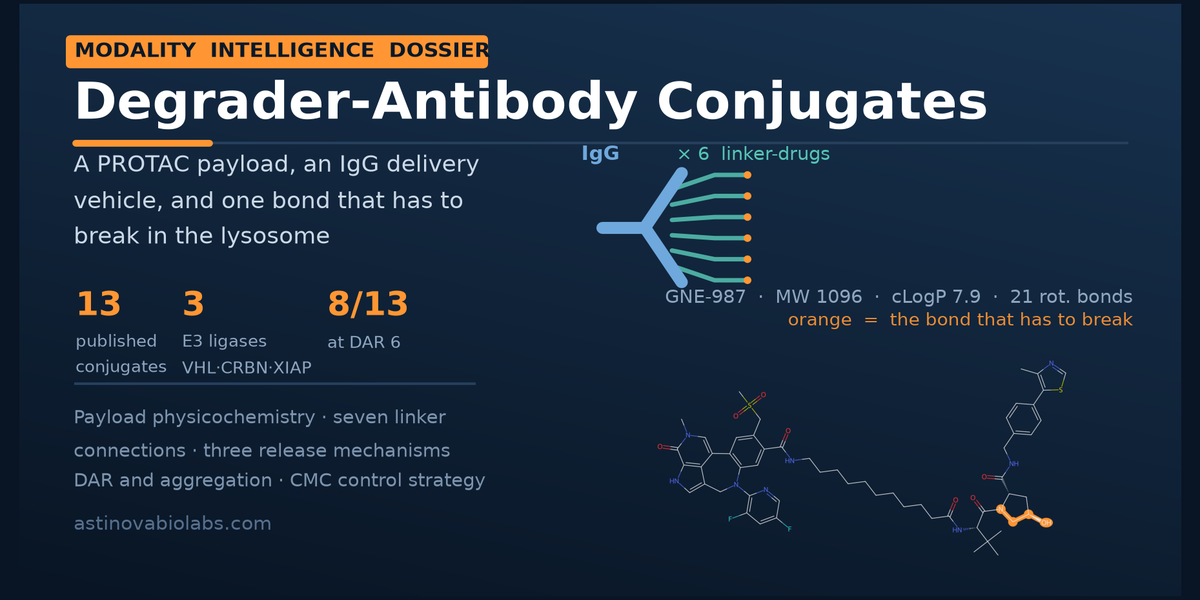
Mechanism: A degrader-antibody conjugate is an ADC whose payload is not a cytotoxin but a heterobifunctional protein degrader — a PROTAC or a molecular glue. The antibody supplies antigen-restricted delivery and IgG-like pharmacokinetics; the payload supplies a catalytic, sub-stoichiometric mechanism of action. After Fv-mediated antigen engagement the conjugate internalises, traffics to the lysosome (pH ≈ 4.5–5.0, cathepsin B/L, phosphatases), and the antibody is catabolised while the linker trigger is cleaved. The freed degrader must then survive that proteolytic compartment, escape it into the cytosol, and nucleate a ternary complex — protein of interest · degrader · E3 ligase — that drives polyubiquitination and 26S proteasomal destruction of the target. Because the degrader is not consumed, one delivered molecule can turn over many copies of the target, so pharmacodynamics outlast exposure in a way inhibitor payloads do not. Critically, the released species must be the unmodified degrader: a residual linker stub on the VHL hydroxyproline or on a cereblon glutarimide abolishes ternary-complex formation and the DAC does nothing. Refs: Dragovich, Chem. Soc. Rev.2022, 51, 3886 (DOI 10.1039/d2cs00141a); Pillow et al., ChemMedChem 2020, 15, 17; Dragovich et al., J. Med. Chem. 2021, 64, 2534 and 2576.
1. Why anyone bolts a PROTAC onto an antibody
Chimeric degraders are chimeric by construction, and they pay for it in DMPK. Two ligands plus a spacer lands you in a physicochemical regime — high molecular weight, high polar surface area, many rotatable bonds — where oral bioavailability is poor and clearance is fast. The degrader field’s own answer has been to engineer toward drug-likeness, which in practice has meant standardising on cereblon (CRBN), whose glutarimide ligands are the most tractable of the E3 recruiters. That route works and has delivered orally bioavailable clinical PROTACs.
Antibody conjugation is the other answer, and it buys three things the oral route cannot:
- In vivo delivery of degraders you would otherwise abandon — particularly VHL-, XIAP- and other non-CRBN-based chemotypes whose properties rule out oral dosing.
- Escape from heroic formulation. Unconjugated PROTACs frequently need non-standard vehicles to reach meaningful exposure. An IgG in saline does not.
- Tissue restriction. A degrader with a wide therapeutic target but a narrow acceptable tissue distribution can be aimed, via the antigen, at the tumour that needs it.
The price is that you inherit every failure mode of ADC development plus a set that is specific to degraders.
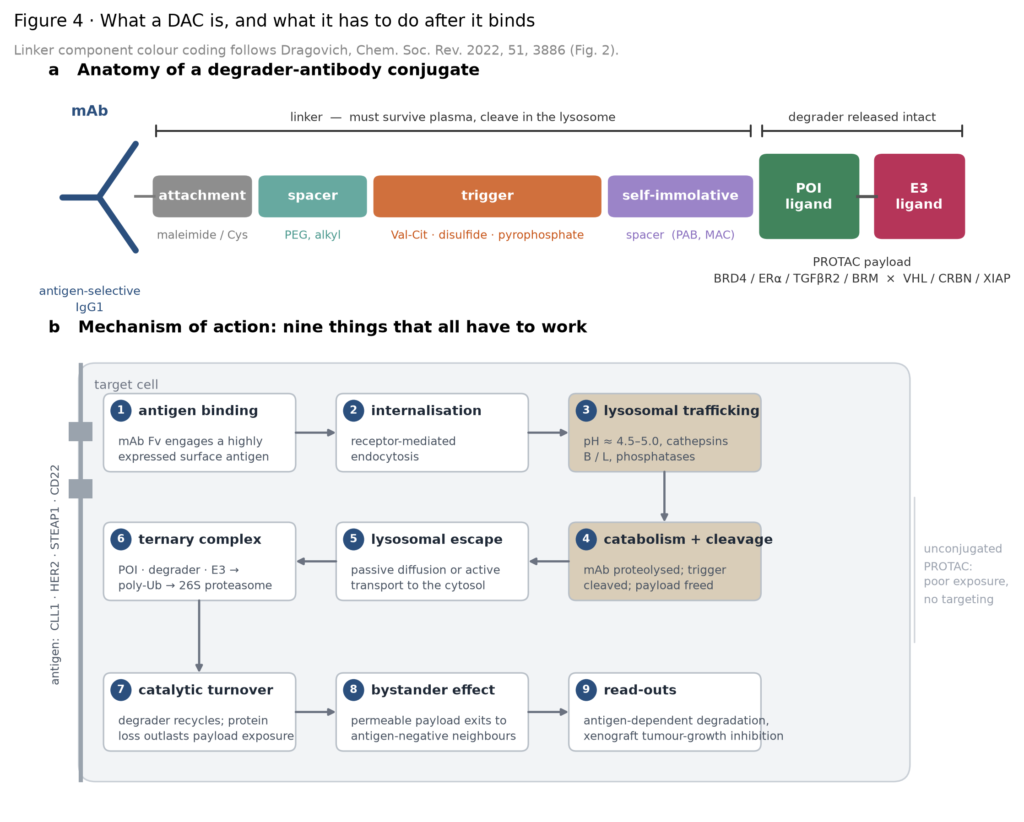
2. Anatomy: five components, each with its own failure mode
Reading left to right from the antibody: an attachment chemistry (maleimide, bifunctional electrophile, engineered Cys or non-natural amino acid), an optional spacer that distances the linker-drug from the protein surface, a trigger designed to be cleaved intracellularly, an optional self-immolative spacer, and the payload connection — the single bond that regenerates the free degrader.
The combined linker-plus-payload entity, the linker-drug, is what a synthesis group actually makes. It is a small molecule, it is chromatographically unpleasant, and it is the object on which a DAC programme lives or dies.
3. The payload problem, quantified
This is where DACs diverge from cytotoxic ADCs. Classical ADC warheads are small and potent: MMAE is MW 718, DXd is MW 493, and the auristatins, maytansinoids and PBD dimers all show sub-nanomolar antiproliferative IC50 values. Degrader payloads are neither small nor that potent.
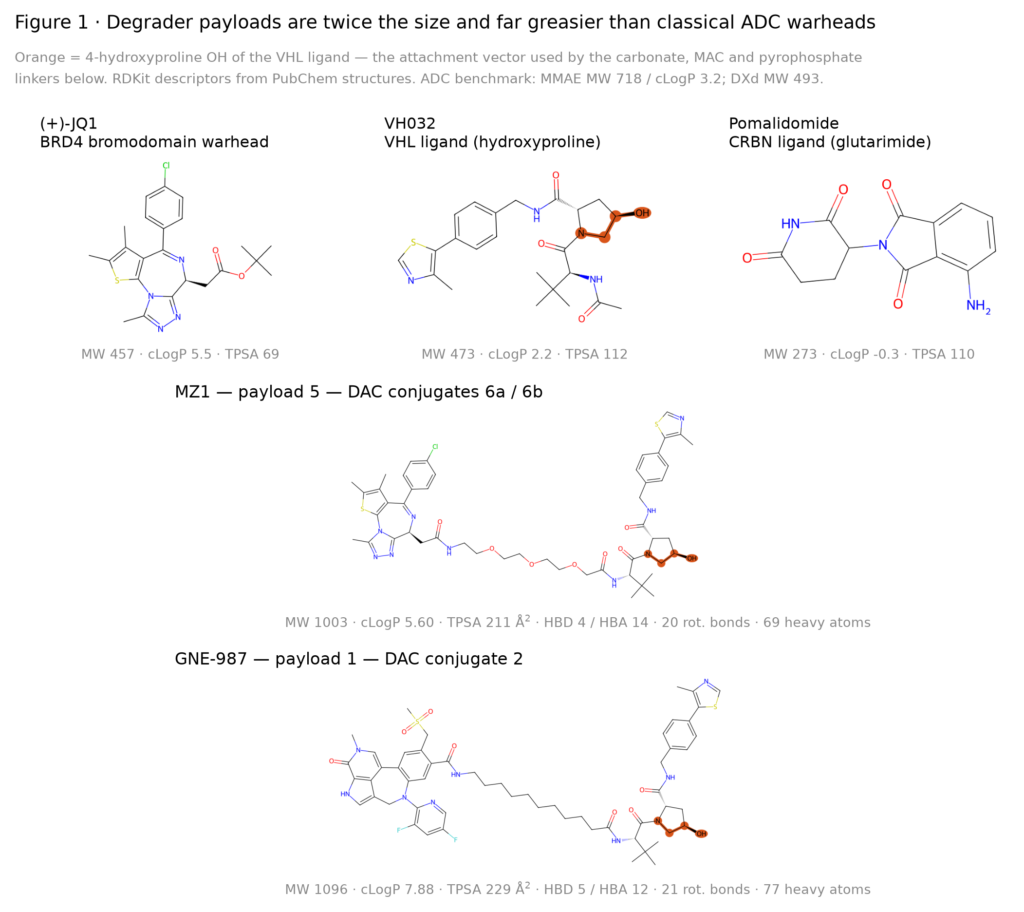
Descriptors computed with RDKit from the PubChem structures:
| Compound | Role | MW | cLogP | TPSA (Ų) | Rot. bonds | Heavy atoms |
|---|---|---|---|---|---|---|
| (+)-JQ1 | BRD4 warhead | 457 | 5.5 | 69 | 3 | 31 |
| VH032 | VHL ligand | 473 | 2.3 | 112 | 6 | 33 |
| Pomalidomide | CRBN ligand | 273 | −0.3 | 110 | 1 | 20 |
| MZ1 | BRD4/VHL PROTAC, payload in 6a/6b | 1003 | 5.60 | 211 | 20 | 69 |
| GNE-987 | BRD4/VHL PROTAC, payload in 2 | 1096 | 7.88 | 229 | 21 | 77 |
GNE-987 at cLogP 7.9 and MW 1096 is not a molecule you casually put six copies of on an IgG surface. Two consequences follow directly, and both showed up experimentally:
- Potency deficit → higher DAR. Degraders generally show weaker cellular degradation and phenotype potency than classical cytotoxins, so DAR must rise above the ADC norm of 2–4. Eight of the thirteen published DACs are DAR 6. This mirrors what happened to ADCs when the field moved to topoisomerase-1 inhibitors (DAR 4–8) and NAMPT inhibitors (DAR 8–10).
- Lipophilicity → aggregation. Attempted DAR 6 STEAP1 conjugates of the more potent BRD4 degrader 9 failed outright: extensive aggregation, no isolable material, and several related disulfide linker-drugs behaved the same way. The same degrader conjugated with a different linker, and the same linker on a different antigen, worked. Conjugation success is empirical and jointly determined by antibody, linker structure and payload lipophilicity — which is exactly the kind of finding that should make you build DAR-ladder screening into a programme early rather than committing to a target DAR on paper.
There is also a cleaner precedent worth holding onto: high DAR is not automatically fatal. A DAR 8 ADC delivered acceptable human pharmacokinetics without polar prodrugs or polymer linkers. The two standard mitigations — polar prodrug masking of linker-drug hydrophobicity during conjugation, and polar polymeric linkers — remain the tools of first resort when aggregation appears.
4. Seven ways to hang a PROTAC on an antibody
Here is the medicinal-chemistry problem that has no ADC analogue. Most published degraders contain no primary amine, and the amine is the handle the ADC linker toolbox was built around. You have two options, and both cost something.
Option A: install a handle. Primary or secondary amines and anilines were introduced at several positions on MZ1 without abolishing degradation. But every one of the modified degraders was a weaker BRD4 degrader than the parent in PC3-S1 cells — the added polarity plausibly impairing cell permeability. Instructively, an extracellular SPR assay showed that ternary-complex half-life correlated well with degradation activity, and the correlation improved when corrected for predicted permeability by immobilised artificial membrane measurement. That combination — SPR ternary-complex kinetics plus IAM permeability — is the right early screen for a DAC payload, because for a deliberately cell-impermeable payload you cannot use a cellular degradation assay to tell “no ternary complex” from “no cell entry.”
Option B: exploit what is already there. Hence the seven connection chemistries below.
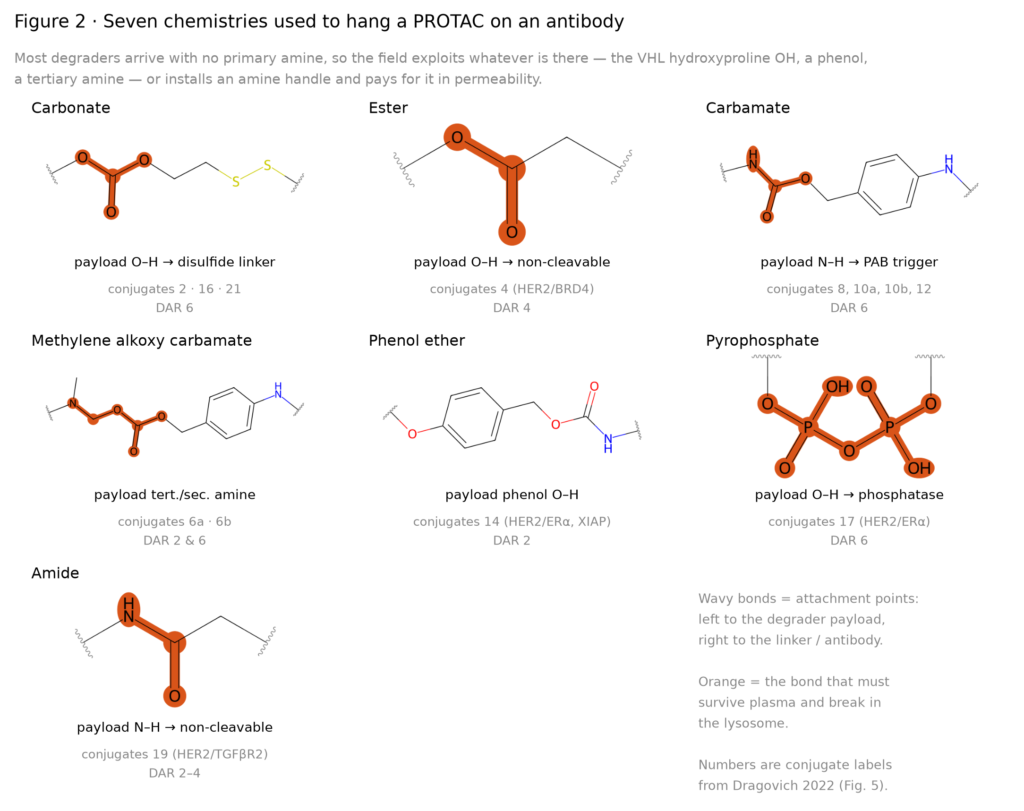
The 4-hydroxyproline OH of the VHL ligand is the workhorse vector — it carries the carbonate, methylene alkoxy carbamate (MAC) and pyrophosphate connections. The phenol-ether connection to an ERα degrader and the amide connection to a TGFβR2 degrader round out the set. And placement matters as much as chemistry: for the XIAP-based ERα degrader 13, the phenol-ether linkage gave an isolable, potently active DAR 2 conjugate, while attaching the same linker-drug through a carbamate to the secondary amine in the XIAP-binding region aggregated so badly the conjugate could not be isolated.
5. Release chemistry: the bond that has to break exactly once
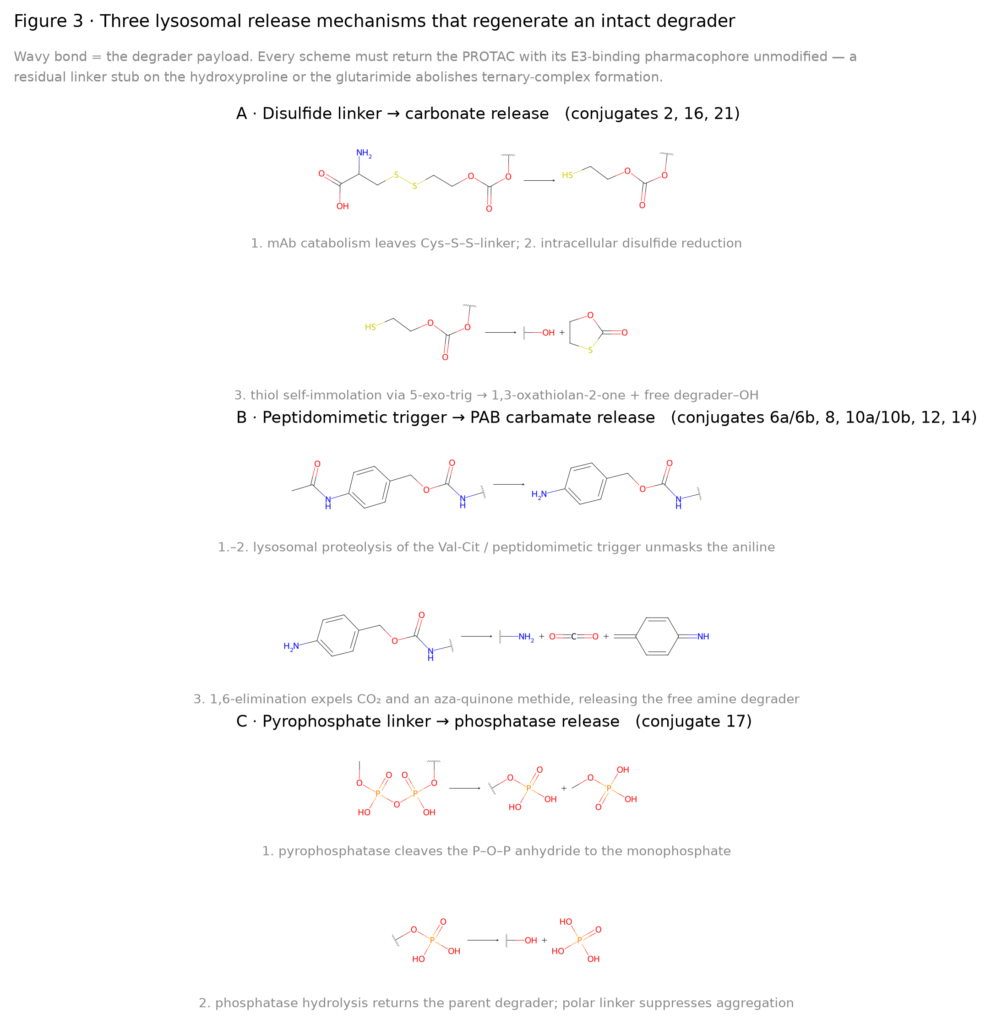
Three mechanisms cover the published set.
A · Disulfide → carbonate. Antibody catabolism leaves a cysteine disulfide-bonded to the linker; reduction gives a thiol that self-immolates onto the carbonate — a 5-exo-trig cyclisation expelling 1,3-oxathiolan-2-one and the free degrader alcohol. This is the chemistry of conjugates 2, 16 and 21. The carbonate looked like an obvious liability going in; it was not. In non-tumour-bearing mice the conjugate-2 carbonates were reasonably stable over 7 days, and clearance over 21 days matched the unconjugated CLL1 antibody. Reduction may well precede antibody catabolism; the ordering is not established.
B · Peptidomimetic or Val-Cit trigger → p-aminobenzyl carbamate. Lysosomal proteolysis unmasks the aniline, which triggers 1,6-elimination expelling CO₂ and an aza-quinone methide and releasing the amine degrader. This is the most-used route — conjugates 6a/6b, 8, 10a/10b, 12 and 14 — and it carries thirty years of ADC precedent behind it.
C · Pyrophosphate → phosphatase. Pyrophosphatase opens the P–O–P anhydride; a second phosphatase event returns the parent alcohol. Conjugate 17 used this on the VHL-binding region of an ERα degrader, and the highly polar linker is a direct answer to the aggregation problem in §3. The cleavage events here may not be lysosomal at all.
The non-cleavable cases sit outside this taxonomy: conjugate 4 (ester connection) and conjugate 19(amide connection) both rely on antibody catabolism alone, leaving the linker fragment permanently attached to the degrader. For 19 that fragment was evidently tolerated — the conjugate degraded TGFβR2 and not the related TGFβR1 in HER2-transfected HEK293 cells at 0.5–1.0 µM over 24–48 h.
6. The published landscape
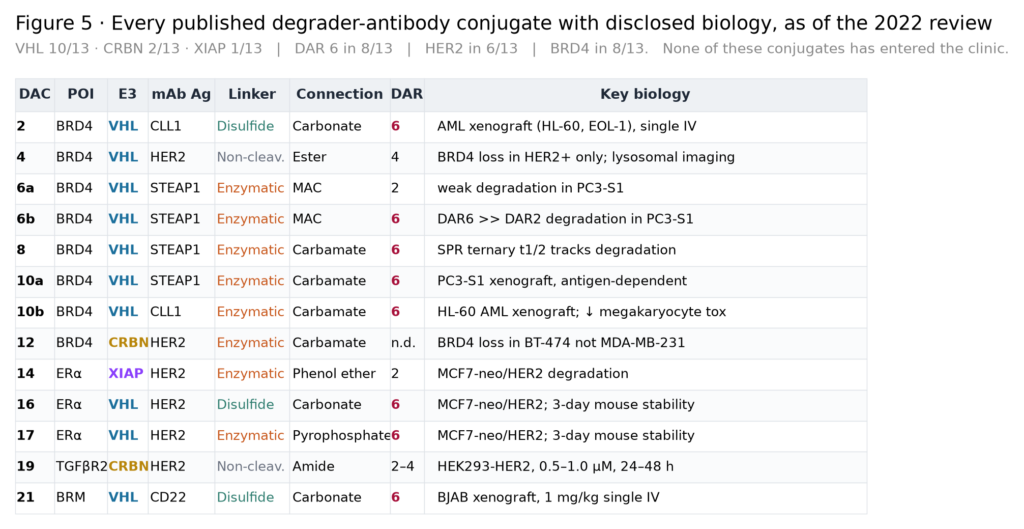
Thirteen conjugates, and the distribution is lopsided in a way that tells you what the field was doing rather than what it believed:
- E3 ligase: VHL 10, CRBN 2, XIAP 1. Precisely inverted relative to the oral degrader field — which makes sense, since antibody delivery removes the very constraint that pushes oral programmes toward CRBN.
- Protein of interest: BRD4 8, ERα 3, TGFβR2 1, BRM/SMARCA2 1. BRD4 is the tool-compound target of the degrader field, not a plausible DAC indication.
- Antigen: HER2 6, STEAP1 4, CLL1 2, CD22 1 — all well-precedented ADC antigens.
- DAR: 6 in eight of thirteen.
Four results carry the proof-of-concept:
Conjugate 2 (GNE-987 → CLL1, disulfide/carbonate, DAR 6). Dose-dependent efficacy in HL-60 and EOL-1 AML xenografts after a single IV dose, with a properly built control set: unconjugated CLL1 antibody inactive; the hydroxyproline-epimer payload conjugate inactive; the HER2-targeted conjugate of the same payload much less active at matched dose; and unconjugated GNE-987 inactive at an equivalent single IV dose. That last control is the whole argument for the modality — the payload works only when the antibody delivers it.
Conjugates 6a vs 6b (MZ1 → STEAP1, MAC connection). Same linker-drug, DAR 2 versus DAR 6, and the DAR 6 entity was markedly the better degrader in PC3-S1 cells. A separate DAR 2/DAR 6 pair showed the same thing at the level of measured intracellular payload concentration. Drug loading is a lever, not a formality.
Conjugates 10a/10b (degrader 9 → STEAP1 or CLL1, carbamate/peptidomimetic, DAR 6). Antigen-dependent efficacy in PC3-S1 and HL-60 xenografts respectively. The interesting number is a safety one: both conjugates were less toxic than the unconjugated degrader 9 in an in vitromegakaryocytopoiesis assay. Therapeutic-index expansion by conjugation is the commercial thesis of the modality, and this is the first quantitative hint of it — from one in vitro assay, with no in vivotoxicology behind it.
Conjugate 21 (BRM/SMARCA2 → CD22, disulfide/carbonate, DAR 6). A single 1 mg/kg IV dose gave strong, antigen-dependent BRM reduction in BJAB lymphoma xenografts. SMARCA2 is a genuinely interesting synthetic-lethal target, and CD22 extends the accessible antigen set into B-cell malignancy.
7. Process-development read-across
For a CDMO group taking on a DAC, the differences from an ADC programme are concentrated in the linker-drug, not the conjugation suite.
Linker-drug synthesis. You are making a 1200–1800 Da, highly functionalised, amphiphilic molecule with a deliberately labile bond in it. The convergent step is typically a late-stage acylation, carbonate/carbamate formation, or a bioorthogonal ligation — the SPAAC route used for conjugate 4 is a reasonable template when the trigger chemistry will not tolerate metal catalysis. Expect purification by reverse-phase chromatography rather than crystallisation, and expect the isolated form to be a lyophilised solid with no useful polymorph story.
Attachment chemistries in the published set. Interchain-cysteine maleimide (conjugate 12); dibromomaleimide thiol rebridging for DAR 4 homogeneity (conjugate 4); partial-reduction interchain maleimide for DAR 2–4 (conjugate 19); and engineered light- and heavy-chain cysteines for site-specific DAR 6 (conjugate 2). Site-specific approaches are worth their cost here for a specific reason: with a greasy payload, DAR heterogeneity and aggregation propensity are not independent, and homogeneity buys you an analytical baseline you will otherwise spend months chasing.
Control strategy — the DAC-specific items.
- Payload connection stability in plasma and whole blood, species-matched. The carbonate data above are the model: a 7-day in vivo stability read, not just a buffer assay.
- Free-payload and free-linker-drug in drug product. A degrader that liberates in circulation is an unconjugated PROTAC with all its original DMPK liabilities.
- Aggregation by SEC and by a light-scattering or sedimentation method, on every DAR level made, at intended formulation concentration. This is the failure mode that kills batches.
- Released-species identity by LC–MS. You must prove the released material is the parent degrader and not a linker-stub adduct. Confirm on the isolated degrader, not by inference from a cell assay.
- Ternary-complex formation (SPR or equivalent) on the payload and on any linker-stub species, plus an IAM or comparable permeability read. For cell-impermeable payloads this is the only orthogonal evidence that the pharmacology is intact.
- DAR and distribution by native MS or RP-HPLC, plus hydrophobicity distribution by HIC. The HIC profile of a DAR 6 greasy-payload conjugate is the single most informative one-page CMC readout you will generate.
Estimated linker-drug COGs (USD). Back-of-envelope, GMP, kilogram-scale linker-drug (not the conjugate): $180,000–600,000 / kg. Drivers: two independent ligand syntheses converging late, 12–20 total steps across the longest linear sequence, chromatographic purification of every late intermediate, a labile connection that restricts workup and drying conditions, and typical 15–30 % overall yield. At DAR 6 you need roughly 40–55 g of linker-drug per kg of conjugated antibody, so linker-drug contributes on the order of $8,000–33,000 per kg of DAC drug substance — material but not dominant next to the mAb and the conjugate-stage fill/finish. Treat as an order-of-magnitude planning figure, not a quote.
8. Where the clinic actually went
The 2022 literature is a VHL/BRD4 story. The clinic is not. The programmes that reached first-in-human took the opposite bet: CRBN-recruiting molecular glue payloads degrading the translation-termination factor GSPT1 — whose loss activates the integrated stress response and drives apoptosis — hung on clinically validated antibodies.
What the public record establishes, stated at the resolution I could confirm:
- ORM-5029 (Orum Therapeutics), described as a highly potent GSPT1 degrader targeting HER2, went into a first-in-human, open-label Phase 1 dose-escalation and expansion study in patients with HER2-expressing advanced solid tumours (J. Clin. Oncol. 2023, 41(16 suppl), TPS1114). Exploratory pharmacodynamic biomarker work on breast-cancer patients from that Phase 1 was presented at AACR in 2023.
- Orum issued a program update and nominated a new drug candidate on 28 April 2025.
- Bristol Myers Squibb discontinued a $100 M Orum degrader-antibody conjugate after reviewing Phase 1 data, reported in mid-September 2026.
- ORM-1153, a CD123-GSPT1 degrader-antibody conjugate, received US FDA clearance of its IND application, announced 23 August 2026.
I have not verified the following at source and they should be checked before you rely on them: the trial registry identifiers; the identity, antibody and target antigen of the BMS-partnered asset; the antibody and payload composition of ORM-5029; the indication, combination partners or planned enrolment of any of these studies; and whether the April 2025 update concerned ORM-5029 specifically.
Even at that resolution the shape is clear, and it is sobering: a first-in-human HER2 programme that ran from 2023 and is no longer being advanced, a partnered asset dropped by a large pharma on first sight of Phase 1 data, and one fresh IND. For a modality four years past its preclinical proof-of-concept, that argues for reading the chemistry above as an unsolved linker-and-hydrophobicity engineering problem rather than a solved delivery problem — the antigens were validated, the antibodies were validated, the degradation pharmacology was validated, and the conjugates still did not convert.
9. What would have to be true
The open questions from the 2022 review are, as far as the public record goes, still open:
- Is DAR 6 actually necessary, or is it an artefact of using tool-compound payloads with mediocre degradation potency? A genuinely potent payload at DAR 2–4 would remove the aggregation and clearance problem at a stroke.
- Which PROTACs are conjugable? There is no predictive model. Aggregation outcomes depend jointly on antigen, linker and payload, and the only reliable read is to make the conjugate.
- Does conjugation widen the therapeutic index in vivo? One in vitro megakaryocyte assay is where the evidence stops.
- Do the proof-of-concept models transfer? Most of the published biology is in engineered antigen-expressing lines — PC3-S1, MCF7-neo/HER2, HEK293-HER2 — and xenografts. Disease-relevant models are the gap.
For a process-development group the practical conclusion is narrower and more actionable: the DAC-specific risk sits in the payload connection and the hydrophobicity budget. Get the connection-stability and HIC/SEC packages built before you commit to a DAR, and design the linker-drug synthesis so the labile bond is formed as late as chemically possible.
Key references
- P. S. Dragovich, Degrader-antibody conjugates, Chem. Soc. Rev. 2022, 51, 3886–3897. DOI 10.1039/d2cs00141a — the tutorial review this dossier is built on.
- T. H. Pillow et al., ChemMedChem 2020, 15, 17 — GNE-987/CLL1, conjugate 2.
- M. Maneiro et al., ACS Chem. Biol. 2020, 15, 1306 — HER2/BRD4 ester-linked conjugate 4.
- P. S. Dragovich et al., J. Med. Chem. 2021, 64, 2534 — MZ1/STEAP1, MAC and carbamate connections, SPR/IAM analysis.
- P. S. Dragovich et al., J. Med. Chem. 2021, 64, 2576 — degrader 9, conjugates 10a/10b, DAR 6 aggregation failures.
- P. S. Dragovich et al., Bioorg. Med. Chem. Lett. 2020, 30, 126907 — ERα conjugates 14, 16, 17.
- M. Zengerle, K.-H. Chan, A. Ciulli, ACS Chem. Biol. 2015, 10, 1770 — MZ1.
- J. D. Bargh, A. Isidro-Llobet, J. S. Parker, D. R. Spring, Chem. Soc. Rev. 2019, 48, 4361 — ADC linker chemistry.
- T. Doi et al., Lancet Oncol. 2017, 18, 1512 — DAR 8 with acceptable human PK.
- J. Clin. Oncol. 2023, 41(16 suppl), TPS1114 — Phase 1, first-in-human, open-label escalation and expansion study of ORM-5029 in HER2-expressing advanced solid tumours (trial-in-progress abstract).
- Cancer Res. 2023, 83(7 suppl), Abstract 2118 — RNAscope multiplex pharmacodynamic biomarker assay, ORM-5029 Phase 1 breast-cancer patients.
- Orum Therapeutics, “Provides Program Update and Announces Drug Candidate Nomination”, 28 April 2025.
- Orum Therapeutics, “U.S. FDA Clearance of an IND Application for ORM-1153, a Novel CD123-GSPT1 Degrader-Antibody Conjugate”, 23 August 2026.
- Fierce Biotech, “BMS dumps $100M Orum degrader-antibody conjugate after glimpsing phase 1 data”, mid-September 2026.