
Mechanism: Giredestrant (GDC-9545) is an oral, non-steroidal, highly potent selective estrogen receptor degrader (SERD). It binds the ERα ligand-binding domain and antagonises the transcriptional activity of both wild-type and mutant ESR1 (e.g. Y537S, D538G) while inducing degradation of the ERα protein with no residual agonism — the deliberate contrast to first-generation SERMs/SERDs. Structurally it is a (1R,3R)-cis-1-aryl-3-methyl-tetrahydro-β-carboline whose basic 1-(3-fluoropropyl)azetidin-3-ylamino side chain projects out of the pocket to destabilise helix 12 and lock the receptor in its antagonist conformation; recent work shows it also immobilises ERα on chromatin, a degradation-independent contribution to antitumour effect. Reporter potency is sub-nanomolar (ERα antagonist IC50 ≈ 0.05 nM; MCF-7 antiproliferative EC50 ≈ 0.4 nM), with activity retained in endocrine-resistant and Y537S-mutant lines and wide off-target margins (hERG IC50 6.1 µM). The approved regimen pairs it with everolimus because co-targeting ER and mTORC1 is synergistic and blunts the dominant PI3K/AKT/mTOR escape route after CDK4/6 inhibition. ERα co-crystal: PDB 7MSA. Refs: J. Med. Chem. 2021 (PMID 34251202); Zhou W et al., Cell Chem. Biol. 2026 (PMID 42161265).
t½: 43 h at steady state (CV 15%), apparent clearance 5.9 L/h — a long half-life that comfortably supports once-daily dosing with a forgiving missed-dose profile · Tmax: median 3 h; steady state by Day 8; absolute oral bioavailability 58%; no clinically significant food effect (PI §12.3).
Synthesis Route of the Originator
The commercial route is disclosed in WO2019245974A1 / US10,954,234 B2 (Genentech/Roche, priority 2018) and by the Roche process group (Xu et al., Org. Process Res. Dev. 2022, 26, 568–582). Giredestrant has two stereocentres, both R, and the whole route is organised around setting them cheaply. C3 (the methyl-bearing carbon) is imported, not made: Boc-D-alaninol is converted to a chiral cyclic sulfamidate and opened by a low-order indolyl cuprate (indole / CuCl / MeMgCl, −20 °C) with 97:3 C3/N1 regioselectivity — deliberately replacing the classical, hazardous nitroalkane route to chiral α-substituted tryptamines. Boc removal gives (R)-α-methyltryptamine in 99.2% ee; a cyclic-sulfate alkylation then installs the 2,2-difluoro-3-hydroxypropyl N2 arm in one step (97.6%). In parallel, 4-bromo-2,6-difluorobenzaldehyde is masked as its diethyl acetal, coupled with 1-(3-fluoropropyl)azetidin-3-amine under BrettPhos Pd G3 (1 mol% Pd), and unmasked to the convergent aldehyde (84.3%). C1 is set last and thermodynamically: a crystallization-driven diastereoselective Pictet–Spengler with L-tartaric acid (EtOH, 70 °C, seeded, 2 days) funnels the cis/trans mixture into the single (1R,3R)-tartrate — the registered drug substance — in 78% yield, with no chromatography and no chiral resolution. This tartaric-acid ring closure, acting as both catalyst and crystallising counterion, is the keystone of the process IP and the economics.
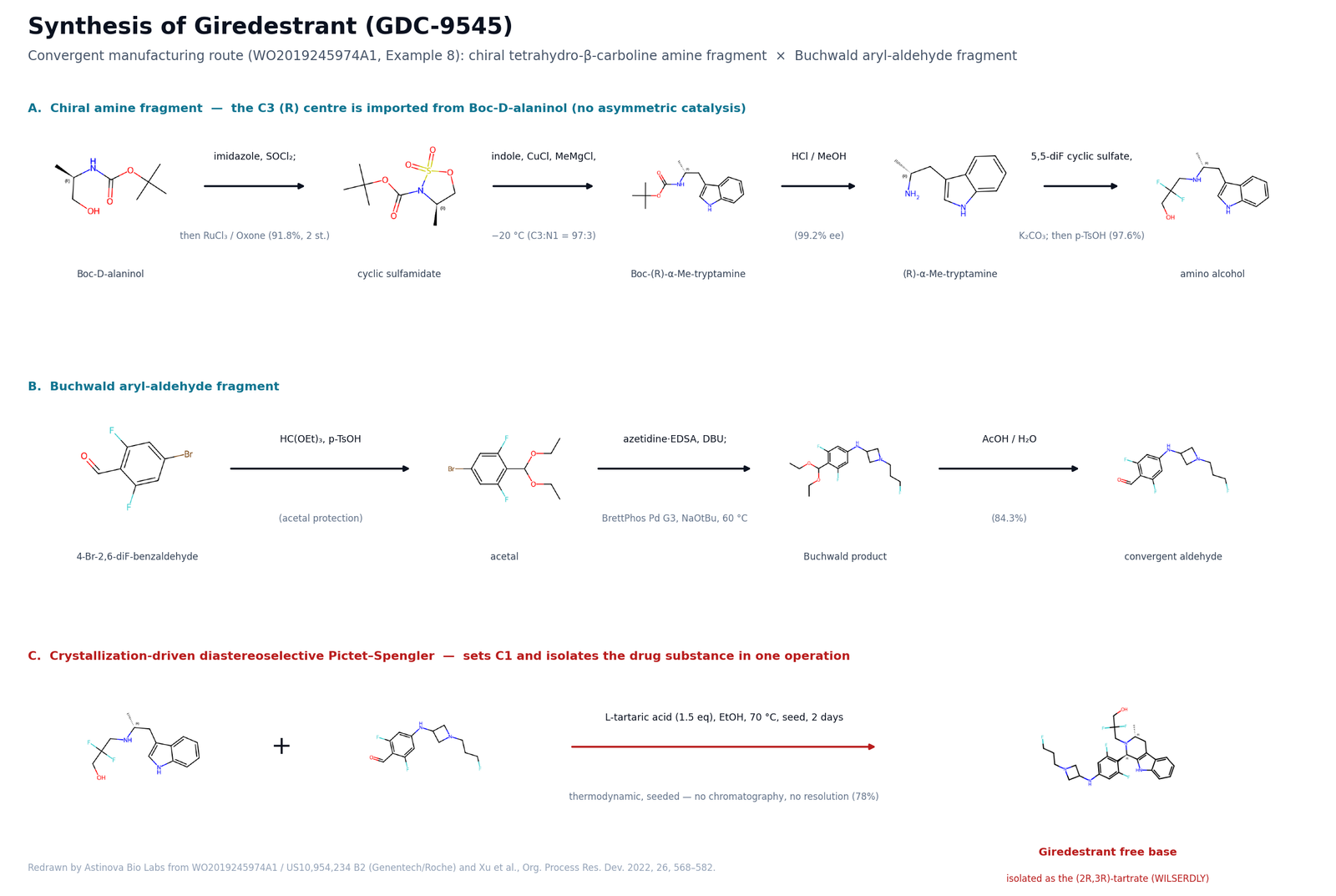
Reagents and conditions: (1) imidazole, SOCl2, DCM, −5→0 °C; then RuCl3·xH2O (cat.) / Oxone, 0→22 °C — 91.8% over two steps. (2) indole (1.5 eq), CuCl (1.3 eq), MeMgCl (1.33 eq), DCM, −20→−10 °C — C3:N1 97:3 (the chloride-only Mg/Cu system is essential; MeMgBr/CuCl collapses to 45:54). (3) HCl/MeOH, 0→30 °C — 99.2% ee, inherited intact from Boc-D-alaninol. (4) 5,5-difluoro-1,3,2-dioxathiane 2,2-dioxide (1.07 eq), K2CO3, MeCN, 80 °C; then p-TsOH·H2O / H2O — 97.6%. (i) HC(OEt)3, p-TsOH, toluene. (ii) azetidine·EDSA freebased with DBU, NaOtBu, BrettPhos Pd G3 (1 mol%), toluene, 60 °C; SiliaMetS Thiol scavenge. (iii) AcOH / H2O — 84.3%. (5) L-tartaric acid (1.5 eq), EtOH, 70 °C, 0.5 mol% seed, 2 days — 78%, isolated directly as the (2R,3R)-tartrate. [WO2019245974A1, Examples 5, 6 and 8.]
Key intermediates
All intermediates trace to cheap chiral-pool and commercial building blocks; the single physical stereocentre (C3) is carried with retention as (R) throughout, and C1 is set only at the final crystallisation.

| Label | Name | Role / sourcing |
|---|---|---|
| SM-1 | Boc-D-alaninol | Chiral-pool source of the C3 (R) centre — no asymmetric catalysis anywhere in the route. |
| INT-1 | (R)-cyclic sulfamidate | From alaninol (imidazole/SOCl2; RuCl3/Oxone), 91.8% over 2 steps. |
| INT-2 | Boc-(R)-α-methyltryptamine | Cu(I)-mediated regioselective C3 indole alkylation, C3:N1 97:3. |
| INT-3 | (R)-α-methyltryptamine | Boc removal (HCl/MeOH); 99.2% ee. |
| SM-2 | 5,5-difluoro cyclic sulfate | Electrophile that installs the gem-difluoro N2 arm in one step. |
| INT-4 | (R)-2,2-difluoro amino alcohol | Cyclic-sulfate alkylation, 97.6% — the chiral secondary amine entering the Pictet–Spengler. |
| SM-3 | 1-(3-fluoropropyl)azetidin-3-amine | Shipped as the crystalline EDSA salt (note: 1-bromo-3-fluoropropane is an ICH M7 genotoxic alkylator requiring control). |
| SM-4 | 4-bromo-2,6-difluorobenzaldehyde | Supplies both ortho-fluorines of the pharmacophore and the C–Br handle. |
| INT-5 | convergent aldehyde | BrettPhos Pd G3 Buchwald–Hartwig on the acetal, then hydrolysis; 84.3%. |
| API | Giredestrant (free base) | Crystallization-driven diastereoselective Pictet–Spengler with L-tartaric acid, 78%; isolated as the (2R,3R)-tartrate. |
Crystal Forms, Salts & Solid-State Profile
Drug substance: the marketed API is giredestrant L-(2R,3R)-tartrate, not the free base (PI §11: C27H31F5N4O · C4H6O6; 522.55 g/mol free base, 672.64 g/mol salt). Product: a single 30 mg capsule strength (= 38.62 mg tartrate; pink cap / brown body, printed “GIR 30”). Absolute oral bioavailability is 58%, so the salt choice is doing real work on dissolution/permeability — and because the tartrate is the diastereoselectivity-driving counterion, a competing salt form would also require a different route. Roche claims an extensive solid-form estate in WO2019245974A1 (free base, tartrate, fumarate, malonate; crystalline Forms A–G, Form 1/2, amorphous), with a second-generation family (CN119156386A, priority 2022) extending cover toward ~2042.
Clinical & Regulatory Profile
Approval (US): 2026-11-16, brand WILSERDLY, as a regular (traditional) approval via Project Orbis — four weeks ahead of the goal date. Indication (PI §1): in combination with everolimus, for adults with ER+, HER2−, ESR1-mutated locally advanced or metastatic breast cancer (FDA-authorized test) whose disease recurred during/after adjuvant endocrine therapy or progressed on ≥1 endocrine-based regimen in the metastatic setting — practically a post-CDK4/6-inhibitor, ctDNA-ESR1-selected 2L/3L position, and the first oral SERD approved as a combination with an mTOR inhibitor rather than as monotherapy. Companion diagnostic: FoundationOne Liquid CDx (plasma ctDNA ESR1 ligand-binding-domain mutations).
Pivotal trial — evERA (NCT05306340, Phase III, N=373): in the ESR1-mutated population, giredestrant + everolimus gave PFS HR 0.38 (95% CI 0.27–0.54, p<0.0001), medians 10.0 vs 5.5 months, ORR 27% vs 14% (Mayer EL et al., N Engl J Med 2026;395(13):1285–1298; PMID 42814929). A separate early-stage adjuvant application (lidERA; iDFS HR 0.70) is under Priority Review with a PDUFA date of 2026-11-30.
PK / ADME highlights
t½ 43 h (once-daily dosing); Tmax ~3 h; F 58%; plasma protein binding >98%. Primarily CYP3A-metabolised — strong CYP3A inhibitors (itraconazole AUC ↑~4×) and inducers (carbamazepine AUC ↓~24%) are to be avoided. No clinically significant food effect, and no dose adjustment for hepatic impairment (Child-Pugh A–C) or mild–moderate renal impairment. The class cardiac signal is bradycardia (mean HR ↓~7 bpm, plateauing by 2 weeks), not QT prolongation (hERG IC50 6.1 µM).
Key references & source trail
- FDA oncology approval notice — giredestrant + everolimus (ER+, HER2−, ESR1-mutated advanced breast cancer), action date 2026-11-16.
- WILSERDLY (giredestrant) capsules, US Prescribing Information, rev. 11/2026.
- Mayer EL, Tolaney SM, Martin M, et al.; evERA Breast Cancer Investigators. Giredestrant plus Everolimus in Advanced Breast Cancer. N Engl J Med 2026;395(13):1285–1298. PMID 42814929.
- Giredestrant discovery & medicinal chemistry: J. Med. Chem. 2021 (PMID 34251202).
- Zhou W et al., chromatin immobilisation by giredestrant, Cell Chem. Biol. 2026 (PMID 42161265).
- Process chemistry: Xu et al., Org. Process Res. Dev. 2022, 26, 568–582 (DOI 10.1021/acs.oprd.1c00263); patent WO2019245974A1 / US10,954,234 B2.