
The problem: the other cholinesterase
In early Alzheimer’s disease, acetylcholinesterase (AChE) does most of the work terminating cholinergic signaling. But as the disease advances, AChE activity falls while butyrylcholinesterase (BChE) rises — in late-stage AD, BChE becomes the dominant hydrolase controlling synaptic acetylcholine. That makes selective BChE inhibition an attractive, stage-appropriate strategy: raise ACh where it matters without the dose-limiting peripheral, parasympathomimetic toxicity that comes with hitting AChE.
The catch: despite decades of BChE inhibitors, only one cymserine derivative (bisnorcymserine) has reached the clinic. The field needs new, selective, brain-penetrant chemotypes with demonstrated in vivo efficacy.
The strategy: a selective carbamate warhead on a pyrrolidine scaffold
Gobec and co-workers (Ljubljana, with structural work from Brazzolotto/Nachon) built a series of N-alkylpyrrolidine carbamates and optimized for three things at once: hBChE potency, selectivity over hAChE, and CNS exposure. Structure-guided SAR across the aryl carbamate and the pyrrolidine N-substituent converged on (S)-(+)-14, the (S)-enantiomer of an N-benzylpyrrolidine naphthyl-carbamate.
The chemistry: building the enantiopure carbamate
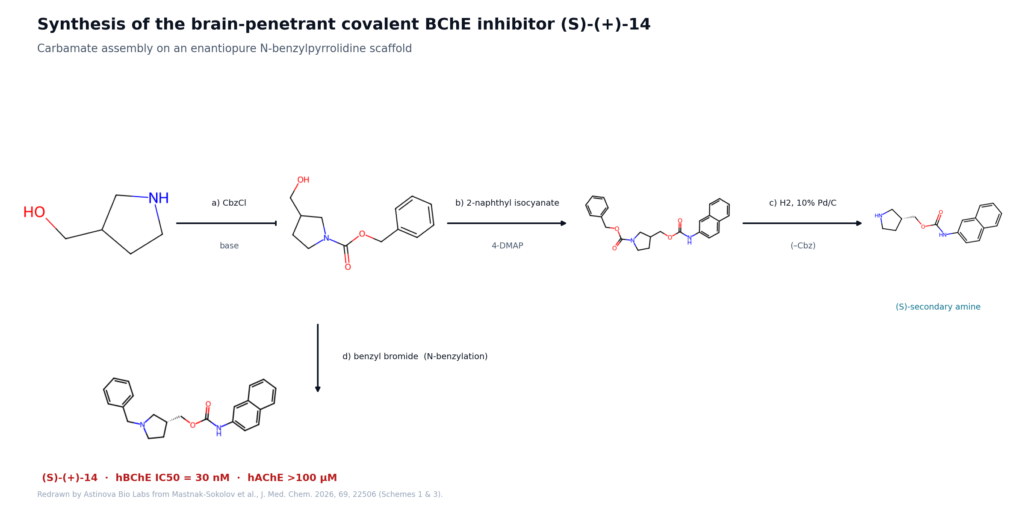
(S)-(+)-14 is (S)-(1-benzylpyrrolidin-3-yl)methyl naphthalen-2-ylcarbamate (C23H24N2O2). The route is short and convergent: Cbz-protect the pyrrolidine nitrogen of enantiopure pyrrolidin-3-ylmethanol; form the carbamate with 2-naphthyl isocyanate (DMAP); remove the Cbz by hydrogenolysis; and N-benzylate with benzyl bromide. The single stereocenter is carried through from a commercial enantiopure building block (98% ee).
The mechanism: carbamoylation of the catalytic serine

Like rivastigmine, (S)-(+)-14 is a covalent, pseudo-irreversible inhibitor. The catalytic Ser198 attacks the carbamate carbonyl, transferring the naphthyl-carbamoyl group onto the enzyme and releasing the (1-benzylpyrrolidin-3-yl)methanol leaving group. The carbamoyl-enzyme is catalytically dead and reactivates only slowly by decarbamoylation. Kinetically this shows up as time-dependent inhibition — IC50 falls with preincubation — the signature of covalent engagement.
Two numbers make the case: hBChE IC50 = 30 nM, and hAChE IC50 > 100 µM (no measurable AChE inhibition). That is the clean BChE selectivity the strategy demands.
The structural proof: caught on Ser198

The X-ray structure of the enzyme–inhibitor complex (PDB pdb_000030gy) shows exactly what the kinetics imply: the naphthyl-carbamoyl group covalently bonded to Ser198, with the catalytic triad (Ser198–His438–Glu325) intact and the released N-benzylpyrrolidinyl-methanol leaving group still sitting in the active-site gorge. A companion structure of the non-reactive analogue compound 9 (pdb_000030gx) captures the pre-reaction, non-covalent pose — together they bracket the reaction coordinate. The (S) configuration of the leaving-group alcohol modeled in the gorge rationalizes the enantiopreference.
The in vivo payoff: procognitive, clean
- Brain-penetrant. Predicted CNS+ in PAMPA-BBB (Papp ~314 nm/s) and achieves brain exposure after intraperitoneal dosing in mice.
- Metabolically stable in human-hepatocyte assays — good enough to support in vivo work.
- Procognitive. As the L-tartrate salt (10 mg/kg i.p.), it reverses scopolamine-induced cognitive impairment in mice across two paradigms — fear-conditioned passive avoidance and novel object recognition — without cholinergic adverse effects or motor deficits.
Why it matters
- A validated, stage-appropriate AD lead. A selective, brain-penetrant covalent BChE inhibitor with demonstrated procognitive efficacy and a solved co-crystal is exactly what a thin clinical pipeline needs.
- Selectivity by design, not luck. The carbamate warhead plus the N-benzylpyrrolidine scaffold delivers >3,000-fold BChE/AChE selectivity — the key to avoiding peripheral cholinergic toxicity.
- A clean covalent handle. A carbamate that carbamoylates Ser198 and decarbamoylates slowly gives durable, time-dependent inhibition that still reverses — a tunable middle ground between reversible and irreversible chemistry.
Reference: Mastnak-Sokolov, P.; Košak, U.; Meden, A.; Knez, D.; Žakelj, S.; Horvat, S.; Pišlar, A.; Kljun, J.; Igert, A.; Dias, J.; Nachon, F.; Brazzolotto, X.; Novak, M.; Rydlova, V.; Zdarova Karasova, J.; Soukup, O.; Manik, A.; Detka, J.; Sałat, K.; Gobec, S. “Structure-Guided Design of a Brain-Penetrant Covalent Inhibitor of Human Butyrylcholinesterase with In Vivo Procognitive Efficacy.” J. Med. Chem. 2026, 69, 22506–22538. DOI: 10.1021/acs.jmedchem.6c01737. Open access under CC-BY 4.0.
All visuals are original to Astinova Bio Labs: the synthesis scheme and mechanism drawn with RDKit/Matplotlib; the covalent-complex view rendered with 3Dmol.js from the deposited co-crystal PDB pdb_000030gy. No paper figures were reused.
Astinova Bio Labs designs and makes molecules like these — covalent warhead and scaffold design, enantioselective synthesis, and structure-based binding analysis. Talk to us about your target.