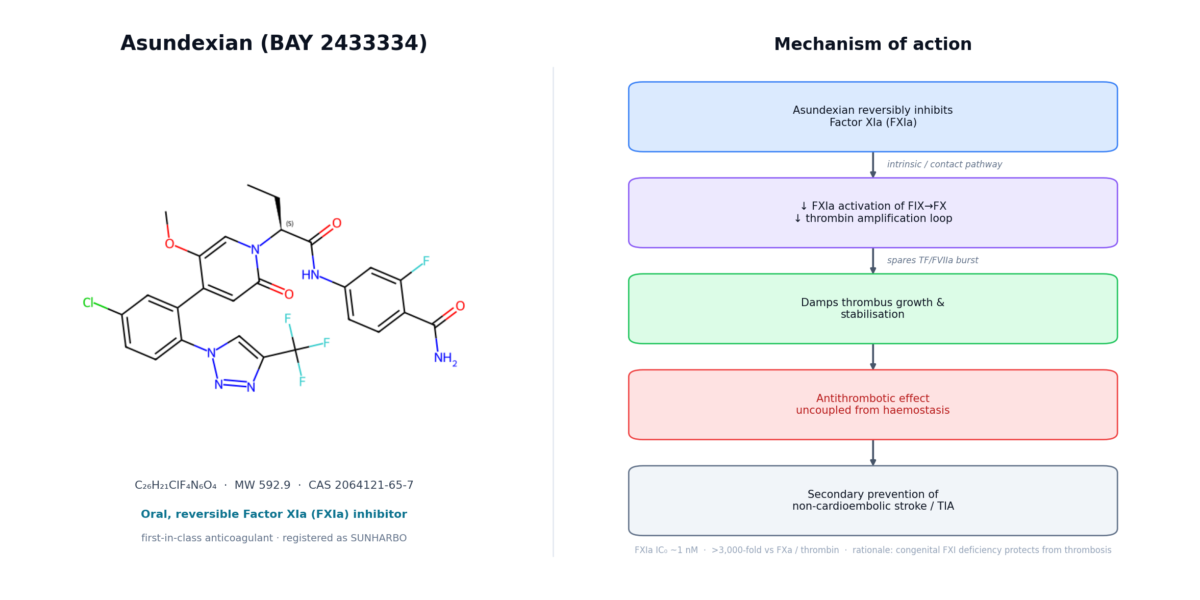
Mechanism: Asundexian (BAY 2433334) is a small-molecule, reversible, orally bioavailable direct inhibitor of activated coagulation Factor XI (FXIa). FXIa drives downstream activation of Factor X — and therefore thrombin generation — through the intrinsic (contact) pathway, and thrombin in turn activates Factor XI in a positive-feedback loop that amplifies and stabilises a growing thrombus. Inhibiting FXIa damps that amplification loop while largely sparing the tissue-factor/FVIIa haemostatic burst that seals a vascular injury — the mechanistic basis for uncoupling thrombosis from haemostasis. The human-genetic rationale is strong: congenital Factor XI deficiency is associated with protection from ischaemic stroke and venous thrombosis without spontaneous bleeding. Asundexian inhibits human FXIa with IC50 ~0.9–1.2 nM, with >3,000-fold selectivity over the downstream proteases FXa (7,210 nM) and thrombin (6,270 nM) and ~6–15-fold over plasma kallikrein. At 50 mg once daily it inhibits FXIa activity by 97% at peak and 93% at trough, prolonging aPTT concentration-dependently with no clinically relevant change in PT/INR; no routine monitoring is recommended, and there is no specific reversal agent (94% plasma-protein bound, not dialyzable).
t½: ~24 h at the 50 mg dose (apparent oral clearance 2.2 L/h; ~1.5-fold accumulation; steady state in 3–5 days) — supporting unmonitored once-daily dosing · Tmax: median 3 h; no clinically significant food effect; the tablet is explicitly crushable and NG/G-tube compatible for a dysphagic post-stroke population (PI §12.3).
Synthesis Route of the Originator
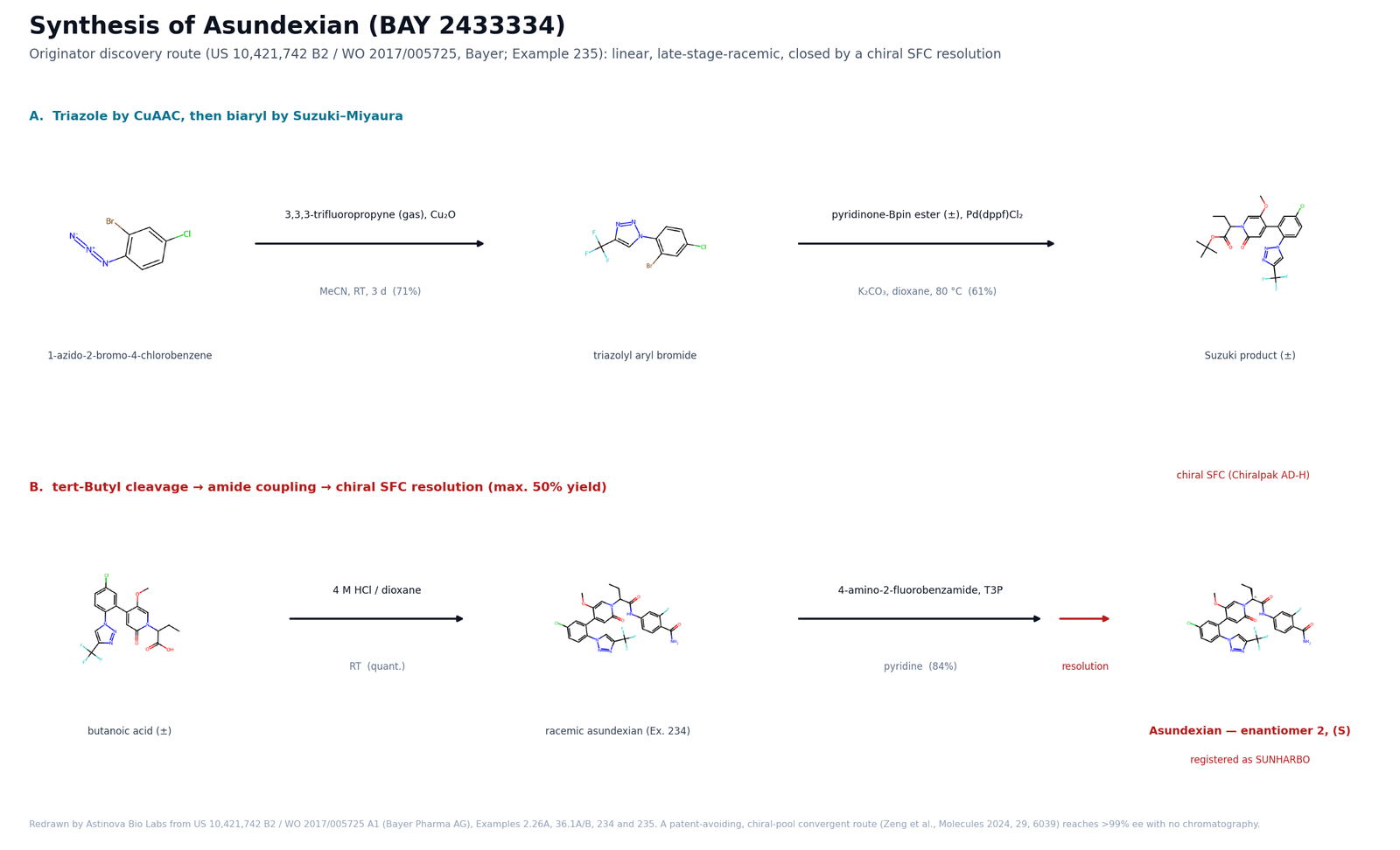
The originator route is read verbatim from US 10,421,742 B2 / WO 2017/005725 A1 (Bayer Pharma AG), where asundexian is Example 235. The disconnection is linear and late-stage-racemic, and that is the whole story. Triazole first, by CuAAC: 1-azido-2-bromo-4-chlorobenzene + 3,3,3-trifluoropropyne (bubbled in as a gas) with Cu2O in MeCN, 3 days at RT (71%), preserving the aryl-bromide handle. Biaryl by Suzuki–Miyaura: coupling with a pre-alkylated pyridinone pinacol boronate ester — as the racemate — using Pd(dppf)Cl2/K2CO3, dioxane, 80 °C (61%); the N/O-alkylation problem is thus solved early on a cheap substrate, but the stereocentre is carried forward racemic. tert-Butyl ester cleavage (4 M HCl/dioxane, quant.) and T3P-mediated amide coupling with 4-amino-2-fluorobenzamide (pyridine, 84%) give racemic asundexian. The single stereocentre is then set by chiral SFC resolution (Chiralpak AD-H, CO2/EtOH) — asundexian is “enantiomer 2”, the (S)-enantiomer — a step whose maximum theoretical yield is 50%. That is a discovery-chemistry route: fine for 26 mg, hopeless for a chronic once-daily medicine.
A patent-avoiding, chiral-pool alternative exists in the open literature. Zeng et al. (Molecules 2024, 29, 6039; PMID 39770127) disclose a five-step, kilogram-scale route from bulk D-2-aminobutyric acid that fixes the stereochemistry early — diazotisation with net retention to (2R)-2-acetoxybutyric acid, T3P amidation (99.07% ee), deacetylation, tosylation, then an inverting SN2 N-alkylation of the western pyridinone fragment (99.32% ee, 35–45:1 N/O selectivity, 40–50% overall) — with no chiral chromatography anywhere. Published twelve years before composition-of-matter expiry, this is DMF groundwork, not academic curiosity; the residual chokepoints for a generic are the CuAAC with gaseous trifluoropropyne on an organic azide and the western fragment itself.
Key intermediates
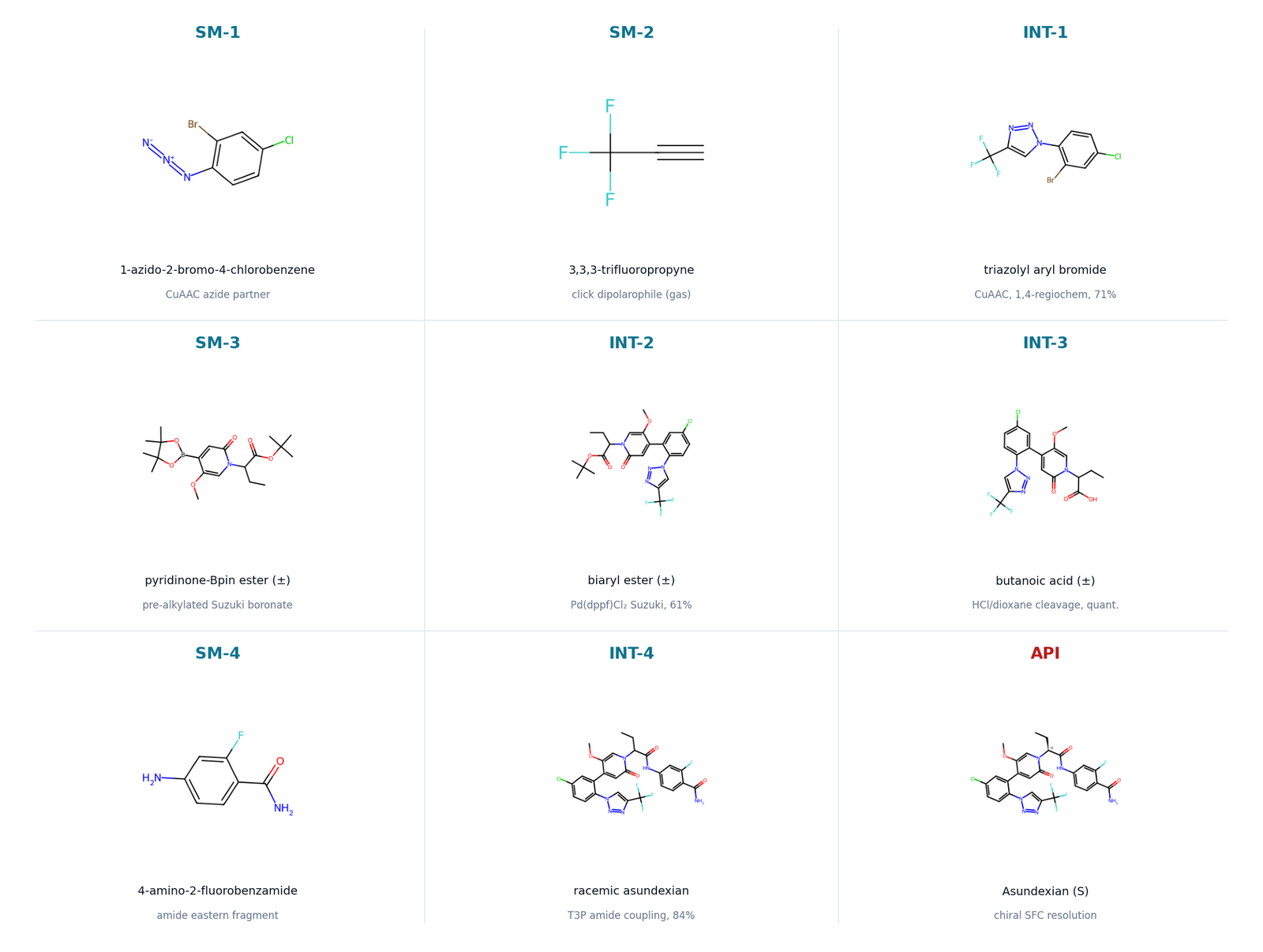
The route is a convergence of three small fragments — a click-derived triazolyl arene, a pre-alkylated pyridinone boronate, and the eastern aminofluorobenzamide — assembled racemic and resolved last.
| Label | Name | Role / sourcing |
|---|---|---|
| SM-1 | 1-azido-2-bromo-4-chlorobenzene | CuAAC azide partner; the aryl-Br is retained for the later Suzuki coupling. |
| SM-2 | 3,3,3-trifluoropropyne | Gaseous dipolarophile delivering the 4-CF3-1,2,3-triazole (1,4-regiochemistry). |
| INT-1 | triazolyl aryl bromide | Cu2O-catalysed CuAAC, MeCN, RT, 3 d; 71%. |
| SM-3 | pyridinone-Bpin ester (±) | Pre-alkylated 5-methoxy-2-oxopyridine boronate — solves N/O-alkylation early, but racemic. |
| INT-2 | biaryl ester (±) | Pd(dppf)Cl2 Suzuki–Miyaura, K2CO3, dioxane, 80 °C; 61%. |
| INT-3 | butanoic acid (±) | tert-butyl ester cleavage (4 M HCl/dioxane); quantitative. |
| SM-4 | 4-amino-2-fluorobenzamide | Eastern fragment installed by T3P amide coupling. |
| INT-4 | racemic asundexian (Ex. 234) | T3P, pyridine; 84%. The last racemic intermediate. |
| API | Asundexian, (S) (Ex. 235) | Chiral SFC resolution (Chiralpak AD-H) to “enantiomer 2”; 100% ee, max 50% yield. |
Crystal Forms, Salts & Solid-State Profile
Asundexian is marketed as the free base (C26H21ClF4N6O4, MW 592.9; one stereocentre, (S); 1 Lipinski violation, cLogP 4.6, PSA 134 Å2). Product: a single 50 mg film-coated tablet (oval, dark orange, debossed “BAY” / “50”). The tablet is explicitly crushable and may be given via nasogastric/gastric tube — a deliberate, differentiating design choice for a post-stroke population with dysphagia. As of 2026-11-17 the Orange Book product page (N221291) exists but the Patent and Exclusivity tables are empty, so exclusivity dates rest on the patent documents and statute rather than an Orange Book listing.
Clinical & Regulatory Profile
Approval (US): 2026-11-09, NDA 221291, brand SUNHARBO — the first approved Factor XIa inhibitor worldwide. Traditional/full approval under Priority Review on a single event-driven superiority trial plus a Phase 2 package; no accelerated approval, no REMS, no boxed warning, and not referred to an advisory committee. Indication (PI §1): in combination with antiplatelet therapy, to reduce the risk of stroke in adults with recent non-cardioembolic ischaemic stroke (NIHSS ≤15) or high-risk TIA — an add-on secondary-prevention position, expressly not a monotherapy anticoagulant indication and not for cardioembolic stroke.
Pivotal trial — OCEANIC-STROKE (NCT05686070, Phase 3, double-blind, placebo-controlled, N=12,327): the primary endpoint of ischaemic stroke occurred in 6.2% on asundexian vs 8.4% on placebo — HR 0.74 (95% CI 0.65–0.84, p<0.0001), a 26% relative risk reduction over a median 14.2 months. Crucially, ISTH major bleeding was not increased (1.6 vs 1.5 per 100 patient-years; HR 1.1, NS) and haemorrhagic strokes were numerically fewer (21 vs 28) — the headline mechanistic claim of the class. There was no MI benefit (HR 1.21) and no mortality signal (HR 0.98); the composites are driven entirely by ischaemic stroke. (Sharma M et al., N Engl J Med 2026;394(15):1467–1479; PMID 41985132.)
PK / ADME highlights
t½ ~24 h (once-daily); Tmax ~3 h; 94% plasma-protein bound. Primarily metabolised by carboxylesterase 1 (CES1) and to a lesser extent CYP3A4 — a high-capacity esterase route that blunts CYP-mediated DDI, so only combined P-gp plus strong CYP3A4 modulators move exposure meaningfully (asundexian is a P-gp substrate). No clinically significant food effect; crushed tablet is bioequivalent to the whole tablet. No dose adjustment in mild hepatic impairment (Child-Pugh A; B/C not recommended) or across the renal spectrum including dialysis. Most frequent adverse reaction was diarrhoea (3.4%).
Key references & source trail
- SUNHARBO (asundexian) tablets, US Prescribing Information (DailyMed SPL, Bayer HealthCare Pharmaceuticals; Initial U.S. Approval 2026).
- FDA NDA approval letter, NDA 221291 (signed 2026-11-09).
- Sharma M, Dong Q, Hirano T, et al.; OCEANIC-STROKE Investigators. Asundexian for Secondary Stroke Prevention. N Engl J Med 2026;394(15):1467–1479. PMID 41985132. (Pre-specified bleeding analysis: Circulation 2026, PMID 42866879.)
- Originator synthesis: US 10,421,742 B2 / WO 2017/005725 A1 (Bayer Pharma AG), Examples 234 & 235.
- Patent-avoiding convergent process: Zeng Y et al., Molecules 2024;29(24):6039. PMID 39770127 (see also CN 111770917 A).