
The problem: the Q61 codon RAS, left behind
Mutant-selective RAS drugs have, so far, been a G12 story — sotorasib, adagrasib, and the newer G12D and pan-KRAS agents. Patients whose tumors are driven by a Q61 codon mutation have been left out. KRAS Q61H alone accounts for ~7,500 new US cases a year, mostly in NSCLC, PDAC, and CRC. Pan-KRAS or RAS(ON)-multiselective agents will reach these patients, but they also hit wild-type RAS in healthy tissue. A genuinely Q61H-selective inhibitor would spare WT RAS — if you can find a noncovalent handle on the featureless surface of the active, GTP-bound protein.
The modality: remodel a chaperone, then grab RAS
RMC-0708 is a tri-complex inhibitor (TCI). It first binds the abundant cytosolic chaperone cyclophilin A (CYPA) and remodels its surface into a neomorphic interface with high affinity for RAS(ON) Q61H. The binary CYPA–compound complex then clamps onto the GTP-bound mutant, forming a tri-complex that blocks effector (RAF) engagement and shuts down MAPK signaling. The scaffolds are beyond-rule-of-five (bRo5) macrocycles derived from sanglifehrin A, a natural CYPA binder.
The strategy: a second macrocycle to catch Q61H
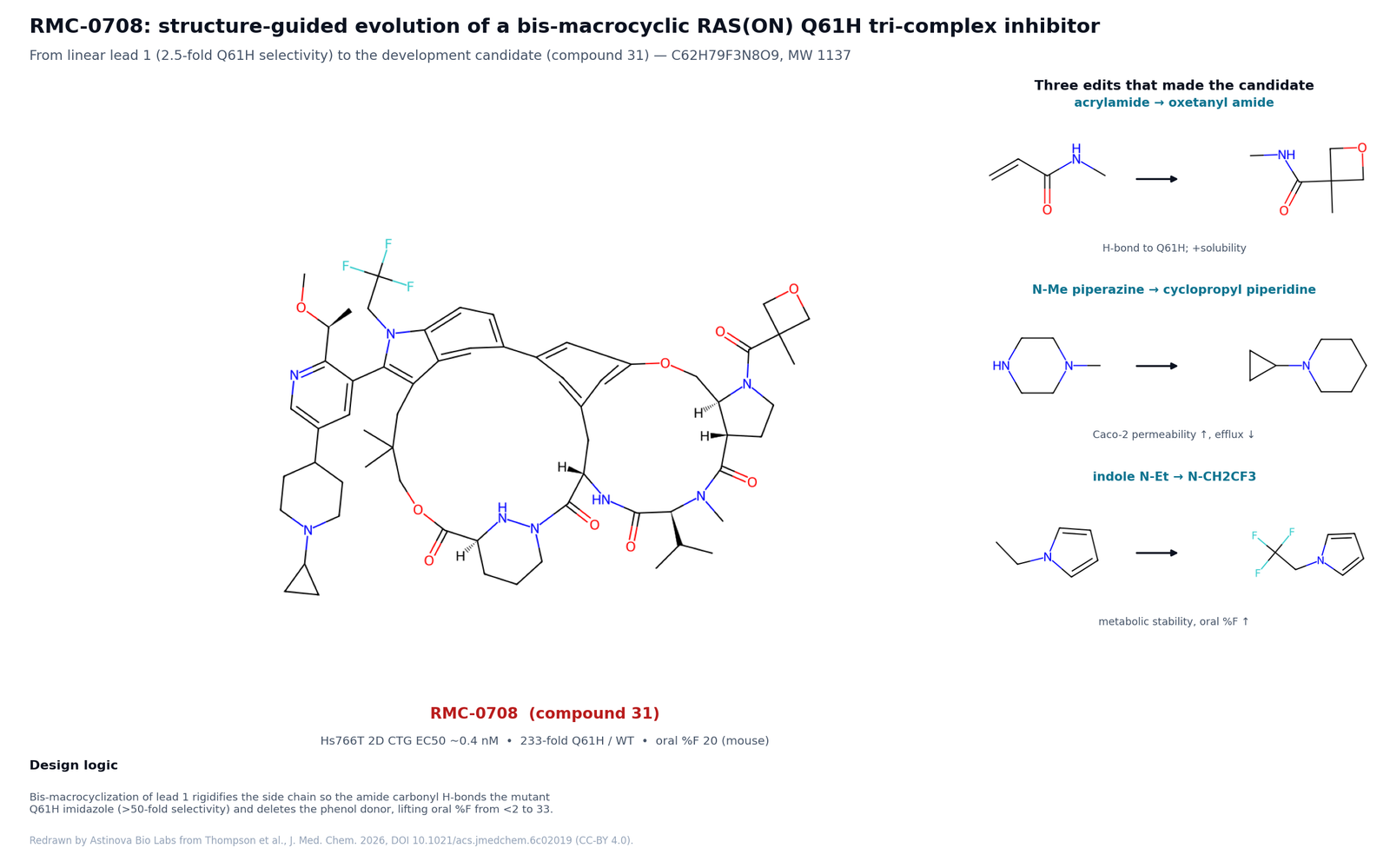
Starting from the prior RAS(ON) inhibitor compound 1 (only 2.5-fold Q61H/WT), the crystal structure suggested room for one more contact. Closing a second macrocycle — a methylene bridge between the phenol and pyrrolidine — gave bis-macrocyclic compound 2, rigidifying the side chain so the amide carbonyl sits ~3 Å from the Q61H imidazole and accepts a hydrogen bond. Selectivity jumped past 50-fold, MD confirmed pre-organization toward the bound pose, and — because the move also deleted the phenol H-bond donor — oral bioavailability climbed from <2% to 33% with lower clearance.
From there it was a three-edit march to the candidate:
- Amide cap: acetamide → α-methyl cyclopropyl → gem-difluoro, then a 3-methyloxetane-3-carbonyl cap — tuning the Q61H H-bond and P-loop (G12) van der Waals contacts to single-digit/sub-nM cellular potency and several-hundred-fold selectivity.
- Basic amine: N-methyl piperazine → N-cyclopropyl piperidine, which restored Caco-2 permeability, cut efflux, and strengthened the CYPA cation–π contact with W121 (KD1 down >5-fold).
- Indole N-substituent: N-ethyl → N-2,2,2-trifluoroethyl, lifting metabolic stability and oral exposure.
The result — compound 31, RMC-0708 (C₆₂H₇₉F₃N₈O₉, MW 1137).
The structural proof: caught on Q61H

The co-crystal of the RMC-0708 · KRAS(ON) Q61H · CYPA tri-complex (PDB 36JS) shows the compound filling the composite pocket between CYPA and the RAS switch regions. On switch I it packs against Y32, P34, I36, and E37; on switch II the core engages Q61H through both a π–π stack and a hydrogen bond, with hydrophobic contacts to Y64/M67; and the oxetane donates an H-bond to the backbone NH of G12 in the P-loop. GMPPNP and Mg²⁺ mark the nucleotide site — this is the active state being drugged.
The data: potent, selective, orally durable
- Cellular selectivity. NanoBRET: complete disruption of KRAS Q61H/RAF (EC₅₀ 2.1 nM) but only partial WT/RAF disruption up to 1 µM — a feature of the modality (the active species is capped by cellular CYPA, ~10 µM).
- Antiproliferation. Median pEC₅₀ 8.98 across Q61H lines vs 7.47 for RAS WT — ~32-fold cellular selectivity.
- PK. Low clearance and oral exposure across mouse/rat/dog/monkey (mouse %F 20, dog 46).
- In vivo. A single oral dose drove deep, durable RAS-pathway suppression (tumor DUSP6) out to 72 h; daily dosing produced tumor regressions in T3M-4 (PDAC), HCC2108 (NSCLC), and CTG-1338 (CRC) xenografts, well tolerated.
- Safety. No hERG/Naᵥ1.5/Caᵥ1.2 inhibition (>10 µM), clean SAFETYScreen47, and selective for KRAS Q61H over WT RAS and non-RAS GTPases.
Why it matters
- A mutant-selective answer for the Q61H population — sparing WT RAS by design, not by dose.
- Macrocyclization as a precision tool. A second ring converted a 2.5-fold starting point into a >200-fold-selective, orally bioavailable bRo5 molecule — the carbonyl placed by geometry, not luck.
- The tri-complex platform, extended. RMC-0708 shows the CYPA-remodeling modality can be tuned to a specific Q61 variant with a solved co-crystal to prove the mechanism.
Reference: Thompson, S. K.; Yang, Y. C.; López Quiñones, A. J.; Chang, S.; McKinley, J. L.; Tomlinson, A. C. A.; Tooley, A. S.; Wei, X.; Flagella, M.; Buckl, A.; Gliedt, M. J.; Yin, J.; Liu, Y.; Chen, A.; Montgomery, D. C.; Marquez, A.; Eilerts, D. F.; Probst, J.; McNamara, A.; Shivakumar, D. M.; Wang, Zhican; Knox, J. E.; Wang, Zhengping; Gill, A. L.; Koltun, E. S. “Discovery of RMC-0708, an Oral, Bis-Macrocyclic, RAS(ON) Q61H-Selective, Noncovalent, Tri-Complex Inhibitor.” J. Med. Chem. 2026, DOI: 10.1021/acs.jmedchem.6c02019. Open access under CC-BY 4.0.
All visuals are original to Astinova Bio Labs: the design/SAR and structure panels drawn with RDKit/Matplotlib; the tri-complex binding view rendered with 3Dmol.js from the deposited co-crystal PDB 36JS.
Astinova Bio Labs designs and makes molecules like these — macrocyclization strategy, bRo5 property optimization, and structure-based binding analysis. Talk to us about your target.