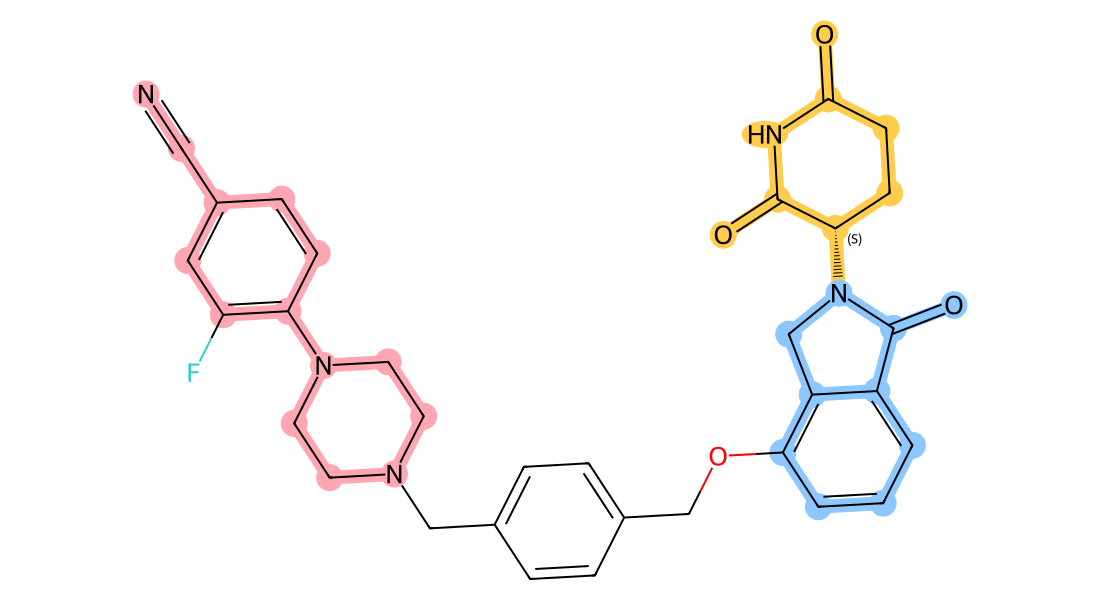
Bristol Myers Squibb’s oral CELMoD is the first cereblon modulator designed from the ground up for fast, deep protein degradation — and its positive Phase 3 SUCCESSOR-2 readout signals a new standard for relapsed/refractory multiple myeloma.
1. Why mezigdomide is a “first-in-class, first-of-its-kind” drug
The immunomodulatory imide drugs (IMiDs) — thalidomide, lenalidomide, pomalidomide — were only retrospectively understood to be molecular glues. Their protein-degrading mechanism was discovered years after they were already in the clinic. They work, but they degrade their targets slowly and incompletely, and myeloma cells eventually adapt and become refractory.
Mezigdomide is different in a way that matters. It is a CELMoD (Cereblon E3 Ligase Modulator) — and it is described as the first CELMoD specifically designed for efficient and rapid protein-degradation kinetics to enter clinical development. In other words, it was engineered from the outset as a degrader, with the degradation event — not simple target binding — as the optimization endpoint. Its medicinal chemists at Celgene selected it by tracking not just binding potency but how fast and how completely it destroys Ikaros and Aiolos.
The payoff is direct: mezigdomide degrades Ikaros/Aiolos more efficiently than lenalidomide or pomalidomide, and it retains potent, apoptosis-inducing activity in myeloma cell lines that have become resistant to those older IMiDs. It is the frontrunner of a rationally designed next generation, now validated by a positive Phase 3 trial.
Mechanism of action: induced proximity, then destruction
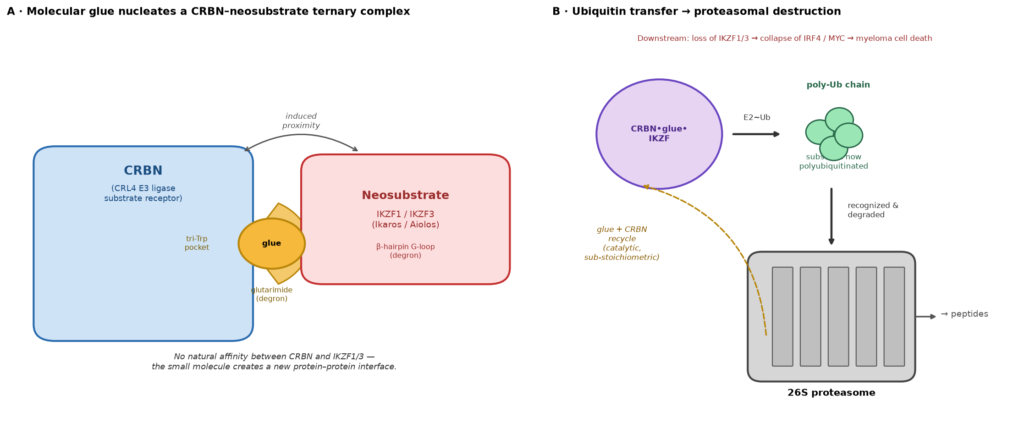
Mezigdomide is a textbook molecular glue. It has no meaningful activity against Ikaros/Aiolos on its own — it manufactures an interaction that nature never built:
- Docking. The glutarimide degron seats mezigdomide in the tri-tryptophan pocket of cereblon, the substrate receptor of the CRL4 (Cullin-4 RING) E3 ubiquitin ligase.
- Induced proximity. With the drug bound, the modified CRBN surface becomes complementary to the β-hairpin “G-loop” degrons of the zinc-finger transcription factors Ikaros (IKZF1) and Aiolos (IKZF3), pulling them into a ternary complex (CRBN • mezigdomide • IKZF).
- Ubiquitination. Held in place, the neosubstrate is polyubiquitinated by the ligase machinery.
- Degradation. The 26S proteasome recognizes the ubiquitin chain and destroys the transcription factor. Mezigdomide and CRBN are released to catalyze the next round — catalytic, sub-stoichiometricpharmacology.
- Dual downstream effect. Loss of Ikaros/Aiolos collapses the myeloma cell’s IRF4–MYC survival axis (direct, cell-autonomous killing) and de-represses IL-2 and IFN-γ, activating T cells and NK cells (immunomodulation). Mezigdomide’s rapid, deep degradation is what lets it trigger this program even in IMiD-resistant cells.
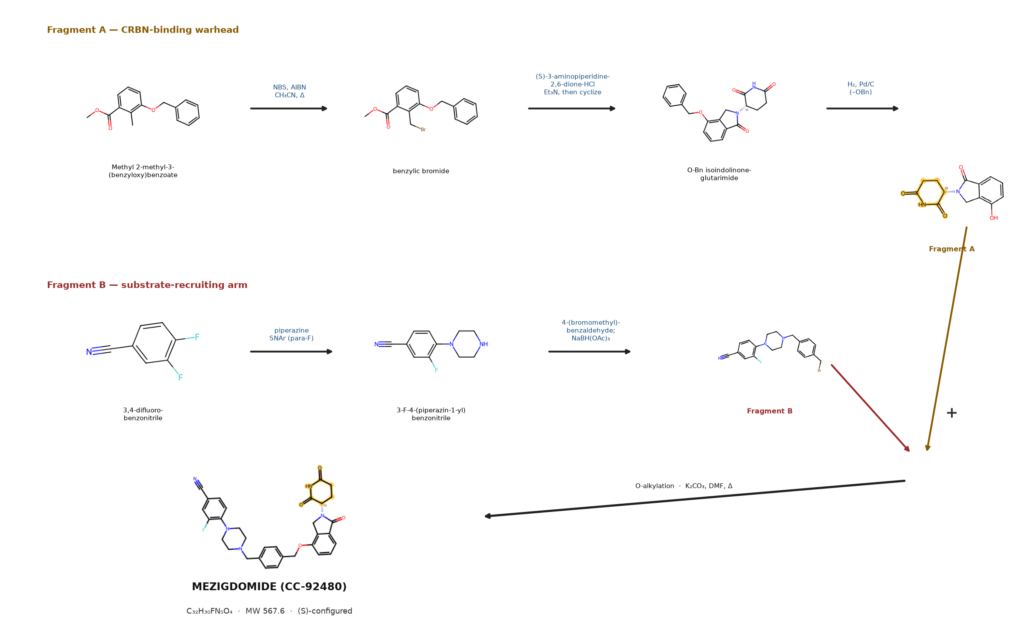
Synthesis scheme: a convergent, two-fragment assembly
Because mezigdomide is modular, it is built convergently — the CRBN-binding “warhead” and the substrate-recruiting “arm” are prepared separately and joined in a final coupling. The scheme below shows a representative route consistent with the published structure and standard glutarimide chemistry.
Clinical highlights
SUCCESSOR-2 (Phase 3, NCT05552976). In its pivotal relapsed/refractory myeloma trial, oral mezigdomide combined with carfilzomib and dexamethasone (MeziKd) met its primary endpoint, delivering a statistically significant and clinically meaningful improvement in progression-free survival versus carfilzomib/dexamethasone alone — the readout underpinning the drug’s regulatory filings.
Earlier proof of concept (CC-92480-MM-001, Phase 1/2, NEJM 2023). Mezigdomide plus dexamethasone showed meaningful response rates in heavily pretreated patients — including those refractory to lenalidomide and pomalidomide, and patients previously exposed to anti-BCMA therapies — establishing the clinical case that a purpose-built degrader can work where first-generation IMiDs fail.
What sets it apart clinically:
- Oral dosing — a convenient backbone for combination regimens, unlike infused antibody or cell therapies.
- Activity in IMiD-resistant disease — the direct clinical translation of its faster, deeper degradation.
- Rational combinability — its dual cytotoxic + immunomodulatory action synergizes with proteasome inhibitors (carfilzomib, bortezomib), anti-CD38 antibodies, and other immune approaches.
The bigger picture
Mezigdomide is the clinical validation of a thesis: that molecular glues can be designed, not merely discovered — and that optimizing for degradation kinetics rather than binding affinity unlocks efficacy where older drugs plateau. With a positive Phase 3 behind it and its sister CELMoD iberdomide close behind in regulatory review, the CELMoD class is poised to become a new backbone of myeloma therapy — and a proof of concept that the “one-click” degrader strategy is fully programmable.
This article is for scientific and educational purposes and is not medical advice; treatment decisions must be made by a qualified healthcare professional with access to the full patient context.