How a single small molecule can staple two proteins together and send one of them to the cellular shredder — the mechanism, the medicinal-chemistry logic, and a worked synthesis of the archetypal drug.
1. Why “glue” is the right word
For a century, small-molecule drugs did essentially one thing: they sat in a pocket of a target protein and blocked it. This is occupancy-driven pharmacology — the drug has to be present, bound, and outcompeting the substrate to have any effect. It also means the target has to have a druggable pocket in the first place, which roughly 80% of the proteome does not.
Molecular glue degraders (MGDs) rewrite that contract. Instead of inhibiting a protein, a molecular glue is a small molecule that sits at the interface between two proteins that would normally never touch — one of them an E3 ubiquitin ligase (the cell’s “tag-for-disposal” machine) and the other a disease-driving target. The glue creates a brand-new, complementary protein–protein surface that neither protein has any natural affinity for. Once glued together, the ligase tags the target with ubiquitin, and the 26S proteasome destroys it.
The consequences are profound:
- It is event-driven, not occupancy-driven. The glue doesn’t need to stay bound. It catalyzes one tagging event, the target is degraded, and the glue is released to do it again — catalytic, sub-stoichiometric pharmacology. One molecule can eliminate many copies of a target.
- It removes the entire protein, not just one active site — so scaffolding functions, allosteric functions, and protein–protein interactions of the target all disappear together.
- It can drug the “undruggable.” The target no longer needs an enzymatic pocket; it only needs a surface the glue-loaded ligase can grip.
This is the sense in which people describe molecular glues as a “one-click” modality: a single, orally available, drug-like small molecule triggers the complete elimination of a pathogenic protein, using machinery the cell already owns.
2. The mechanism of action, step by step
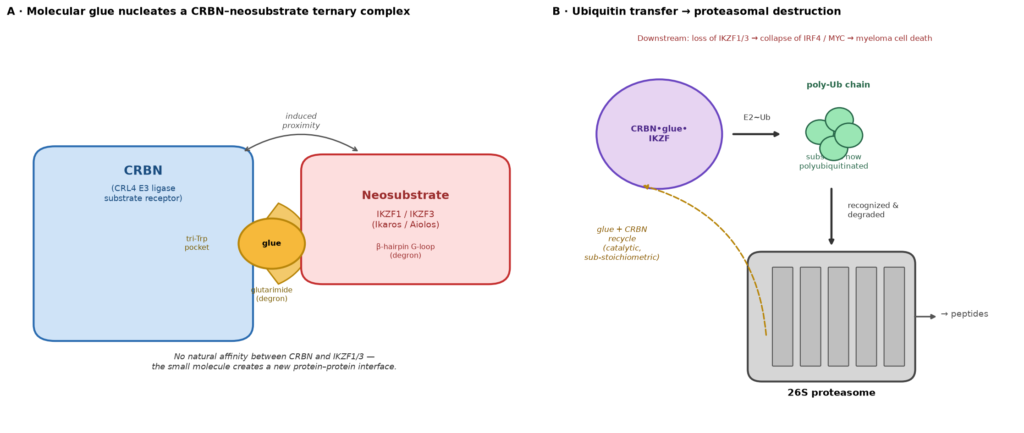
The best-understood molecular glues hijack cereblon (CRBN), the substrate-recognition subunit of the CRL4 (Cullin-4 RING) E3 ubiquitin ligase complex.
Step 1 — The glue docks into cereblon. Each of these drugs carries a glutarimide ring (a 2,6-dioxopiperidine). This ring is the degron mimic: it plugs into CRBN’s shallow tri-tryptophan pocket exactly where CRBN’s natural degron substrates would bind. This is highlighted in gold in every structure below.
Step 2 — A new surface is created. With the glutarimide buried, the rest of the drug — the phthalimide or isoindolinone “hotspot” — protrudes from CRBN’s surface and reshapes it. This modified surface is now complementary to a β-hairpin “G-loop” degron found on certain transcription factors.
Step 3 — The neosubstrate is recruited. Proteins bearing that structural degron — most famously the zinc-finger transcription factors IKZF1 (Ikaros) and IKZF3 (Aiolos) — are drawn into a ternary complex (CRBN • glue • neosubstrate). Crucially, CRBN and IKZF1/3 have no natural affinity for one another; the glue manufactures the interaction. These recruited targets are called neosubstrates because they were never natural substrates of the ligase.
Step 4 — Ubiquitin transfer. Now held in place, the neosubstrate is presented to the CRL4 machinery’s E2 ubiquitin-conjugating enzyme, which builds a polyubiquitin chain on it.
Step 5 — Proteasomal degradation. The polyubiquitinated neosubstrate is recognized and shredded by the 26S proteasome. The glue and CRBN are released to recycle.
Step 6 — Downstream collapse. In multiple myeloma, losing IKZF1/3 collapses the downstream oncogenic program — chiefly IRF4 and MYC — killing the tumor cell, while simultaneously de-repressing T-cell and NK-cell immunity. This dual cytotoxic-plus-immunomodulatory action is the therapeutic signature of the class.
3. The medicinal-chemistry story: one scaffold, four decades
The remarkable thing is that this entire class descends from a single, notorious molecule. The structural evolution below tells the story — and note the gold glutarimide degron is conserved in every single one. Medicinal chemistry has kept the CRBN-binding “anchor” fixed and re-engineered everything else to tune whichneosubstrates get recruited and how efficiently.
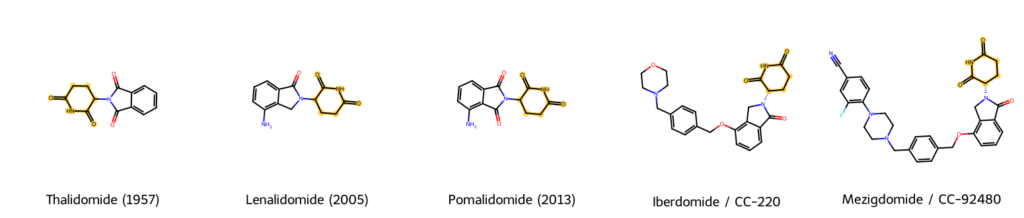
- Thalidomide (1957) — Infamous as a sedative that caused severe birth defects (we now know teratogenicity comes from aberrant recruitment of the transcription factor SALL4 to CRBN). Decades later it was rehabilitated for multiple myeloma and leprosy. The parent glutarimide–phthalimide.
- Lenalidomide (2005) — Adds an amino group and converts the phthalimide to an isoindolinone. A blockbuster in multiple myeloma and in del(5q) myelodysplastic syndrome, where it additionally degrades the kinase CK1α. For years one of the best-selling oncology drugs in the world.
- Pomalidomide (2013) — An amino-phthalimide, more potent, for relapsed/refractory myeloma.
- Iberdomide (CC-220) and Mezigdomide (CC-92480) — The CELMoDs (Cereblon E3 Ligase Modulating Drugs). These rationally designed, next-generation glues bolt a large “business end” (a morpholine- or benzonitrile-piperazine arm through a benzyl-ether linker) onto the isoindolinone. They bind CRBN with far higher affinity than lenalidomide and drive faster, deeper degradation of IKZF1/3 — engineered specifically to overcome resistance in heavily pretreated patients.
The frontier clinical example: mezigdomide
Mezigdomide is the most advanced next-generation molecular glue. In March 2026, BMS announced positive interim Phase III results from the SUCCESSOR-2 trial (NCT05552976): oral mezigdomide plus carfilzomib and dexamethasone (MeziKd) met its primary endpoint, roughly doubling median progression-free survival to 18.0 months versus 8.3 months for carfilzomib/dexamethasone alone in relapsed/refractory myeloma, with data being shared with global health authorities. Its sister CELMoD iberdomide is a step further along the regulatory path: the FDA accepted its NDA (iberdomide + daratumumab + dexamethasone) in February 2026 with Breakthrough Therapy Designation and Priority Review, based on the Phase III EXCALIBER-RRMM trial (MRD-negativity endpoint), and a PDUFA target date of August 17, 2026 — putting iberdomide in position to become the first approved CELMoD. Both illustrate the payoff of the “keep the degron, redesign the surface” strategy: same one-click mechanism, dramatically improved degradation kinetics.
4. A worked synthesis: lenalidomide in three steps
To make the chemistry concrete, here is the classic manufacturing route to lenalidomide — the cleanest teaching example of how you actually build a molecular glue. The synthesis is elegantly short because the molecule is small and modular: you build the substrate-recruiting isoindolinone half and the CRBN-binding glutarimide half, and stitch them together in one cyclization.
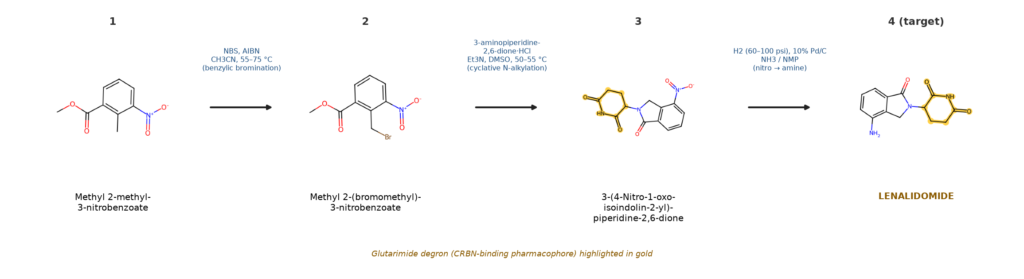
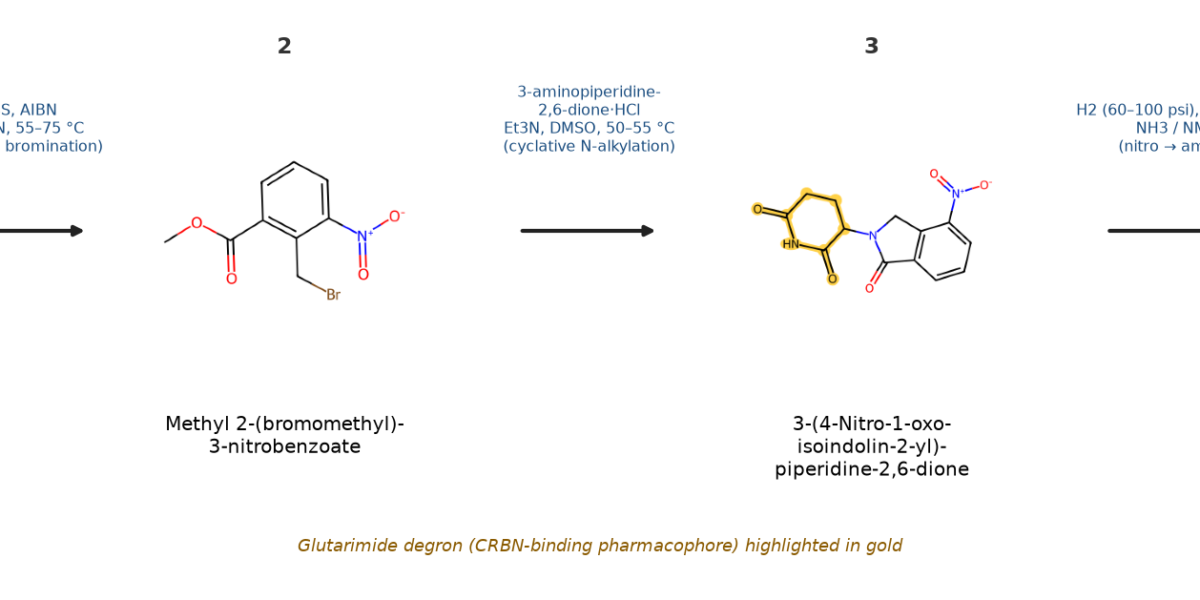
Step 1 — Benzylic bromination. Methyl 2-methyl-3-nitrobenzoate is treated with N-bromosuccinimide (NBS) and the radical initiator AIBN in acetonitrile at 55–75 °C. This installs a bromide on the benzylic methyl group, giving methyl 2-(bromomethyl)-3-nitrobenzoate — a reactive electrophile primed for the ring-forming step. (The nitro group is carried through deliberately; it becomes the drug’s defining amine at the very end.)
Step 2 — Cyclative N-alkylation (the key bond-forming step). The bromomethyl ester is condensed with 3-aminopiperidine-2,6-dione hydrochloride — this is the pre-formed glutarimide degron — using triethylamine as base in DMSO at 50–55 °C. The primary amine of the glutarimide does double duty: it displaces the benzylic bromide (N-alkylation) and then cyclizes onto the ester carbonyl (lactam formation), closing the five-membered isoindolinone ring in a single operation. The product, 3-(4-nitro-1-oxoisoindolin-2-yl)piperidine-2,6-dione, already has the complete molecular-glue architecture — degron plus substrate-recruiting head — assembled.
Step 3 — Nitro reduction. Finally, catalytic hydrogenation (H₂ at 60–100 psi over 10% Pd/C, in ammonia-buffered NMP) reduces the aromatic nitro group to the aromatic amine. That newly unveiled 4-amino group is precisely what distinguishes lenalidomide from thalidomide, and the run is capped by recrystallization to API-grade purity.
Three steps, cheap reagents, one strategic cyclization — a reminder that these transformative drugs are, chemically, remarkably accessible.
5. Why the field is exploding
Molecular glues combine the drug-like virtues of ordinary small molecules — oral dosing, cell permeability, straightforward synthesis (as above) — with the catalytic, complete-knockout power of targeted protein degradation. Compared with the other major degrader modality, PROTACs (bifunctional molecules that tether a target ligand to an E3 ligand), glues are far smaller and more “natural” as drugs because they don’t require a pre-existing high-affinity ligand for the target — they induce the interaction from a modest starting surface.
That is why the pipeline has erupted well beyond the CRBN/IMiD franchise:
- Beyond IKZF1/3: rationally designed glues now degrade CK1α, GSPT1, RBM39, HuR, and a growing list of previously “undruggable” targets.
- Beyond cereblon: newer programs recruit other E3 ligases (DCAF15, DDB1, β-TrCP and others), and even non-degrading glues that simply reshape protein function.
- Beyond oncology: autoimmune disease (e.g., iberdomide in lupus), neurodegeneration, and rare disease are all now in scope.
With three approved IMiD glues, next-generation CELMoDs at the threshold of approval, and dozens of first-in-class degraders in trials, molecular glue technology has moved from a serendipitous accident (thalidomide) to a deliberate, programmable strategy for deleting disease proteins — one click at a time.