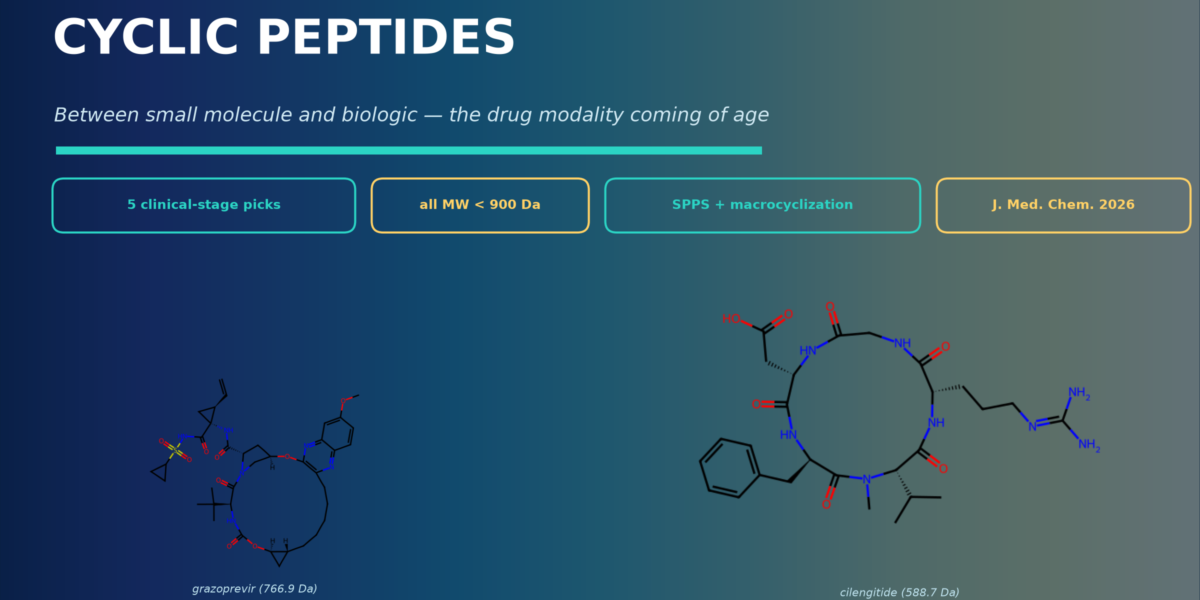
Why cyclic peptides matter
Drug discovery has long been split between two worlds: small molecules (cheap, oral, cell-permeable, but often unable to grip large flat protein surfaces) and biologics (exquisitely specific, but injectable, expensive, and locked out of the cell). Cyclic peptides sit deliberately in between. As the review frames it, they occupy a space between small molecules and biologics, offering improved rigidity, stability, and target engagement — and among all FDA-approved peptide therapeutics, about 25% are cyclic peptides.
Closing a peptide into a ring buys three things at once: conformational rigidity (pre-organized to hit its target, paying less entropic penalty on binding), proteolytic stability (no free termini for exopeptidases; often unnatural residues that endopeptidases don’t recognize), and — the prize the field is chasing — the possibility of oral bioavailability. The review’s central data-driven message is that oral administration is gaining attention, signaling real progress against the class’s long-standing bioavailability problem.
There is one catch that shapes everything below. Cyclic peptides typically occupy an intermediate molecular-weight range of ∼500–3000 Da, sitting between small molecules and large biologics. So a molecular-weight ceiling of 900 Da is a genuinely restrictive filter — it selects the small, most “drug-like” tail of the class, where oral absorption is most plausible. Most of the clinical pipeline sits well above it.
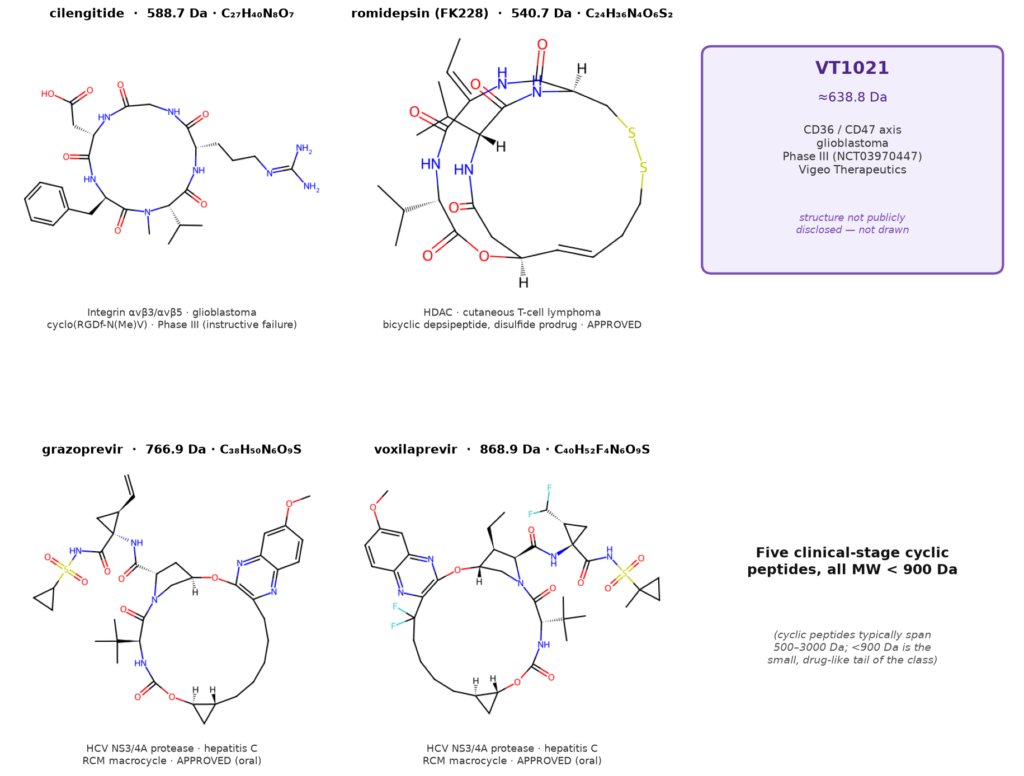
Four represent the two great “success stories” of small cyclic peptides — HCV protease inhibitors and natural-product-derived HDAC/integrin ligands — and one is a current oncology frontrunner.
- VT1021 (≈638.8 Da) — the marquee active clinical candidate. A cyclic peptide targeting the CD36 / CD47axis in the tumor microenvironment, in Phase III for glioblastoma (Vigeo Therapeutics). It reprograms tumor-associated macrophages and inhibits angiogenesis. Its structure is not publicly disclosed, so I have deliberately not drawn it — the info panel summarizes what is known rather than inventing a ring.
- Cilengitide (588.7 Da, C₂₇H₄₀N₈O₇) — the textbook RGD cyclic pentapeptide,
cyclo(-Arg-Gly-Asp-D-Phe-N(Me)Val-), a selective αvβ3/αvβ5 integrin antagonist. It reached Phase III in glioblastoma and, though it ultimately failed to extend survival, it remains the single most instructive molecule in the field for teaching cyclic-peptide design (see the synthesis below). - Romidepsin / FK228 (540.7 Da, C₂₄H₃₆N₄O₆S₂) — a natural-product bicyclic depsipeptide and approved HDAC inhibitor for cutaneous T-cell lymphoma. Its intramolecular disulfide is a redox “trigger”: reduction inside the cell releases a free thiol that chelates the zinc in the HDAC active site — a built-in prodrug strategy.
- Grazoprevir (766.9 Da, C₃₈H₅₀N₆O₉S) — a macrocyclic HCV NS3/4A protease inhibitor (in Zepatier). Its ring was closed by ring-closing metathesis (RCM), the reaction that made this whole class of oral macrocyclic antivirals possible.
- Voxilaprevir (868.9 Da, C₄₀H₅₂F₄N₆O₉S) — a later, fluorinated NS3/4A macrocycle (in Vosevi), sitting right at the top of our weight window. It shows how far the RGD/protease-inhibitor macrocyclization strategy could be pushed while staying orally active.
Together they span oncology, antivirals, and hematologic malignancy, and three distinct ring-forming chemistries — head-to-tail amide macrolactamization (cilengitide), disulfide/depsipeptide (romidepsin), and olefin metathesis (grazoprevir, voxilaprevir).
A worked synthesis: cilengitide by Fmoc SPPS + macrolactamization
Cilengitide is the ideal teaching synthesis because it showcases, in one molecule, the three design tricks that define modern cyclic-peptide medicinal chemistry: a D-amino acid (D-Phe), an N-methylated residue (N-methyl-Val), and head-to-tail cyclization — all layered on the biologically critical RGD recognition motif.
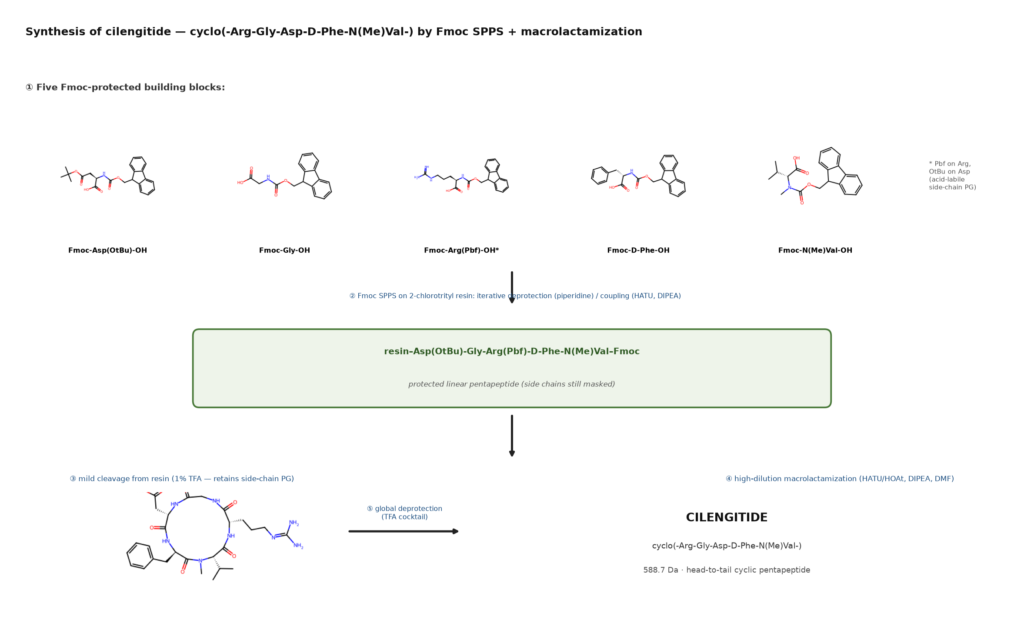
The strategy, step by step:
- Five Fmoc building blocks are used, with acid-labile side-chain protection — Pbf on the arginine guanidine, OtBu on the aspartate carboxyl — so the side chains stay masked while the backbone is manipulated.
- Fmoc solid-phase peptide synthesis (SPPS) on 2-chlorotrityl chloride resin: iterative cycles of Fmoc removal (piperidine) and coupling (HATU/DIPEA) assemble the linear, side-chain-protected pentapeptide anchored through the Asp side chain. The N-methyl-valine coupling is the sluggish step — N-methyl amino acids are notoriously hard to acylate, which is exactly why they confer protease resistance.
- Mild cleavage from the 2-chlorotrityl resin with dilute (≈1%) TFA releases the linear peptide with side-chain protecting groups intact — this is the key to a clean cyclization, exposing only the backbone termini.
- Macrolactamization under high dilution (HATU/HOAt, DIPEA, DMF) closes the ring head-to-tail. High dilution favors the intramolecular amide bond over intermolecular oligomerization — the perennial challenge of peptide macrocyclization. The presence of the D-amino acid and N-methyl residue helps by pre-biasing the backbone into a turn that brings the termini together.
- Global deprotection with a TFA cocktail strips Pbf and OtBu to reveal cilengitide.
This SPPS-then-cyclize logic — build linear on resin, cleave with protection intact, close the ring in dilute solution, then deprotect — is the workhorse route to most head-to-tail cyclic peptides, and it maps directly onto the review’s discussion of cyclization strategy and chemical modification.
The bigger medicinal-chemistry lessons
- Ring-closing chemistry is destiny. Whether the macrocycle is formed by amide macrolactamization (cilengitide), by disulfide/ester in a natural product (romidepsin), or by ring-closing metathesis (the HCV protease inhibitors), the cyclization method shapes what chemical space is reachable — and RCM in particular unlocked orally active antiviral macrocycles.
- Unnatural residues are features, not bugs. D-amino acids and N-methylation appear again and again because they simultaneously rigidify the ring, block proteases, and — by masking backbone H-bond donors — improve membrane permeability. Cilengitide wears all of these.
- Small is hard-won. The reason so few clinical cyclic peptides fall under 900 Da is that shrinking the ring while keeping a real protein–protein-interaction surface is genuinely difficult. The compounds that manage it (HCV protease inhibitors, RGD peptides, HDAC depsipeptides) are the ones that found a compact, high-information recognition motif.
- Failure teaches. Cilengitide did not win its Phase III, but its clean, selective pharmacology and its crystallographically-defined RGD binding made it the reference molecule for an entire generation of integrin and macrocycle chemists.
Cyclic peptides remain medicinal chemistry’s “middle kingdom” — and as the oral-delivery problem yields, that middle ground is exactly where a lot of the next decade’s drugs will be found.
A tour through the cyclic-peptide landscape mapped by Thite et al. (J. Med. Chem. 2026, 69, 17770–17799) — with five clinical-stage compounds under 900 Da, their chemistry and targets, and a worked solid-phase synthesis of the one that taught the field its hardest lesson.