
The problem: resistance now travels in pairs
The “silent pandemic” of antimicrobial resistance (AMR) was linked to 4.95 million deaths in 2019, with a projected 10 million/year by 2050. For the WHO’s critical Gram-negative threats — Enterobacterales and Acinetobacter baumannii — the proximate cause is the β-lactamase: an enzyme that hydrolyses the β-lactam ring at the heart of our most reliable antibiotic class.
The clinically awkward reality is that these enzymes no longer come one at a time. Surveillance (ATLAS) shows meropenem-resistant isolates carrying MBLs in 36%, KPC in 25%, and OXA-48-like in 24%, with the NDM + OXA-48-like pairing emerging as the dominant driver in Enterobacterales. Two mechanistic classes are in play simultaneously:
- Serine β-lactamases (SBLs) — Ambler classes A/C/D; a catalytic serine acylates and hydrolyses the β-lactam. Many SBL inhibitors (SBLIs) are marketed.
- Metallo-β-lactamases (MBLs) — Ambler class B; a di-Zn2+ centre activates a bridging hydroxide. No MBL inhibitor is FDA-approved, and only a handful are in late-stage trials.
Inhibit one class and the other still shreds your β-lactam. This Perspective from Naicker, Silva and co-workers (UKZN / Karolinska / UFPA) argues for a pragmatic, immediately deployable answer: triple combination therapy — a β-lactam antibiotic + an SBLI + an MBL-targeting agent — as a bridge while dedicated dual-/MBL-inhibitors mature.
The strategy: three mechanisms, one regimen

The logic is additive coverage. The β-lactam still delivers the lethal PBP-targeting hit; the SBLI shields it from serine enzymes; and an MBL-targeting agent closes the class B gap — either a dedicated inhibitor or, cleverly, an MBL-stable β-lactam (aztreonam) that simply isn’t a substrate for the zinc machinery. The distinction the authors draw between dual-β-lactamase inhibitors (one molecule hitting SBLs and MBLs) and dual-target enhancers (β-lactamase inhibition plus direct PBP binding) matters for how each agent is partnered.
The chemical landscape: four scaffolds doing the work

The medicinal-chemistry story is a progression of warheads, and it maps cleanly onto four classes:
- β-Lactam-based SBLIs — clavulanic acid (1972), tazobactam, and the 2024 approval enmetazobactam (a single triazolium methyl on tazobactam that sharpens ESBL coverage with cefepime). Classic covalent “suicide” inhibitors — but a shared β-lactam pharmacophore means β-lactamases eventually learn to hydrolyse them too.
- Diazabicyclooctanones (DBOs) — avibactam is the reversible-covalent SBLI half of the hero combination below; zidebactam and nacubactam are dual-target enhancers that add high-affinity PBP2 binding to their class A/C inhibition (both in Phase 3).
- Bicyclic boronates — the dual-β-lactamase inhibitors: taniborbactam, xeruborbactam, and KSP-1007. Fusing a second ring onto the vaborbactam-type boron orients the warhead into the shallow MBL groove, letting one molecule trap both enzyme classes. Xeruborbactam’s cyclopropyl rigidifies the scaffold and extends borylation to SME-1; KSP-1007 covers Ambler A–D.
- β-Lactam partners & the anaerobic cap — aztreonam (MBL-stable monobactam), meropenem/cefepime, and metronidazole.
The binding rationale: different warhead chemistry for each enzyme
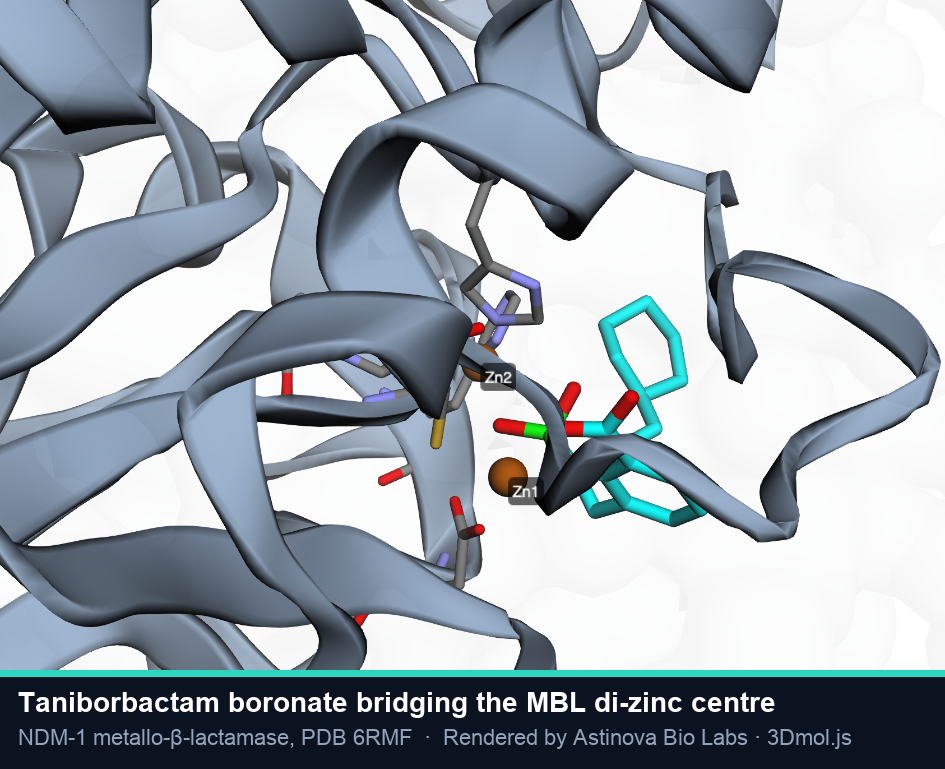
Two real co-crystal structures tell the whole mechanistic story.
On the serine side, avibactam’s sulfonamide-activated urea is attacked by the catalytic serine to form a stable, slowly-reversible carbamoyl-enzyme — the drug sits on Ser70, blocking turnover of the partner β-lactam.

On the metallo side, there is no serine to trap. A boronate must instead engage the di-zinc centre directly: taniborbactam’s boron adopts the tetrahedral, hydroxide-bound geometry that mimics the high-energy hydrolysis intermediate and bridges Zn1/Zn2 in NDM-1. This is exactly why boronates can span SBLs and MBLs — and why first-generation boronates remain structurally precarious.
The clinical milestone: Emblaveo (2025)
The paradigm proof is aztreonam–avibactam (Emblaveo) — not a single dual molecule but two agents co-formulated: avibactam neutralises the co-produced SBLs that would otherwise destroy aztreonam, while aztreonam itself slips past the MBLs. In vitro, the combination inhibited 99.6% of CRE isolates (including 100% of MBL-producers) across Europe, Asia-Pacific and Latin America. In 2025 the FDA approved Emblaveo with metronidazole for complicated intra-abdominal infections (cIAI) in adults with limited options — a bona fide triple regimen (anaerobic cover + SBL inhibition + MBL-stable β-lactam).
Why it matters
- Zero approved MBL inhibitors is the defining gap in Gram-negative therapy. Taniborbactam — once the great MBLI hope — was rejected by the FDA (2024) on PK/tissue-distribution grounds and has shown early resistance via single NDM/VIM substitutions. Enzymatic potency does not absolve a candidate of its physicochemical responsibilities.
- Triple combination therapy is deployable today from individually approved agents, buying time for dedicated MBLIs and dual inhibitors to mature. It is a bridge, not an endpoint.
- For the medicinal chemist, the take-home is scaffold-level: covering both SBLs and MBLs is a geometry and warhead problem (serine-acylating DBO vs. zinc-bridging boronate), compounded by the usual permeability/efflux/PK gauntlet in Gram-negatives.
Reference & image credit: Reddy, N.; Silva, J. R. A.; Arvidsson, P. I.; Kruger, H. G.; Govender, T.; Naicker, T. “Triple Combination Therapy: A Promising Path Forward against β-Lactamase-Mediated Resistance.” J. Med. Chem. 2026, 69, 23075–23091. DOI: 10.1021/acs.jmedchem.6c00399. Published open access under a CC-BY 4.0 license, © 2026 The Authors, published by the American Chemical Society. All structures, the concept/mechanism figure, and both binding-mode renders (avibactam–CTX-M-15, PDB 4HBU; taniborbactam–NDM-1, PDB 6RMF) were generated from scratch by Astinova Bio Labs (RDKit + 3Dmol.js) — no paper figures were reused.
Astinova Bio Labs designs and makes molecules like these — scaffold design, original scheme/structure drawing, and structure-based binding analysis. Talk to us about your target.