
Compiled: 2026-10-22 · Trigger event: FDA approval, 2026-09-25 Innovator: AbbVie Inc., 1 N. Waukegan Road, North Chicago, IL 60064 (Marketed by AbbVie Inc.; JUVMO is a trademark of Cerevel Therapeutics, LLC, an AbbVie company). Chain of origin: DISCOVERED AT PFIZER (Brodney, Davoren, Gray et al.; research code PF-06649751), out-licensed/contributed in 2018 to Cerevel Therapeutics (Bain Capital + Pfizer-backed neuroscience spin-out; code CVL-751) [VERIFY exact 2018 transaction terms], then acquired by AbbVie via the ~$8.7B Cerevel acquisition (announced 2023-12-06, completed 2024-08-01). Status: Approved NME
Mechanism: Tavapadon is an orally bioavailable, NON-CATECHOL, SELECTIVE PARTIAL AGONIST at the dopamine D1 and D5 (D1-like) receptor subtypes – the FDA label states simply ‘Tavapadon is a selective partial agonist at the dopamine D1 and D5 receptor subtypes (D1/D5)’ (PI 12.1), and it is formally classed as a non-ergot dopamine agonist. Reported affinity is Ki ~8.5 nM at human D1 (ChEMBL CHEMBL3697617, from the originator patent binding data; a second patent value of 21 nM corresponds to the companion (+)-atropisomer, Example 8), with partial intrinsic activity at D1 and D5 and no meaningful engagement of D2/D3 – the subtypes that drive the somnolence, impulse-control disorders and peripheral oedema that have progressively limited pramipexole, ropinirole and rotigotine. The therapeutic logic is two-sided: D1/D5 selectivity avoids the D2/D3 liability set, while PARTIAL rather than full agonism is intended to deliver sustained striatal D1 signalling without the receptor desensitisation, tachyphylaxis and hypotension that defeated earlier full catechol D1 agonists (ABT-431, dihydrexidine); the Pfizer non-catechol chemotype that produced tavapadon was characterised as recruiting beta-arrestin poorly and desensitising the receptor less than catechol agonists (Gray et al., Nat Commun 2018;9:674), although a later preprint reports measurable beta-arrestin recruitment by PF-06649751, so the degree of biased signalling should be treated as unsettled [VERIFY]. Clinically the mechanism reads through to the label: efficacy as monotherapy in early PD (MDS-UPDRS Part II) AND as a levodopa adjunct in motor fluctuations (ON time without troublesome dyskinesia), with impulse-control disorders at only 1-2% and dyskinesia at 0.6% in the monotherapy studies.
Synthesis Route of the Originator
The disclosed route is the one in the ORIGIN PATENT, US 10,093,655 B2 (Pfizer Inc.; Brodney, Davoren, Gray et al.; provisional 61/840,144 of 27-Jun-2013), where tavapadon is Example 7 and its mirror-image atropisomer is Example 8; the uracil-core steps are taken from Examples 1 and 2 of the same patent. No peer-reviewed process paper and no SI-level discovery-paper synthesis for tavapadon specifically was located; the Pfizer non-catechol D1 series was described pharmacologically in Gray et al., Nat Commun 2018;9:674, which does not supply the tavapadon endgame. Six operations, four of them bond-forming:
- Uracil construction – ethyl 2-cyanopropanoate + 1-methylurea, NaOMe/MeOH, reflux 18 h, then HCl to pH ~2 -> 6-amino-1,5-dimethylpyrimidine-2,4(1H,3H)-dione hydrochloride (C1), 80%. The 1-Me and 5-Me are installed from the start by the choice of urea and cyanoester.
- Sandmeyer bromination – NaNO2 (1.5 eq), CuBr2 (2 eq), MeCN/H2O 1:1, rt 66 h -> 6-bromo-1,5-dimethyluracil (C2), 75%. The pivotal hub.
- N3-Boc activation – Boc2O (1.2 eq), Et3N (1.2 eq), DMAP (0.1 eq), THF, 70 C 1 h then rt 18 h -> C22, 94%.
- Suzuki-Miyaura, biaryl bond formed RACEMICALLY – [4-(benzyloxy)-2-methylphenyl]boronic acid (1.5 eq), SPhos aminobiphenyl precatalyst (5 mol%), Cs2CO3 (3 eq), 2-MeTHF/H2O, 50 C, 66 h -> C23, 71%. This step creates the chiral axis; it is the step an atroposelective process would replace.
- Tandem Boc + benzyl removal – 30% HBr in AcOH, rt 18 h -> phenol C24, 89%.
- SNAr diaryl-ether formation – 2-chloro-3-(trifluoromethyl)pyridine (1.1 eq), Cs2CO3 (1.2 eq), DMF, 100 C, 18 h -> RACEMIC tavapadon (C25), 85%.
- Atropisomer resolution – preparative chiral chromatography on Phenomenex Lux Cellulose-2, heptane/ethanol gradient. The FIRST-eluting atropenantiomer, a tan solid of NEGATIVE (-) rotation, is Example 7 = tavapadon, 41% of the racemate (vs 42% for the (+)-Example 8). The PI names the drug substance as the (S)-atropisomer.
The economics of step 7 dominate: a 41% chromatographic resolution at the very end caps overall yield near 20% and discards an equal mass of fully elaborated (+)-isomer. Teva’s WO2023102087A1 claim to a 1:1 tavapadon/4-hydroxybenzoic-acid co-crystal is a strong hint that a crystallisation-based resolution is feasible. Also note that the public SMILES and InChIKey (AKQXQLUNFKDZBN-UHFFFAOYSA-N) encode NO axial stereochemistry, so the scheme below is drawn flat and the final step is a resolution whose drawn product is constitutionally identical to its substrate. All intermediate structures were RDKit-validated and cross-checked against the patent’s own LCMS data (C23 m/z 337.2 [(M-Boc)+H]+; C24 m/z 247.2 [M+H]+; C25 m/z 392.2 [M+H]+).
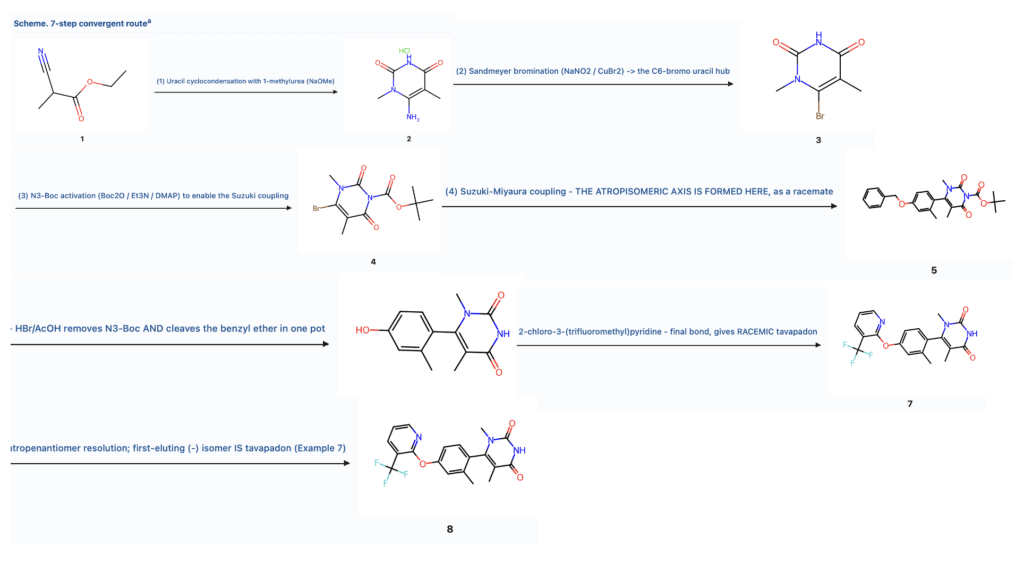
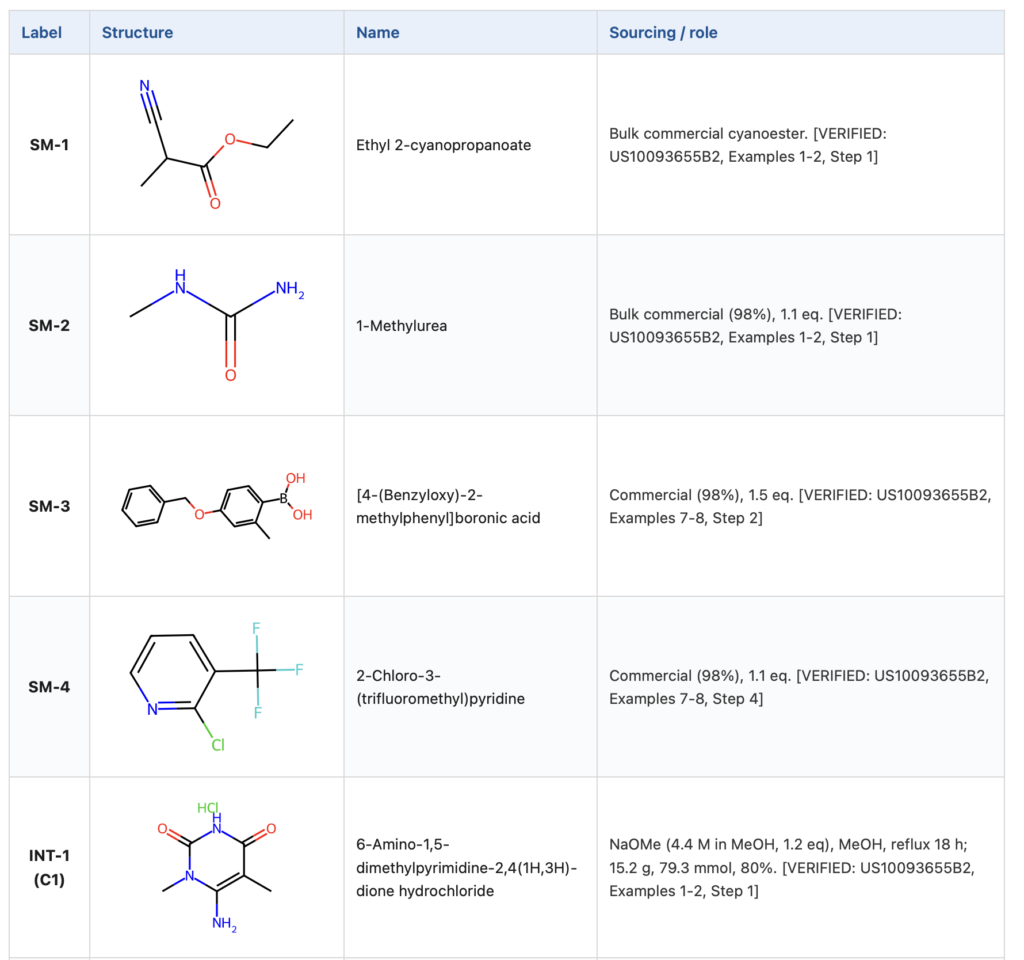
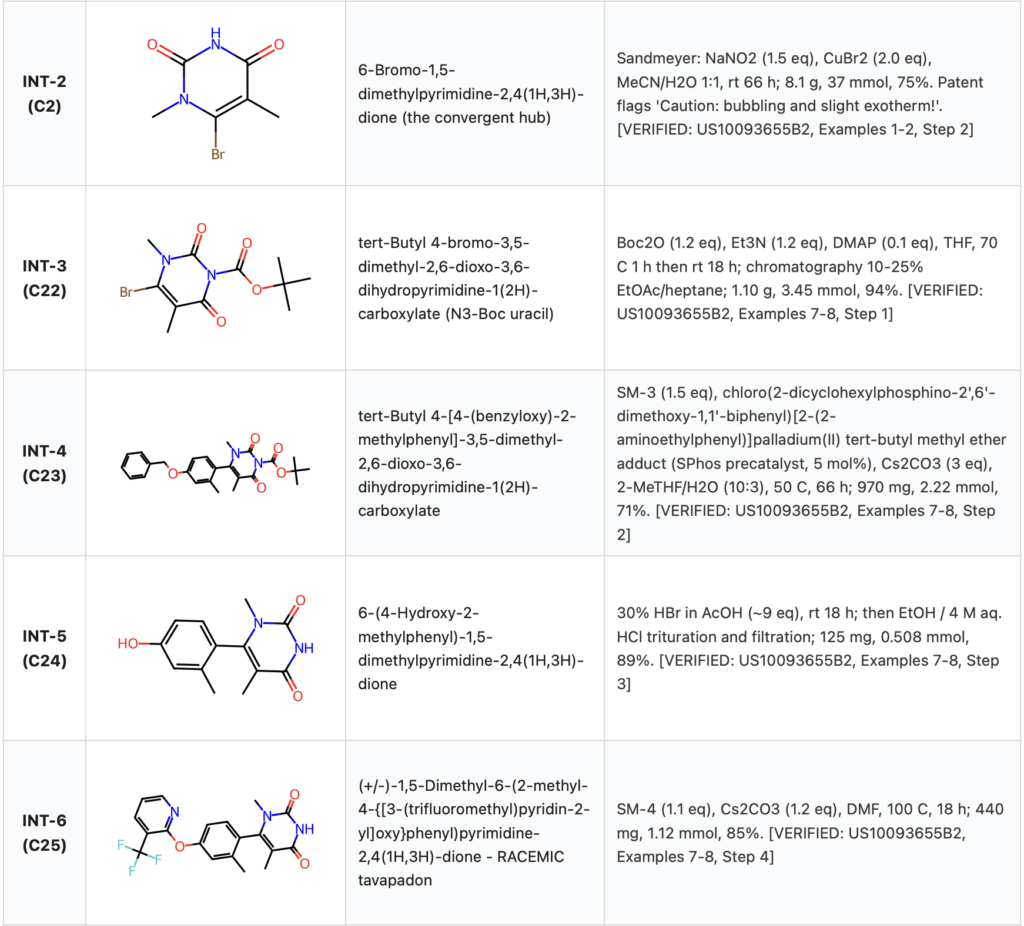
aReagents and conditions: (1) “A solution of sodium methoxide in methanol (4.4 M, 27 mL, 119 mmol) was added to a solution of ethyl 2-cyanopropanoate (95%, 13.2 mL, 99.6 mmol) and 1-methylurea (98%, 8.26 g, 109 mmol) in methanol (75 mL), and the reaction mixture was heated at reflux for 18 hours, then cooled to room temperature.” Solvent removed in vacuo, residue repeatedly evaporated with acetonitrile (3 x 50 mL), partitioned between acetonitrile (100 mL) and water (100 mL), then aqueous 6 M HCl added slowly to pH ~2 and stirred 1 h; precipitate filtered and washed with tert-butyl methyl ether. Yield 15.2 g, 79.3 mmol, 80%, white solid. LCMS m/z 156.1 [M+H]+. [VERIFIED: US10093655B2, Examples 1 and 2, Step 1]; (2) “A 1:1 mixture of acetonitrile and water (120 mL) was added to a mixture of C1 (9.50 g, 49.6 mmol), sodium nitrite (5.24 g, 76 mmol), and copper(II) bromide (22.4 g, 100 mmol) {Caution: bubbling and slight exotherm!}, and the reaction mixture was allowed to stir at room temperature for 66 hours.” Then aqueous 1 N H2SO4 (200 mL) and ethyl acetate (100 mL) added; precipitate filtered and washed with water and ethyl acetate (7.70 g); organic filtrate concentrated to give further solid washed with 1:1 EtOAc/heptane (0.4 g). Total yield 8.1 g, 37 mmol, 75%, light-yellow solid. GCMS m/z 218, 220 [M+]. [VERIFIED: US10093655B2, Examples 1 and 2, Step 2] — PROCESS NOTE: the patent’s own caution flag (gas evolution + exotherm from diazonium decomposition) makes this the principal scale-up hazard of the route; needs calorimetry, controlled dosing and copper removal to ICH Q3D limits.; (3) “Compound C2 (800 mg, 3.65 mmol), di-tert-butyl dicarbonate (99%, 966 mg, 4.38 mmol), triethylamine (0.62 mL, 4.4 mmol) and 4-(dimethylamino)pyridine (45 mg, 0.36 mmol) were combined in tetrahydrofuran (15 mL) and heated to 70 C for 1 hour, then allowed to stir at room temperature for 18 hours.” Concentrated in vacuo and purified by chromatography on silica gel (gradient 10% to 25% ethyl acetate in heptane). Yield 1.10 g, 3.45 mmol, 94%, white solid. 1H NMR (400 MHz, CDCl3) 3.64 (s, 3H), 2.12 (s, 3H), 1.61 (s, 9H). [VERIFIED: US10093655B2, Examples 7 and 8, Step 1] — STRATEGY NOTE: masking the acidic uracil N3-H is what turns an electron-poor, deactivated heteroaryl bromide into a competent Suzuki electrophile; the Boc is later removed in the SAME operation as the benzyl ether.; (4) “A mixture of C22 (1.00 g, 3.13 mmol), [4-(benzyloxy)-2-methylphenyl]boronic acid (98%, 1.16 g, 4.68 mmol), chloro(2-dicyclohexylphosphino-2′,6′-dimethoxy-1,1′-biphenyl)[2-(2-aminoethylphenyl)]palladium(II)-tert-butyl methyl ether adduct (S-Phos precatalyst) (119 mg, 0.156 mmol), and cesium carbonate (3.06 g, 9.39 mmol) in 2-methyltetrahydrofuran (10 mL) and water (3 mL) was heated at 50 C for 66 hours.” Diluted with water and ethyl acetate, filtered to remove solids, filtrate extracted several times with ethyl acetate, combined organics washed with saturated aqueous NaCl, dried over MgSO4, filtered, concentrated; solid suspended in 1:3 ethyl acetate/heptane, stirred and filtered. Yield 970 mg, 2.22 mmol, 71%, white solid. LCMS m/z 337.2 [(M-Boc)+H]+. [VERIFIED: US10093655B2, Examples 7 and 8, Step 2] — CRITICAL STEP: 66 h at only 50 C with 5 mol% of an SPhos aminobiphenyl precatalyst reflects how sluggish this doubly hindered coupling is (ortho-substituted boronic acid onto an alpha-carbonyl heteroaryl bromide). It is also the step that creates the chiral axis – RACEMICALLY. An atroposelective version of this coupling is the single most valuable unclaimed piece of process IP on this molecule.; (5) “Compound C23 (250 mg, 0.573 mmol) was mixed with a 30% solution of hydrogen bromide in acetic acid (1 mL, 5 mmol) and allowed to stir for 18 hours at room temperature.” Acetic acid removed under reduced pressure; residue dissolved in a minimal quantity of ethanol and diluted with 4 M aqueous hydrochloric acid to give a slightly cloudy mixture; evaporated to dryness, the solid suspended in 4 N aqueous HCl, stirred several minutes and filtered. Yield 125 mg, 0.508 mmol, 89%, yellow solid. LCMS m/z 247.2 [M+H]+. 1H NMR (400 MHz, DMSO-d6) 11.36 (br s, 1H), 9.71 (v br s, 1H), 6.99 (d, J=8.2 Hz, 1H), 6.76 (d, J=2.3 Hz, 1H), 6.72 (dd, J=8.1, 2.3 Hz, 1H), 2.82 (s, 3H), 2.03 (s, 3H), 1.44 (s, 3H). [VERIFIED: US10093655B2, Examples 7 and 8, Step 3] — PROCESS NOTE: two deprotections for the price of one operation is a genuine economy, but benzyl bromide is generated as a by-product and is a likely mutagenic impurity needing an ICH M7 control strategy; 30% HBr/AcOH also requires corrosion-resistant service.; (6) “2-Chloro-3-(trifluoromethyl)pyridine (98%, 269 mg, 1.45 mmol), C24 (325 mg, 1.32 mmol) and cesium carbonate (521 mg, 1.60 mmol) were combined in N,N-dimethylformamide (6 mL) and the resulting suspension was heated at 100 C for 18 hours.” Cooled to room temperature, diluted with aqueous 1 M hydrochloric acid and extracted several times with ethyl acetate; combined organics washed twice with water and once with saturated aqueous sodium chloride, dried over magnesium sulfate, filtered, concentrated in vacuo; the resulting solid suspended in 1:1 ethyl acetate/heptane, stirred several minutes and collected by filtration. Yield 440 mg, 1.12 mmol, 85%, white solid. LCMS m/z 392.2 [M+H]+. 1H NMR (400 MHz, CDCl3) 8.31-8.36 (m, 2H), 8.05 (br d, J=7.5 Hz, 1H), 7.13-7.22 (m, 4H), 3.06 (s, 3H), 2.21 (s, 3H), 1.69 (s, 3H). [VERIFIED: US10093655B2, Examples 7 and 8, Step 4] — STRATEGY NOTE: the 3-CF3 group activates pyridine C2 toward Cs2CO3-mediated SNAr and is simultaneously the D1/D5 potency-defining substituent; introducing the most expensive fragment last is deliberate. The product is Teva’s ‘Form R1’ racemate in WO2023102087A1.; (7) “Racemate C25 (1.30 g, 3.32 mmol) was separated into its atropenantiomers via chiral chromatography (Column: Phenomenex Lux Cellulose-2; Gradient: heptane/ethanol). The first-eluting atropenantiomer, obtained as a tan solid that exhibited a negative (-) rotation, was designated as Example 7. Yield: 536 mg, 1.37 mmol, 41%. The second-eluting atropenantiomer, also obtained as a tan solid but with a positive (+) rotation, was designated as Example 8. Yield: 553 mg, 1.41 mmol, 42%.” Example 7 (tavapadon): LCMS m/z 392.2 [M+H]+; 1H NMR (400 MHz, CDCl3) 8.34 (ddq, J=4.9, 1.9, 0.6 Hz, 1H), 8.30 (br s, 1H), 8.05 (ddq, J=7.6, 1.9, 0.7 Hz, 1H), 7.13-7.21 (m, 4H), 3.06 (s, 3H), 2.21 (br s, 3H), 1.69 (s, 3H). [VERIFIED: US10093655B2, Examples 7 and 8, Step 5; the patent’s General Experimental section states that ‘chiral separations were carried out to separate atropisomers (or atropenantiomers)’ and defines (-) as counter-clockwise rotation.] — DRAWING CAVEAT: product_smiles is deliberately IDENTICAL to the substrate SMILES because standard SMILES cannot express axial (atropisomeric) chirality; the real product is the single (-)/(S)-twisted atropenantiomer, named in FDA PI section 11 as ‘(S)-1,5-dimethyl-6-(2-methyl-4-{[3-(trifluoromethyl)pyridin-2-yl]oxy}phenyl)pyrimidine-2,4(1H,3H)-dione’. — PROCESS CAVEAT: this 41% chromatographic resolution in the FINAL step caps overall yield near 11-12% and discards an equal mass of fully elaborated (+)-atropisomer. Whether AbbVie’s commercial process still uses chromatography, or has moved to a crystallisation/co-crystal resolution (cf. Teva’s 1:1 tavapadon/4-hydroxybenzoic-acid Form H1, WO2023102087A1) or a thermal-racemisation recycle, is NOT public. [VERIFY].
Key intermediates
Crystal Forms, Salts, and Solid-State Profile
- API in approved drug product: Tavapadon FREE BASE (no salt), C19H16F3N3O3, MW 391.35 Da. PI 11: ‘a white to pale-yellow solid that is practically insoluble in water’. Computed properties: XLogP 3.3, TPSA 71.5 A^2, HBD 1, HBA 7, 3 rotatable bonds, 0 Lipinski violations, QED 0.74. CRITICAL SOLID-STATE/CMC FEATURE: the drug substance is a single ATROPISOMER – ‘(S)-1,5-dimethyl-6-(2-methyl-4-{[3-(trifluoromethyl)pyridin-2-yl]oxy}phenyl)pyrimidine-2,4(1H,3H)-dione’ per PI 11 – with NO sp3 stereocentre. Axial (atropisomeric) purity is therefore a drug-substance critical quality attribute requiring chiral HPLC release testing and a configurational-stability/racemisation study across the 36-month shelf life and at the tableting/film-coating temperatures. The marketed polymorph is not disclosed in the label. [VERIFY originator form designation and racemisation-barrier data.]
- Strengths approved: Film-coated tablets 0.25 mg, 1 mg (titration pack only), 5 mg, 10 mg, 15 mg. Store 20-25 C, excursions 15-30 C; 36-month expiry dating period per the approval letter. Very low drug load (0.25-15 mg) in a lactose/MCC immediate-release tablet, i.e. a conventional low-dose direct-compression or dry-granulation platform rather than any enabling formulation – consistent with ‘practically insoluble in water’ being manageable at these doses.
- Third-party polymorph activity: ACTIVE and early. Teva (Teva Czech Industries / Teva Pharmaceutical Industries / Teva Pharmaceuticals USA) filed WO2023102087A1 with 2021-12-03 priority – during Phase 3, roughly five years before approval – claiming crystalline anhydrous (-)-tavapadon Form 1, anisole solvate Form 3, toluene solvate Form 5, a ~1:1 tavapadon : 4-hydroxybenzoic acid co-crystal/salt Form H1, and anhydrous RACEMATE Form R1, with amorphous-content limits. US national phase published as US20250034113A1 (18/714,646); EP4441039A1, CA3239783A1, AU2022402852A1, IL313212A also pending. Interpretation: Teva has been positioning for tavapadon LOE since Phase 3; Form H1 in particular is the kind of co-crystal one builds to do a CRYSTALLISATION-based resolution of the atropisomers instead of preparative chiral chromatography. Monitor SureChEMBL (https://www.surechembl.org/search/?q=AKQXQLUNFKDZBN-UHFFFAOYSA-N) and Espacenet for further filings by Teva, Zydus, MSN, Hetero and Aurobindo.
- Originator polymorph filing: Not disclosed. The PI gives only the physical description (‘white to pale-yellow solid, practically insoluble in water’); no Pfizer/Cerevel/AbbVie solid-form publication was identified in the search performed. Given Teva’s 2021 filing, the originator almost certainly holds its own form/process position – expect it to surface in the Orange Book patent listing due within 30 days of the 2026-09-25 approval. [VERIFY]
Key peer-reviewed literature
- Campos TS et al., Parkinsonism & related disorders 2026 — Short-term efficacy and safety of tavapadon for Parkinson’s disease: An exploratory… (PMID 42822261)
- Rashid AA et al., Neurological sciences : official journal of the Italian Neurological Society and of the Italian Society of Clinical Neurophysiology 2026 — “Efficacy, safety and certainty of evidence for selective D1/D5 dopamine receptor… (PMID 42601529)
- Fernandez HH et al., The Lancet. Neurology 2026 — Safety, tolerability, and efficacy of flexible-dose tavapadon for Parkinson’s disease… (PMID 42456682)
- Rascol O et al., The Lancet. Neurology 2026 — Tavapadon for the treatment of Parkinson’s disease (PMID 42456666)
- Palma JA et al., Clinical autonomic research : official journal of the Clinical Autonomic Research Society 2026 — Cardiovascular pharmacology of dopaminergic agents in humans: a review (PMID 42393412)
- Du G et al., bioRxiv : the preprint server for biology 2026 — Levodopa increases substantia nigra iron: implications for Parkinson’s disease (PMID 42282569)
- Leiter S et al., Drugs 2026 — Recent Developments in the Drug Treatment of Parkinson’s Disease (PMID 42162439)
- Łobińska IA et al., Neurologia i neurochirurgia polska 2026 — Dopamine agonist withdrawal syndrome – what do we really know? (PMID 41870480)
- Fernandez HH et al., JAMA neurology 2026 — Tavapadon as Adjunctive Treatment for Parkinson Disease: The TEMPO-3 Randomized Clinical Trial (PMID 41860544)
- Pahwa R et al., JAMA neurology 2026 — Fixed-Dose Tavapadon for Early Parkinson Disease: A Randomized Clinical Trial(PMID 41860533)