The problem: catalytic IDO1 inhibition was the wrong — or at least an incomplete — hypothesis
The IDO1 field has a credibility problem. The selective holo-IDO1 inhibitor epacadostat failed to improve outcomes with pembrolizumab in the Phase III ECHO-301 melanoma trial, and most catalytic inhibitors have followed suit. Two mechanistic blind spots explain much of this: (i) tryptophan catabolism can be bypassed by TDO, so blocking IDO1 alone leaves the kynurenine pathway running; and (ii) IDO1 is not just an enzyme — the heme-free apo form is a signaling protein that recruits SHP-2 through phosphorylated ITIM motifs, driving a tolerogenic, pro-tumor program that a purely catalytic inhibitor never touches.

The strategy: keep the multimodal pharmacology, fix the metabolism
This Novara team (Rezzi, Butticè, Di Martino, Pirali and co-workers, J. Med. Chem. 2026) started from VS-15 — a bis-tryptamine hit (A375 IC50 ≈ 480 nM) with an unusual profile: it engages apo-IDO1 in pockets A and D and shows balanced IDO1/TDO activity. The liability was pharmacokinetic: VS-15 is metabolically fragile (~5% residual substrate in mouse liver microsomes). The campaign was therefore a metabolic-stability rescue that had to preserve a multimodal mechanism — not the usual potency chase.
The chemistry: a convergent, unsymmetrical urea
The key SAR move was replacing a metabolically soft amide/alkyl tether with a urea in the side chain. The route is cleanly convergent: an anthranilamide fragment (2-aminobenzoic acid coupled to tryptamine, EDCI/HOBt) is joined to a second tryptamine through an unsymmetrical urea via an activated carbamate. The two indole arms occupy pockets A and D; the central benzene and urea set the geometry.

The binding rationale: targeting the apo (heme-free) pocket
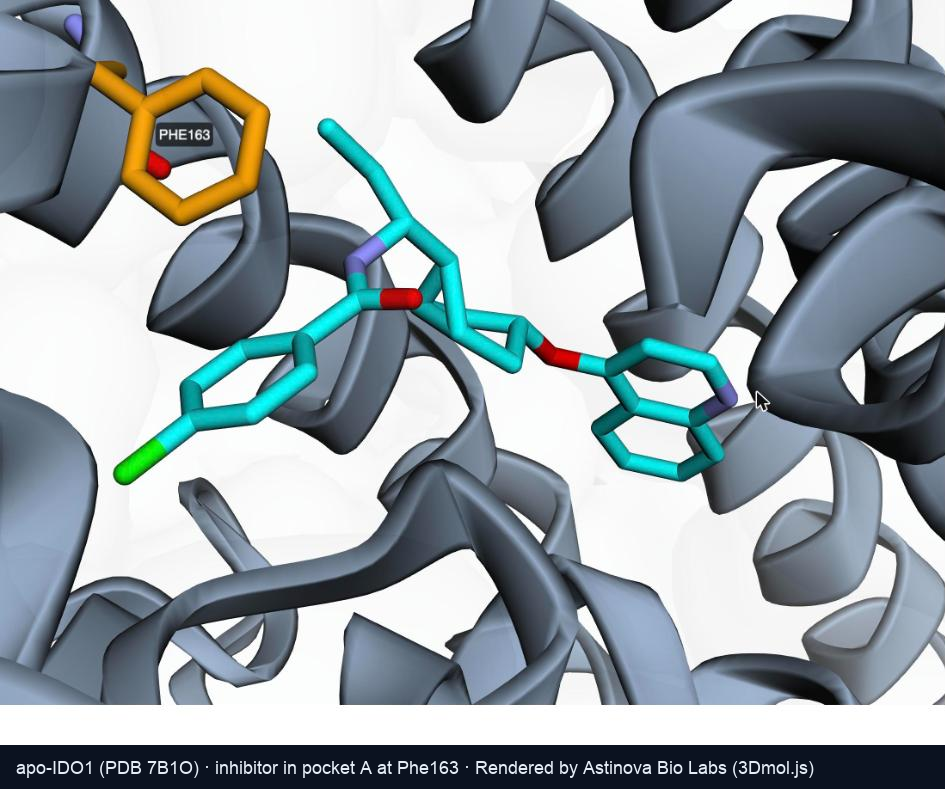
Unlike epacadostat-class agents that coordinate the heme iron, compound 66’s spectroscopic behavior is consistent with engaging the heme-free apoenzyme. Rendering the IDO1 pocket (apo form, PDB 7B1O) shows the aromatic pocket-A residue Phe163 framing the indole arm — the kind of hydrophobic anchor the bis-indole scaffold is built to exploit, with no dependence on heme coordination.
The lead: compound 66
- Balanced dual inhibition of IDO1 and TDO (enzymatic IC50 values in the low-µM range across the series)
- Cellular IDO1 (IFNγ-induced) IC50 = 1.10 µM with markedly improved microsomal stability over VS-15
- Attenuates the apo-IDO1/SHP-2 interaction in SKOV-3 cells — it suppresses the non-catalytic signaling arm, not just kynurenine output
- Reduces cancer-cell proliferation and migration (SKOV-3)
Why it matters
- Multimodal by design: a chemical probe that dissects catalytic vs. signaling IDO1 biology with one molecule — a cleaner alternative to either a pure catalytic inhibitor or full IDO1 degradation.
- Dual IDO1/TDO coverage pre-empts the TDO bypass that likely blunted first-generation agents.
- For targets with dual enzymatic/scaffolding roles, the scaffold — not just the active-site warhead — is the design problem.
Reference & image credit: Rezzi, S. J.; Butticè, A. et al. “Discovery of a Dual IDO1/TDO Inhibitor That Modulates Enzymatic Activity and IDO1/SHP-2 Signaling.” J. Med. Chem. 2026, 69, 18336–18363. DOI: 10.1021/acs.jmedchem.6c00759. Graphical abstract reproduced under a CC-BY 4.0 license © 2026 The Authors, published by the American Chemical Society. Synthesis scheme redrawn and binding-site figure (apo-IDO1, PDB 7B1O) rendered by Astinova Bio Labs.
Astinova Bio Labs designs and makes molecules like this — route design, original scheme redrawing, and structure-based binding analysis. Talk to us about your target.